
5.3 Sample Collection and Analysis
Like all dissolved gas tracers, samples for [latex]{SF}_{6}[/latex] must be collected such that gas exchange with the atmosphere does not occur and bubbles are not trapped within the sample container. Numerous sample containers have been used including custom‑made metal cylinders with valves on each end (Figure 22). A simple and effective sampling method uses a one‑liter glass bottle with a narrow mouth as shown in Figure 22. The bottles are filled using a submersible pump with the discharge tube extending to near the bottom of the bottle. The bottle is purged with 3 to 4 L of water before slowly removing the discharge tube such that the bottle is totally filled—no headspace is left. A polyethylene cone-shaped liner inside a cap (i.e., a polyseal cap), is then installed onto the bottle. The cone‑shaped liner displaces a small amount of water that was at the water–atmosphere interface upon installation, resulting in minimal contamination of the remaining water by the modern atmosphere.
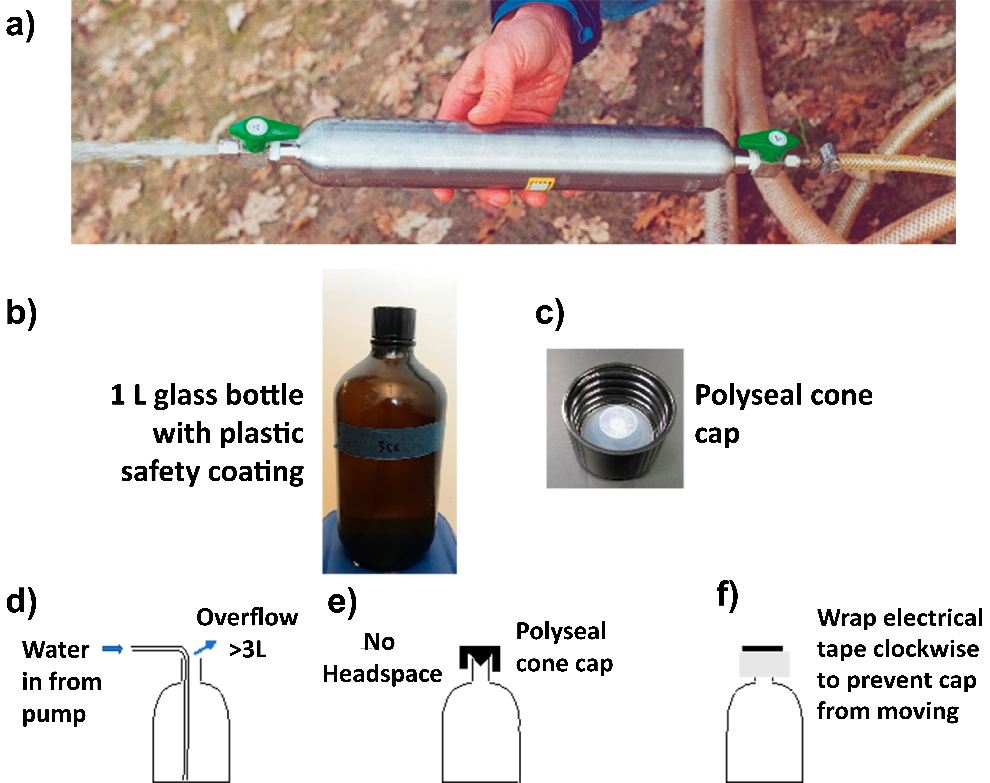
Figure 22 ‑ Sampling SF6 a) stainless steel cylinder for SF6 samples and b) glass narrow‑mouth bottle with c) polyseal cone‑shaped cap. Samples for the bottles should be filled by d) inserting a tube to the bottom and flushing more than 3L, then e) installing the cap with no headspace and f) wrapping electrical tape counterclockwise around the cap to prevent it from moving,
Headspace and purge‑and‑trap are the two primary analytical methods used for [latex]{SF}_{6}[/latex] age dating. The headspace technique introduces a known amount of [latex]{SF}_{6}[/latex] free gas into a sample container of known volume. The container is shaken resulting in a partitioning of [latex]{SF}_{6}[/latex] between the water and gas headspace. Because of its low solubility, there is a strong preference for [latex]{SF}_{6}[/latex] to reside in the gas phase. After equilibration, the headspace gas is subsampled with a syringe or gas sampling valve and then quantified with a gas chromatograph (GC) using an electron capture detector.
With the purge‑and‑trap technique, a known amount of water is introduced into a sparging chamber. [latex]{SF}_{6}[/latex]free carrier gas—typically [latex]N_{2}[/latex] or [latex]He[/latex]—is bubbled through the water inside the sparging chamber and then through a trap that retains [latex]{SF}_{6}[/latex] but not the carrier gas or oxygen. Traps are typically filled with a porous polymer (e.g., Porapak™ Q) and are held at −70 to −80 °C. After sufficient stripping, the trap is warmed to release [latex]{SF}_{6}[/latex], which is then routed into a GC for analysis.
Both the headspace and purge‑and‑trap methods have been used for low‑level [latex]{SF}_{6}[/latex] analyses (Bullister & Wisegarver, 2008; Busenberg & Plummer, 2000; Busenberg & Plummer, 2010; Wanninkhof et al., 1987; Wanninkhof et al., 1991). The headspace method is particularly useful for higher concentrations that exist in injected tracer studies (Clark et al., 1994; Cook, Lamontagne, et al., 2006; Wanninkhof et al., 1990).