
4.5 Sensitivity of Age to Input Parameters
Based on low solubility and sensitivity to excess air, the behavior of [latex]He[/latex] is like [latex]Ne[/latex] as shown in Figure 5. Early [latex]_{}^{3}H[/latex]/[latex]_{}^{3}{He}[/latex] age‑dating studies relied solely on [latex]Ne[/latex] and [latex]He[/latex] measurements, and some noble gas labs continue to use this approach. Step 2a in Figure 15 refers to the [latex]Ne[/latex]‑only model. It is instructive to carefully review the [latex]Ne[/latex]‑only model formulation shown in Equation (21) because
- [latex]_{\ }^{3}{He}_{trit}[/latex] can be determined manually using just two gas concentrations with simplifying assumptions,
- therefore, the equation can be used to develop an intuition about the sensitivity of [latex]_{}^{3}H[/latex]/[latex]_{}^{3}{He}[/latex] ages of different variables required for calculation of [latex]_{\ }^{3}{He}_{trit}[/latex].
| [latex]_{\ }^{3}{He}_{trit} =_{\ }^{4}{He}_{m}\left( R_{m} - R_{terr} \right) -_{\ }^{4}{He}_{sol}\left( R_{sol} - R_{terr} \right) - \left( \frac{_{\ }^{4}{He}}{Ne} \right)_{EA}\left( {Ne}_{m} - {Ne}_{sol} \right)\left( R_{a} - R_{terr} \right)[/latex] | (21) |
|---|
where:
| [latex]_{\ }^{4}{He}_{m}[/latex] | = | measured concentration of [latex]_{}^{4}{He}[/latex] |
|---|---|---|
| [latex]R_{m}[/latex] | = | measured [latex]_{}^{3}{He}[/latex]/[latex]_{}^{4}{He}[/latex] ratio; commonly referred to simply as [latex]R[/latex] as in the notation [latex]\frac{R}{R_{a}}[/latex] |
| [latex]R_{terr}[/latex] | = | [latex]_{}^{3}{He}[/latex]/[latex]_{}^{4}{He}[/latex] ratio for terrigenic [latex]He[/latex] (Table 4) |
| [latex]R_{sol}[/latex] | = | [latex]_{}^{3}{He}[/latex]/[latex]_{}^{4}{He}[/latex] ratio for water in solubility equilibrium with air at assumed recharge temperature and elevation; [latex]R_{sol}[/latex] is equal to [latex]{\alpha R}_{a}[/latex], where [latex]\alpha[/latex] is the air‑water fractionation factor (0.98) |
| [latex]\left( \frac{_{\ }^{4}{He}}{\ \ Ne} \right)_{EA}[/latex] | = | [latex]\frac{_{}^{4}{He}}{Ne}[/latex] ratio of excess air dissolved in the sample; 0.288 for complete dissolution (unfractionated excess air) |
| [latex]{Ne}_{m}[/latex] | = | measured [latex]Ne[/latex] concentration in water |
| [latex]{Ne}_{sol}[/latex] | = | [latex]Ne[/latex] concentration for water in solubility equilibrium with air at assumed recharge temperature and elevation |
| [latex]R_{a}[/latex] | = | [latex]_{}^{3}{He}[/latex]/[latex]_{}^{4}{He}[/latex] ratio of atmospheric air |
Exercise 6⮧ provides an opportunity to practice calculating estimated groundwater age including the additional calculations needed to determine tritium-helium age such as the [latex]Ne[/latex]‑only formulation.
Only [latex]_{}^{4}{He}[/latex] and [latex]Ne[/latex] concentrations explicitly appear on the right‑hand side of Equation (18), so it is worth noting that [latex]_{}^{4}{He}\ R_{x} =_{}^{4}{He}\ (\frac{_{}^{3}{He}}{_{}^{4}{He)}}_{x}[/latex] where [latex]x[/latex] is, for example, a subscript as shown in Equation (21). This simplifies to a [latex]_{}^{3}{He}[/latex] concentration.
The first term in Equation (21), i.e. the [latex]_{\ }^{4}{{He}_{m}\left( R_{m} - R_{terr} \right)}[/latex], is equivalent to the first term in Equation (18), i.e. the [latex]_{\ }^{3}{He}_{m}[/latex] minus a [latex]_{\ }^{3}{He}_{terr}[/latex] component. The second and third terms in Equation (21)—which represent solubility equilibrium and excess air components at an assumed recharge temperature—are equivalent to the second term in Equation (18), i.e. [latex]_{\ }^{3}{He}_{atm}[/latex] minus a [latex]_{\ }^{3}{He}_{terr}[/latex] component.
Relative to other noble gases, [latex]He[/latex] is least sensitive to recharge temperature (as shown in Figure 3 of Section 2) and salinity (as shown in Figure 4 of Section 2). Similarly, [latex]_{}^{3}H[/latex]/[latex]_{}^{3}{He}[/latex] age is mildly sensitive to recharge temperature and elevation, as shown in Figure 17a and Figure 17b, respectively.
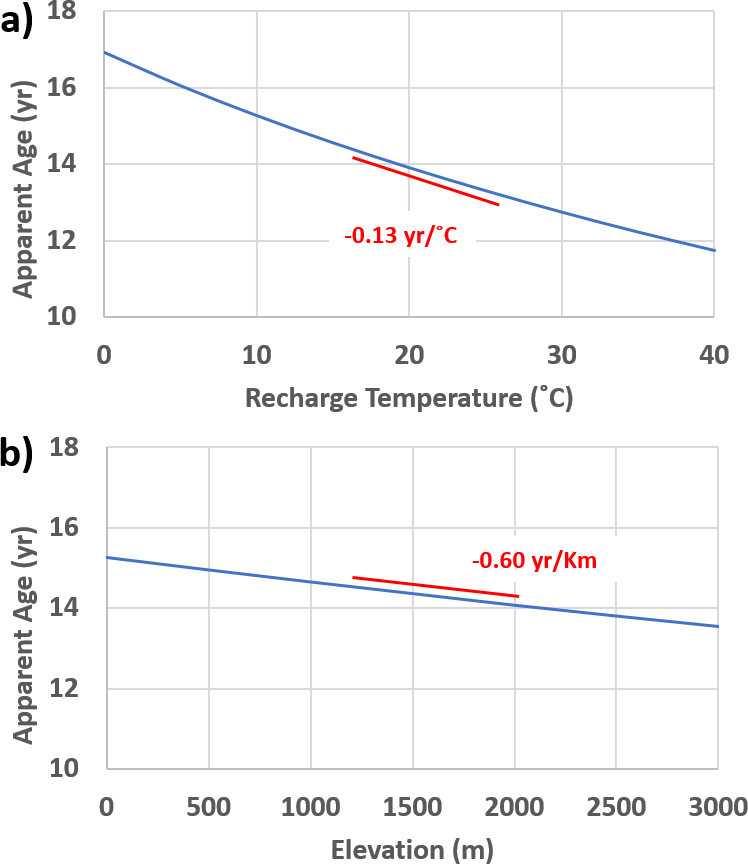
Figure 17 ‑ Sensitivity of 3H/3He tracer age for a) recharge temperature and b) elevation. The recharge temperature and elevation sensitivity examples were calculated from a hypothetical base case with 3H = 10 TU, R/Ra = 1.5, recharge temperature of 10 °C, and recharge elevation of 0 m. Recharge temperature or elevation were then varied over the range shown in the respective plots. While curves shown are non‑linear, approximate slopes (red lines) for portions of the curves are annotated for illustration of relative sensitivity.
In contrast to recharge temperature, recharge elevation, and salinity, [latex]_{}^{3}H[/latex]/[latex]_{}^{3}{He}[/latex] age is sensitive to excess air. The sensitivity to excess air is twofold, based on the total amount of excess air (Figure 18a) and the extent of dissolution of air bubbles during the formation of excess air measured in the groundwater sample (Figure 18b). In the context of Equation (21), this sensitivity is based on the [latex]\left( {Ne}_{m} - {Ne}_{sol} \right)[/latex] term (where excess [latex]Ne[/latex] indicates excess air) and the value of the [latex]_{}^{4}{He}[/latex]/ [latex]Ne[/latex] term.
In the case where [latex]R/R_{a}[/latex] is small—suggesting relatively little [latex]_{\ }^{3}{He}_{trit}[/latex] in the sample—a very modest overestimation of excess air (> 0.6 ccSTP/kg) can yield a negative tracer age. The [latex]_{}^{4}{He}[/latex]/[latex]Ne[/latex] term can range from the value for atmospheric air (0.288; using this value assumes complete dissolution of air at the time excess air is formed, i.e., UA) to 0.8 for partial dissolution.
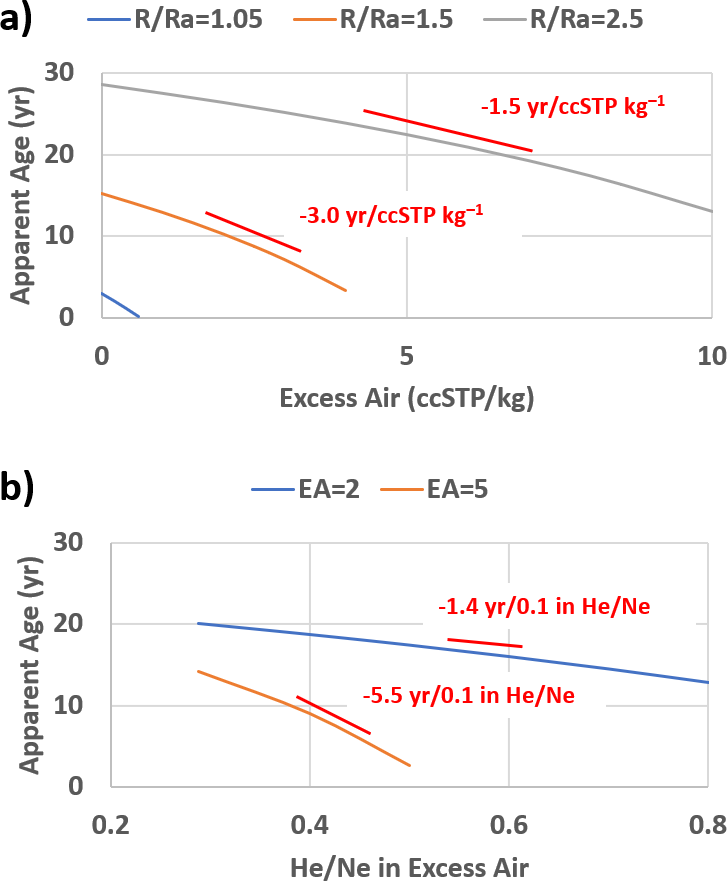
Figure 18 ‑ Sensitivity of 3H/3He tracer age to excess air. Graph a) is based on a hypothetical sample with 3H = 10 TU, recharge temperature of 10 °C, and recharge elevation of 0 m. For a sample with “true” excess air = 0 ccSTPkg-1, adding 4 ccSTPkg‑1 excess air reduces the tracer age from 12.9 years to 3.3 years when R/Ra = 1.5. In graph b), tracer age was calculated for two samples with moderate excess air (2 or 5 ccSTP/kg), but with different 4He/Ne ratios as shown in Equation (21) ranging from 0.288 (atmospheric air) to 0.8 (the ratio of air that is fractionated by the ratio of Ne to He solubilities). While curves shown are non‑linear, approximate slopes (short red lines) for portions of the curves are annotated to illustrate relative sensitivity.
Inspection of the [latex]Ne[/latex]‑only formulation in Equation (21) shows how the [latex]_{}^{4}{He}[/latex]/[latex]Ne[/latex] ratio could impact the determination of [latex]_{\ }^{3}{He}_{trit}[/latex] and therefore tracer age. More complex model formulations such as the closed‑system equilibration (CE) model and the partial re‑equilibration (PR) model (Stute et al., 1995), are also based on different assumptions about fractionation of gases, particularly for excess air. The CE model in its simplest form is equivalent to the UA model, while the PR model yields very different estimates of [latex]He[/latex] content when compared with other noble gases. While it is advisable to seek the simplest model(s) that reasonably fit the noble gas data (i.e., start first with [latex]Ne[/latex]-only and/or UA model as shown in Figure 15, Step 2a), it is also important to consider other noble gas models as warranted by the data and/or conceptual models of the sampled system. Comprehensive discussion of excess air models can be found in Aeschbach‑Hertig & Solomon (2013).
The prevalence of the [latex]R_{terr}[/latex] variable in Equation (21) illustrates how [latex]_{}^{3}H[/latex]/[latex]_{}^{3}{He}[/latex] ages may be sensitive to assumptions about terrigenic [latex]He[/latex]. Similarly, other methods for determination of [latex]_{}^{4}{He}_{terr}[/latex] (Figure 15, Step 3) can be used to evaluate the magnitude of [latex]_{}^{4}{He}_{terr}[/latex]. If [latex]_{}^{4}{He}_{terr\ }[/latex]is < 109 ccSTP/g, then [latex]_{}^{3}{He}_{trit}[/latex] is not sensitive to the selection of [latex]R_{terr}[/latex] (Figure 19). [latex]_{}^{3}{He}_{terr}[/latex] may be present due to production of helium in the Earth’s crust and/or derived from the Earth’s mantle (Table 4). However, mantle sources are negligible (< 0.2 TU) in many cases and typically not considered (Schlosser et al., 1989). However, if present, mantle [latex]He[/latex] may preclude calculation of groundwater age due to the magnitude of [latex]R_{man}[/latex].
Last, the [latex]_{}^{4}{He}_{m}[/latex] variable in Equation (21) is key to calculating [latex]_{}^{3}{He}_{trit}[/latex]. Figure 19b shows how the tracer age is sensitive to the measurement accuracy for [latex]_{}^{4}{He}[/latex]. For the illustrative example, we observe that the tracer age would be negative if [latex]_{}^{4}{He}[/latex] were severely underestimated (< 65 percent of solubility at the assumed recharge temperature and elevation).
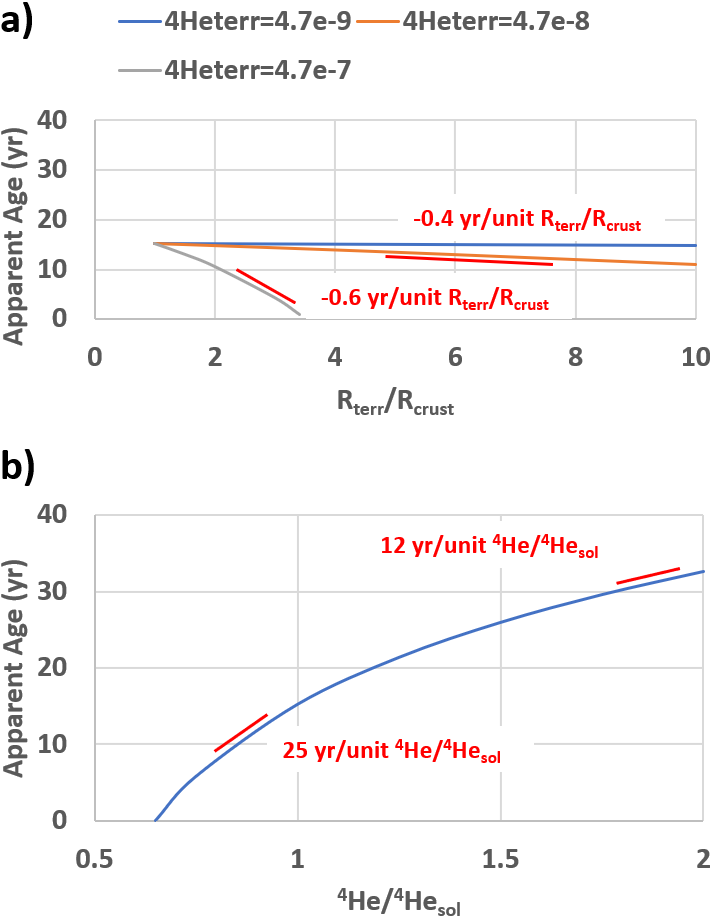
Figure 19 ‑ Sensitivity of 3H/3He tracer (apparent) age to variation in a) Rterr and b) 4He. Simulations were based on a hypothetical sample with 3H = 10 TU, recharge temperature of 10 °C, and recharge elevation of 0 m. An R/Ra of 1.5 was assumed for the Rterr illustration. While curves shown are non‑linear, approximate slopes (short red lines) for portions of the curves are annotated to illustrate relative sensitivity.