
1. Introduction
Groundwater age refers to the elapsed time taken for a parcel of water to move along a groundwater flow path from where it enters as recharge to the point of sample collection. It is often said that groundwater moves slowly so its age may seem irrelevant to our daily lives, but knowing the age of groundwater can help estimate:
- groundwater recharge rates which drive groundwater systems and are useful to municipalities for long-term water resource planning and to know whether they are using more water than is replenished by rain and snow;
- how long it takes for groundwater recharge to reach gaining streams;
- recharge year for groundwater samples which is useful for
- investigating historical input of contaminants to aquifers, including non‑point sources to determine what type and magnitude of contaminants the groundwater might contain based on land use practices at the time, and
- predicting future discharge of contaminants from aquifers to wells, springs, and streams; and
- calibration constraints to develop more reliable groundwater models of the area.
Because age represents an integration of upstream groundwater velocities, the age at a point in an aquifer potentially contains more information than a point sample taken for a physical property such as porosity or permeability. In this book, we review the basic concepts and systematics of dating methods applicable to groundwater ages younger than about 60 years. The historical development, basic concepts, sample collection and analysis, age calculations, and tracer-specific issues are discussed. The application of age-dating tracers for studying groundwater flow systems—including old water—is the topic of the Groundwater Project book Introduction to Isotopes and Environmental Tracers as Indicators of Groundwater Flow (Cook, 2020), which we encourage readers to review.
The focus of this book is on interpreting tracer concentrations from a single discrete sample of groundwater to estimate the tracer age of the sample. When a time series of samples and/or a collection of samples that can be interpreted to give a flow‑weighted average of the aquifer’s water are available, powerful tools such as lumped parameter models (LPM) are available for estimating the mean residence time (Jurgens et al., 2012; Maloszewski & Zuber, 1982). The use of LPMs is beyond the scope of this book; however, understanding the age‑dating concepts discussed in this book will help readers implement these models.
The information in this book has been distilled from original research papers—that are cited herein—and is intended to serve as an overview for readers who want to become familiar with dating methods. In this book, we:
- describe the basic analytical methods used for age‑dating tracers,
- list and explain the assumptions and specific information needed to convert tracer concentrations to ages,
- provide readers with the ability to compute apparent groundwater age given measured tracer concentration, and
- describe the uncertainty associated with calculated apparent groundwater ages.
Readers who intend to use tracer data in a study are encouraged to consult the original papers for details and additional explanation.
Use of the age-dating tracers described in this book require specialized analytical equipment and laboratories with this equipment are limited. For example, more than 50 laboratories participated in a recent (2022) proficiency evaluation of [latex]_{}^{3}H[/latex] conducted by the International Atomic Energy Agency (IAEA). While, only ten laboratories participated in a noble gas intercomparison conducted in 2012 (Visser et al., 2014). Readers seeking contact information for laboratories that offer these specialized analyses are welcome to contact the authors.
The concept of groundwater dating differs from dating as used in geologic studies where age typically refers to the elapsed time since mineral formation. Water molecules continuously associate and dissociate with a hydrogen bond lifetime on the order of one picosecond (Keutsch & Saykally, 2001), so the elapsed time since formation is not meaningful in a hydrologic context. However, the time required for a tracer to move from the recharge location to a collection point can be highly relevant for understanding groundwater flow.
Groundwater tracers can be categorized according to how they function (i.e., how they provide information related to time).
- Decaying tracers use a known rate of radioactive decay along with a known input concentration.
- Transient tracers use a non‑constant and known input concentration.
- Accumulating tracers use a known initial concentration and a known rate of production in the subsurface.
Most of the young groundwater tracers discussed in this book are transient tracers, but some make use of radioactive decay and accumulation.
Figure 1 shows groundwater dating methods as a function of the practical time scale over which the tracers are useful. Included in Figure 1 are numerous age‑dating tracer methods for evaluating travel times on the order of days to about 60 years. This time scale is relevant to many shallow aquifers that are susceptible to contamination and are often used for residential water supply and irrigation. The methods included in this book are tritium ([latex]_{}^{3}H[/latex]), tritium/helium-3 ([latex]_{}^{3}H[/latex]/[latex]_{}^{3}{He}[/latex]), sulfur hexafluoride [latex]{(SF}_{6}),[/latex]and chlorofluoro-carbons (CFCs). Other tracers can be used to qualitatively demonstrate that groundwater is young such as the occurrence of artificial sweeteners and/or pharmaceuticals, elevated nitrate and chloride, and a time series of stable isotopes. However, the focus of this book is on quantitative age-dating tracers.
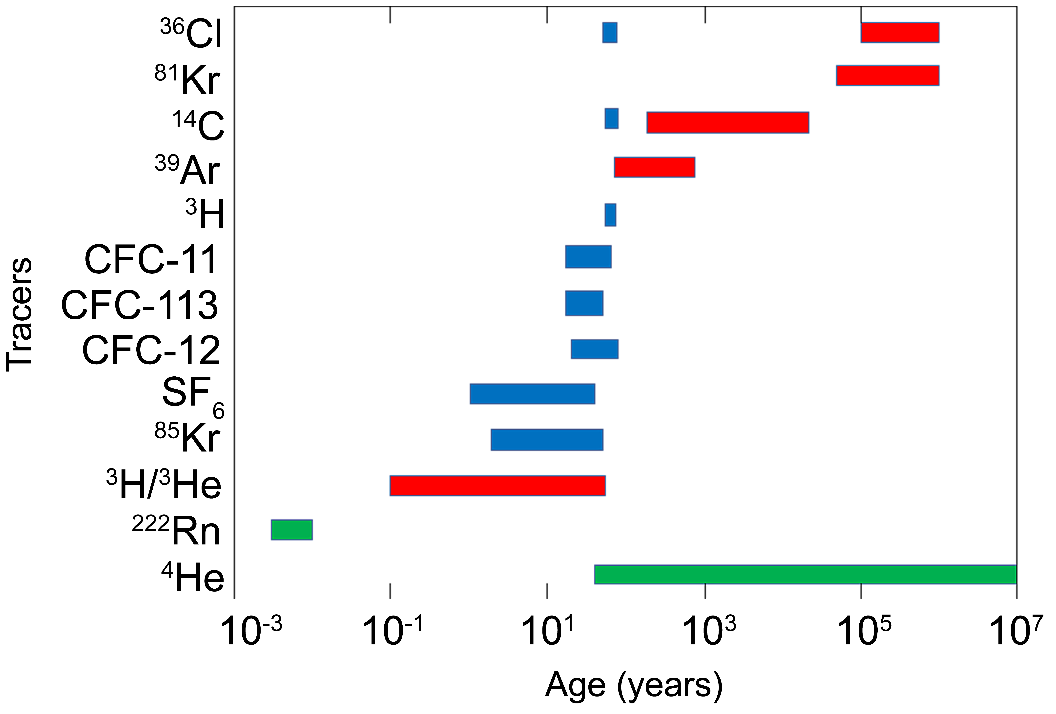
Figure 1 ‑ Approximate age ranges over which different environmental tracers can provide information on groundwater age. Radioactive tracers are indicated in red, transient tracers in blue, and accumulating tracers in green (Cook, 2020).
Except [latex]_{}^{3}H[/latex], the young groundwater dating methods discussed in this book utilize dissolved gases and require specialized sample collection techniques to prevent contact between the sample and the atmosphere. Due to laboratory requirements, sample collection methods differ for each of the tracers. While a discussion of the general concepts of sample collection is included in this book, readers are strongly encouraged to contact their specific analytical laboratory for sample collection information and/or to request specialized equipment and sample containers.
The occurrence and solubility of dissolved gases in groundwater is discussed in Section 2 as these concepts are important for most of the young groundwater dating methods. The extent to which a tracer contained within groundwater is transported at the same rate as bulk groundwater largely determines the usefulness of a particular age-dating tracer. Age calculations involve tracer concentrations, and the term tracer age or apparent age is used throughout this book to emphasize that differences may exist between the movement of a tracer and the bulk movement of groundwater.
Apparent ages are often highly stratified in aquifers; long and even moderate length well screens can result in samples containing mixtures of water that moved along very different flow paths. Figure 2 illustrates (1) how different well depths and screen lengths intercept different flow paths and groundwater age ranges, and (2) how lower recharge rates increase groundwater age gradients; that is, groundwater age increases more rapidly with depth. Also, when wells are aggressively pumped mixing of water from different depths with different ages can occur.
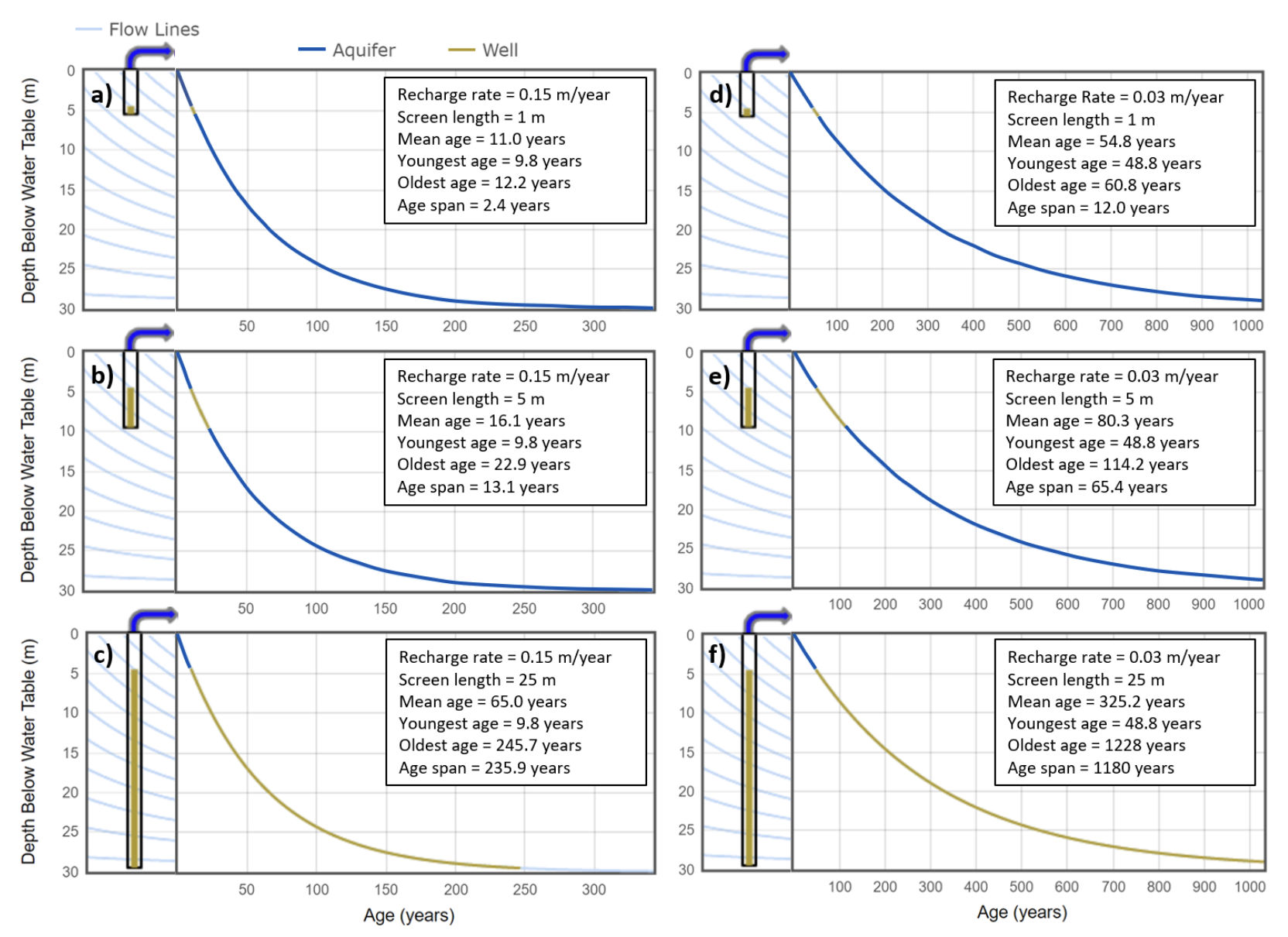
Figure 2 ‑ Groundwater age values for different well depths and screen lengths in a homogeneous aquifer with uniform thickness and uniform porosity. A partial aquifer cross section with groundwater flow lines, well depth, and screen length are depicted on the left side of each panel. Overall mean groundwater age for the aquifer in panels a) through c) is 60 years, while it is 300 years in panels d) through f) because the recharge rate is one‑fifth the rate in panels (a) through (c). The gold bar indicates the well screen. Water from all depths along the screen differ in age and enter the well to provide a sample of water with a range of ages. That age range of water entering the well is shown by the gold portion of the age versus depth curve. Modified from the Groundwater Age Mixtures and Contaminant Trends Tool (GAMACTT) provided by Böhlke and others (2014).
We used the web‑based Groundwater Age Mixtures and Contaminant Trends Tool (GAMACTT: Böhlke et al., 2014; US Geological Survey, 2016) to develop Figure 2, based on a homogeneous aquifer with uniform thickness (30 m), uniform porosity (0.3), and two different recharge rates (0.15 m/yr and 0.03 m/yr). In these illustrations, a shallow well screen with length of 1 m intercepts young groundwater with an age span of 2.4 years and 12 years respectively in the 0.15 m/year and 0.03 m/year recharge rate scenarios (Figure 2a and Figure 2d). In the low‑recharge scenario, even a relatively shallow 5 meter well screen (Figure 2e) intercepts groundwater outside the functional age‑dating limitations of tracers discussed in this book because the oldest age intercepted is about 114 years. Both low‑ and high‑recharge scenarios yield a mixture of young and old groundwater from 25 m screens (Figure 2c and Figure 2f) with the low‑recharge scenario yielding some groundwater that would be more appropriately age‑dated with [latex]_{}^{14}C[/latex] (Figure 1).
The examples in Figure 2 are based on highly simplified aquifer parameters. In the field, aquifer heterogeneity could lead to the interception of groundwater with even greater age ranges. Also, the estimates of groundwater age discussed in this book utilize solutes dissolved in the water. When advection is the dominate transport mechanism the movement of these solutes and groundwater is similar and so age estimates derived from solute measurements approximate the transit time of groundwater. However, in complex hydrogeologic environments where other transport mechanisms are important, the tracer age of the water may be significantly different than the transit time of water. In bedrock aquifers—where flow is often dominated by discrete fractures and wells intersect multiple fractures—the spectrum of ages can be particularly large, and diffusion of solutes into and out of the matrix (matrix diffusion) complicates the use of age‑dating tracers. Further discussion of more complex hydrogeological settings is outside the scope of this book, but we emphasize that it is critical to consider plausible recharge rates and develop appropriate conceptual models for the groundwater system being studied. This groundwork can be used to carefully design or select wells or other sampling points (e.g., streams, springs) that increase the likelihood of successfully sampling, analyzing, and interpreting age tracers in groundwater.
In addition to the convergence of bulk groundwater flow paths (e.g., Figure 2), molecular diffusion and hydrodynamic dispersion contribute to groundwater samples that contain tracer concentrations that represent a spectrum rather than a single age. As discussed by Cook (2020), whether the average tracer concentration associated with this spectrum of ages calculates to the average age of the tracer distribution depends in part on the relationship between tracer concentration and time. When tracer concentration and time are linearly related, the average concentration can be used to map the average age.
While a linear relationship between age and time may approximately exist for some tracers over a narrow range of time, in general, the age calculated using measured (i.e., average) tracer concentrations will be biased—either older or younger (Cook, 2020)—away from the mean. As a result, some researchers (Turnadge & Smerdon, 2014) have argued against the quantitative use of groundwater ages in favor of reporting raw tracer concentrations.
While rigorous quantitative use of age‑dating tracers involves using numerical simulations of groundwater flow and solute transport while adjusting the simulated system to obtain a match between observed and simulated tracer concentrations, it is our view that calculated tracer ages are useful for conceptualizing and understanding groundwater flow systems. Moreover, if the assumptions and equation(s) for calculating the tracer age are clearly defined, the age becomes a transformation of the concentration without loss of raw information or generality. Furthermore, age is a concept that resonates with groundwater practitioners and the general public, offering opportunities to communicate hydrogeologic concepts in ways that—though imperfect—are not possible using only tracer concentrations. Finally, for many tracers, the measured value has to be adjusted or converted to be directly related to transit time and compared with simulations. For example, measured values of [latex]_{}^{3}{He}[/latex] must be corrected for non‑tritiogenic components as shown in Section 4. Thus, the concepts in this book are useful regardless of whether the goal is a simulated concentration or an estimated age.