
3.2 Basic Concepts and Systematics
As a groundwater dating method, [latex]_{}^{3}H[/latex] is both a transient and radioactive tracer. Figure 9 illustrates the general concept of using a transient radioactive tracer to estimate the recharge year (age = sample year − recharge year). When the recharge concentration is either increasing or constant, the measured concentration can be uniquely related to the recharge year by extending the measured concentration backward in time along a decay curve until the extended value intersects the recharge concentration curve (Figure 9).
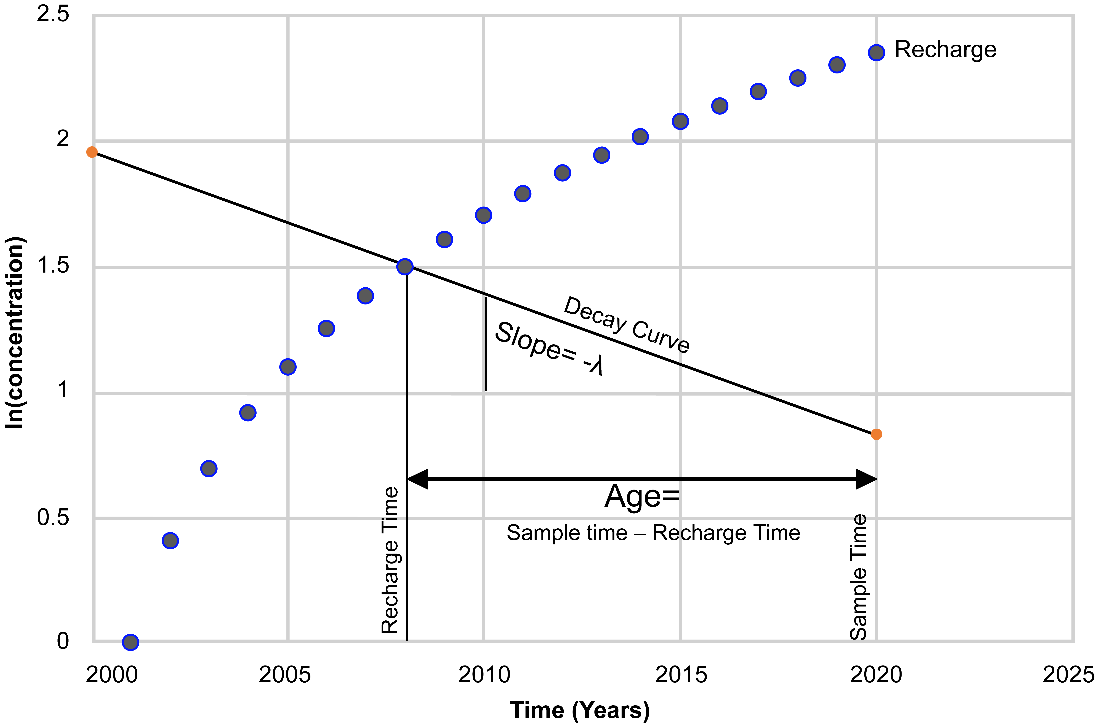
Figure 9 ‑ General concept of using a radioactive transient tracer for groundwater dating. The solid circles represent the concentration of recharge as a function time. The vertical axis is the natural logarithm of the tracer concentration. A decay curve having a slope of −λ (where λ is the decay constant (T-1)) is drawn through the point corresponding to the concentration of the sample and the time it was collected to intersect the recharge curve. The intersection of the line and the curve gives the recharge time of the sample. The age is given by the sample time minus the recharge time.
Using this approach to determine a tracer age for groundwater assumes that the amount of tracer decay in the unsaturated zone—prior to recharge—is small relative to the decay that occurred during groundwater transport prior to sampling—that is, an age determined using [latex]_{}^{3}H[/latex] includes the transit time in the unsaturated zone. The slope of the decay curve on a semi-log plot is given by the decay constant of the tracer. An alternative to the approach illustrated in Figure 9 is to decay‑correct the atmospheric curve to the time of sampling, in which case the age can be read directly from a plot (Cook & Dogramaci, 2019).
While tritium data are available from GNIP↗ which is managed by the IAEA in the USA, spatial and temporal interpolations of [latex]_{}^{3}H[/latex] in precipitation are available from Michel and others (2018).