
4.2 Basic Concepts and Systematics
Tritium decays via beta emission to stable [latex]_{}^{3}{He}[/latex]. [latex]\frac{_{}^{3}H}{_{}^{3}{He}}[/latex] age dating relies on measurement of both parent ([latex]_{}^{3}H[/latex]) and child ([latex]_{}^{3}{He}[/latex]) products that occur during groundwater transport. The physical process starts with
- infiltration of water at the land surface,
- transport through the vadose zone, and finally
- recharge to the groundwater system.
During processes (1) and (2), the water is exposed to a gas phase. The gas phase is atmospheric air at the land surface and often a close approximation to atmospheric air at the water table. Thus, any [latex]_{}^{3}{He}_{trit}[/latex] produced during infiltration and vadose zone transport is generally lost as the dissolved gases in water equilibrate with atmospheric air. Once recharge occurs, process (3), the groundwater is no longer in contact with an atmospheric gas phase.
As a result, and assuming the recharge rate is sufficiently high—nominally, > 3 mm yr-1, (Gilmore et al., 2021; Solomon et al., 1993)—the [latex]_{}^{3}{He}_{trit}[/latex] begins to accumulate in the groundwater. Accumulation of [latex]_{}^{3}{He}_{trit}[/latex] continues until groundwater is sampled or exposed again to a gas phase such as when the groundwater discharges to a stream or spring or is pumped out of a well.
Figure 13 illustrates the accumulation of [latex]_{}^{3}{He}_{trit}[/latex] over time as the initial [latex]_{}^{3}H[/latex] in groundwater recharge decays. The horizontal axis illustrates the relevant timescale of the [latex]\frac{_{}^{3}H}{_{}^{3}{He}}[/latex] age-dating method, where 2.6 percent of initial [latex]_{}^{3}H[/latex] remains after 65 years and 1.4 percent remains after 75 years.
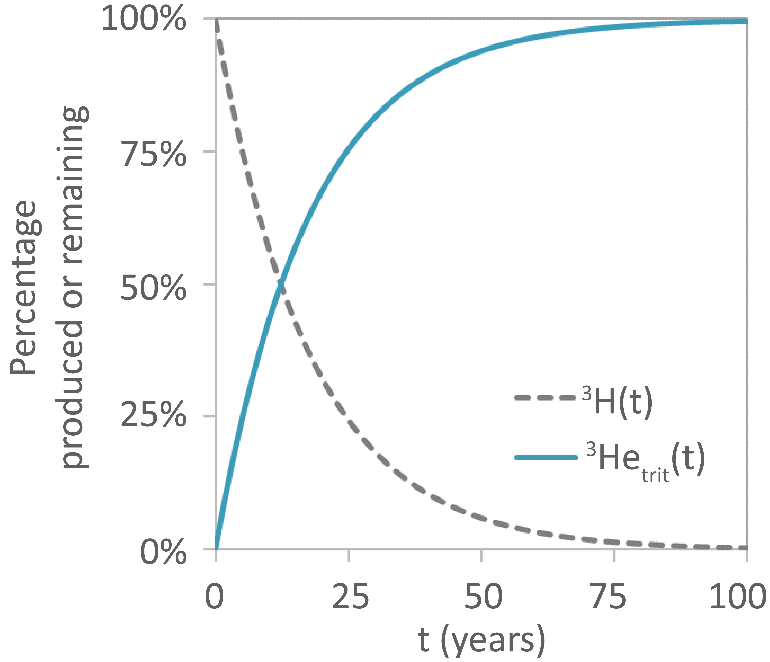
Figure 13 ‑ 3H remaining and 3Hetrit produced over time due to radioactive decay. A 3H half‑life of 12.32 years was used.
To determine the groundwater age from [latex]_{}^{3}H[/latex](t) and [latex]_{}^{3}{He}_{trit}[/latex](t), the age equation shown in Equation (14) is used.
| [latex]Age = \frac{\ln\left( 1 + \frac{_{\ }^{3}{{He}_{trit}(t)}}{_{}^{3}H(t)} \right)}{\lambda}[/latex] |
|
|---|
where:
| Age | = | elapsed time since groundwater recharge, i.e., since exposure to atmosphere (T) |
|---|---|---|
| λ | = | decay constant (T-1) |
| t | = | time of sampling |
Concentration units for both [latex]_{}^{3}{He}_{trit}[/latex] and [latex]_{}^{3}H[/latex] in Equation (14) are in TU. The age equation assumes that groundwater tracer transport can be described as piston flow (Maloszewski & Zuber, 1996). Practically speaking, this assumption means that [latex]_{}^{3}H[/latex] and produced [latex]_{}^{3}{He}_{trit}[/latex] travel together without mixing across other groundwater flowlines. Exercise 5⮧ provides an opportunity to practice calculating estimated groundwater age.
The age equation is based on the decay of tritium to tritiogenic helium shown in Equation (15).
| [latex]_{\ }^{3}{H_{trit}(t)} = \ _{\ }^{3}{H\left( t_{0} \right)(1 - e^{- \lambda t})\ }[/latex] | (15) |
|---|
Initial [latex]_{}^{3}H[/latex] ([latex]_{}^{3}H[/latex](t0)) is equal to the [latex]_{}^{3}H[/latex](t) plus [latex]_{}^{3}{He}_{trit}[/latex] determined from the groundwater sample as shown in Equation (16).
| [latex]_{\ }^{3}{H\left( t_{0} \right)} = \ _{\ }^{3}{H(t) +_{\ }^{3}{{He}_{trit}(t)}\ }[/latex] | (16) |
|---|
The decay constant (λ) is calculated as shown in Equation (17), based on the half‑life of tritium (12.32 years; Lucas & Unterweger, 2000).
| [latex]lambda = \ \frac{\ln 2}{12.32\ years} =[/latex]0.05626 yr–1 | (17) |
|---|