
6.1 Background and Historical Development
Chlorofluorocarbons are synthetic gases that are relatively stable in both the atmosphere and subsurface. Industrial production of CFCs began in the 1930s as refrigerants for cooling devices; in the 1940s, they were widely used as propellants, solvents, degreasers, and blowing agents for plastic foam. Atmospheric lifetimes of CFC‑11, CFC‑12, and CFC‑113 are 45 [latex]\pm[/latex]7, 87 [latex]\pm[/latex]17, and 100 [latex]\pm[/latex]32 years respectively (Volk et al, 1997). As a result of widespread production and long atmospheric lifetimes, CFC concentration in the atmosphere began to rise in the 1940s.
The first measurements of CFCs in the atmosphere were reported in 1971 after the invention of the electron capture detector (ECD; Lovelock, 1971). Atmospheric concentrations prior to 1971 have been reconstructed. This is possible because
- CFCs are synthetic compounds without natural sources (i.e., concentrations prior to 1920 were zero),
- records exist of CFCs produced,
- concentrations in firn (i.e., granular snow on a glacier) air from glaciers have been measured, and
- numerical simulations have been performed (Plummer & Busenberg, 2006, and the references cited in their chapter).
Lovelock and others (1973) reported CFC‑11 concentrations in both air and seawater and suggested that CFCs could be used as a tracer in ocean circulation studies. The continued production of CFCs through the mid‑1980s led to a monotonic increase in atmospheric concentrations and thus recharging water was imprinted with a unique CFC concentration each year. However, the realization that CFCs were a primary contributor to stratospheric ozone depletion (Molina & Rowland, 1974) resulted in an agreement among many industrialized nations to limit the release of CFCs, which ultimately resulted in a peaking and subsequent decline in atmospheric CFC concentrations (Figure 24).
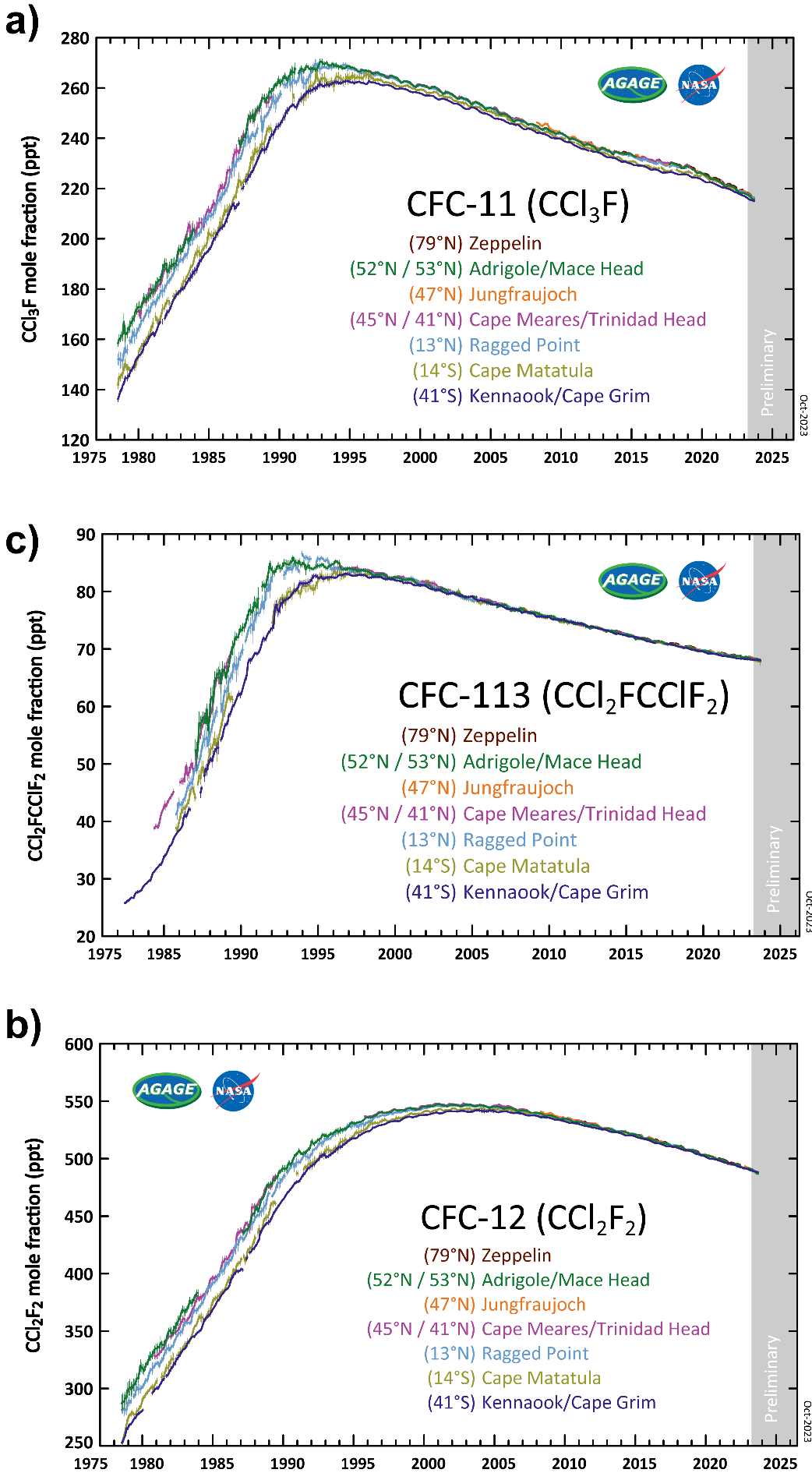
Figure 24 ‑ Measured CFC atmospheric mixing ratio for northern and southern hemispheres for the period between 1975 and the early 2020s. Earlier, atmospheric concentrations have been reconstructed using production records and ocean samples (redrawn from http://agage.mit.edu/⭧).
The production of CFCs occurred mostly in the northern hemisphere between 30° N and 70° N (Hartley et al, 1996). This resulted in higher atmospheric concentrations in the northern versus southern hemisphere from the 1940s to 2000. However, because atmospheric lifetimes are much longer than interhemispheric mixing, these differences are much less than tritium, and declining production has resulted in an essentially negligible difference since about 2000. In urban areas, however, CFC concentrations in air are often elevated due to local sources. For example, CFC‑11 and CFC-12 were elevated by 125 percent and 62 percent above the northern hemisphere average in Heidelberg, Germany (Oster et al., 1996). Ho and others (1998) observed enrichments of between six and 13 percent in the air of New York City, New York, USA.