
6.5 Sensitivity of Age to Input Parameters
The procedure outlined in the previous section for calculating a tracer age from a measured concentration of CFCs involves numerous parameters (recharge temperature, salinity, elevation) that are uncertain to some degree. In this section, we summarize the sensitivity of the computed age to uncertainty in recharge temperature and elevation.
Figure 27 shows the relationship between the CFC tracer age and various input parameters for a water sample having aqueous concentrations of 1.5, 0.7, and 0.1 pmole/kg for CFC‑11, CFC‑12, and CFC‑113 respectively. The sample was assumed to have been collected in the year 2015, and the age was calculated as 2015 minus the computed recharge year. The recharge temperature and recharge elevation were varied to illustrate the sensitivity of the computed age to these parameters.
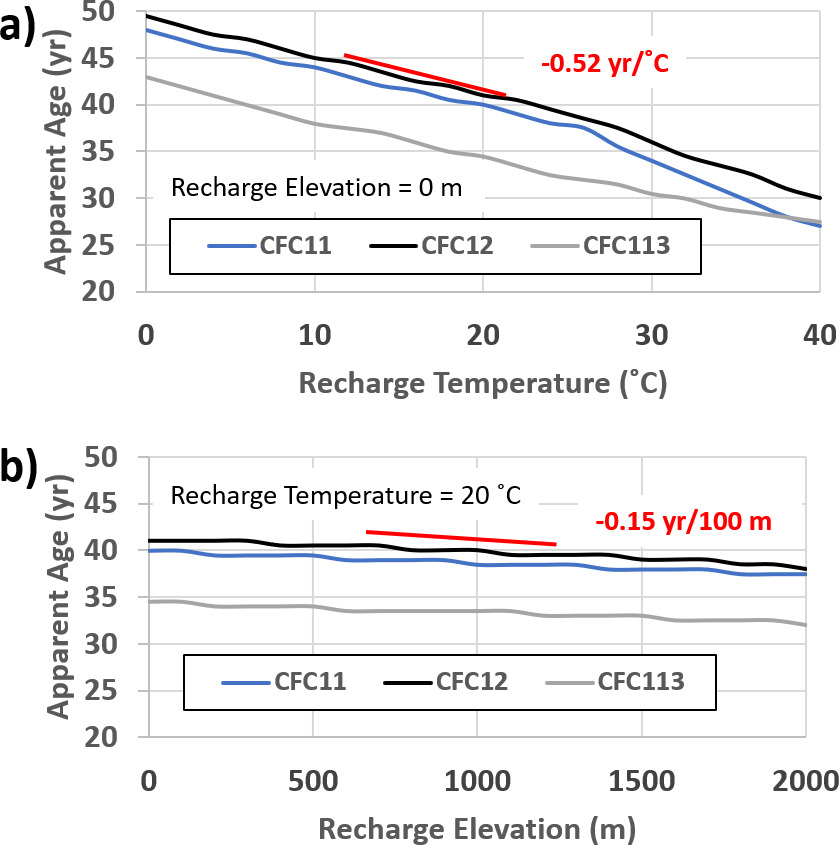
Figure 27 ‑ Sensitivity of CFC tracer ages to input parameters. The tracer age of a hypothetical sample having CFC concentrations of 1.5, 0.7, and 0.1 pmole/kg for CFC‑11, CFC‑12, and CFC‑113, respectively, were computed for various values of recharge temperature and recharge elevation as indicated. The sensitivities—change in age per change in parameter—are shown in red.
The sensitivity of the tracer age to recharge temperature is about − 0.52 year/°C for recharge temperatures ranging from 0 to 40 °C. In other words, if the assumed recharge temperature was 1 °C warmer than the true value, the tracer age would be 0.5 years younger than the true age. The sensitivity to recharge elevation is about − 0.15 year/100 m, so using a recharge elevation that is 100 m greater than the true elevation results in an age that is 0.15 years younger. The relationship is not smooth because of an artifact of the numerical simulation that uses annual average atmospheric concentrations instead of continuous values.