
2.1 Henry’s Law
Henry’s Law describes the equilibrium relationship between the concentration of a gas dissolved in water and the concentration of that gas in the gas phase. The gas phase concentration is a function of both the total gas pressure and the mole fraction of the gas in the gas mixture. Changing either the total gas pressure or the mole fraction can, in turn, change the dissolved concentration. There are many different forms of Henry’s Law with some forms describing the solubility of a gas in a liquid, while other forms describe the volatility of a gas. In this section, the volatility forms are described as they are commonly used for noble gases, and they are helpful for describing the effect that bubbles have on dissolved concentrations. When using data from the literature, it is critical that researchers understand exactly which form of Henry’s Law is being used, as numerical values and units can differ substantially.
A dimensionless form of Henry’s Law is shown in Equation (1).
| [latex]C_{i}^{gas} = K_{w,i}^{cc}C_{i}^{water}[/latex] | (1) |
|---|
where:
| [latex]C_{i}^{gas}[/latex] | = | molar concentration of gas i in the gas phase (molL-3, e.g., moles/L) |
|---|---|---|
| [latex]C_{i}^{water}[/latex] | = | molar concentration of gas i in the water phase (molL-3, e.g., moles/L) |
| [latex]K_{w,i}^{cc}[/latex] | = | Henry Coefficient for gas i (dimensionless) |
The dimensioned form of Henry’s Law is shown in Equation (2).
| [latex]p_{i} = K_{w,i}c_{i}[/latex] | (2) |
|---|
where:
| [latex]p_{i}[/latex] | = | partial pressure of gas i in the gas phase (ML-1T-2, typically atm) |
|---|---|---|
| [latex]c_{i}[/latex] | = | concentration of gas i in the water phase (molL-3, typically moles/L) |
| [latex]K_{w,i}[/latex] | = | Henry Coefficient for gas i (ML2T2mol-1, typically atm[latex]-[/latex]L/mole) |
Both the dimensionless and dimensioned forms of Henry Coefficient are specific for each gas and are a function of temperature and salinity, which we subsequently describe.
In noble gas geochemistry, aqueous concentrations are often expressed in units of ccSTP/g. This unit describes the volume of gas in cubic centimeters at standard temperature (0 °C for gases) and pressure (1 atm) per unit mass of water. To visualize this unit, consider 1 gram of water in which the gas is completely removed and placed in a syringe that is then cooled to 0 °C. If the syringe is then compressed until the gas pressure is 1 atm, the gas volume in cubic centimeters within the syringe is ccSTP and the original gas concentration in the water is this volume per 1 g of water. This volume (ccSTP) can be converted to moles using the ideal gas law as shown in Equation (3).
| [latex]n = \frac{PV}{RT} = \frac{(1\ atm)(1\ ccSTP)}{82.057366\ \frac{cc\ atm}{mole\ {^\circ}K}(273.15\ {^\circ}K)} = 0.00004462\ mole[/latex] | (3) |
|---|
So, 1 cc of gas at standard temperature and pressure is 0.00004462 moles. Therefore, a water having 1 ccSTP of gas per gram of water has a concentration of:
[latex]1\ ccSTP/g = 0.00004462[/latex] moles [latex]g^{- 1} = 0.004462[/latex] moles [latex]{kg}^{- 1}[/latex]. Units used in the literature for noble gas concentrations vary (e.g., ccSTP/g, ccSTP/kg, moles/kg). As with all equations, it is important to use consistent units throughout the calculation.
When the aqueous concentration is in units of ccSTP/g, values for [latex]K_{w,i}^{}[/latex] at various temperatures for pure water are shown in Table 1. Also shown in Table 1 are values of [latex]K_{w,i}^{cc}[/latex] (dimensionless). One utility of the dimensionless form of Henry’s Law is that the value of [latex]K_{w,i}^{cc}[/latex] represents the preference for a given gas to reside in the gas phase when equal volumes of gas and water are equilibrated. For example, if equal volumes of gas and water are in equilibrium, the amount of [latex]He[/latex] in the gas phase will be more than 100 times the amount in water. In contrast, the amount of xenon ([latex]Xe[/latex]) in the gas phase will be about five times greater (at 0 °C) than in the water phase for equal volumes of gas and water. The values for [latex]K_{w,i}^{cc}[/latex] shown in Table 1 underscore the importance of collecting samples with no headspace.
Table 1 ‑ Henry Coefficient for gases in pure water.
| Dimensioned Henry Coefficient [latex]\mathbf{K}_{\mathbf{w,i}}^{}[/latex] (atm g / ccSTP) | ||||||||
|---|---|---|---|---|---|---|---|---|
| Temp °C | He 1 | Ne 1 | Ar 2 | Kr 3 | Xe 4 | O2 5 | N2 5 | |
| 0 | 106 | 80.3 | 18.6 | 9.13 | 4.49 | 21.8 | 42.2 | |
| 10 | 111 | 89.0 | 23.9 | 12.4 | 6.52 | 26.9 | 53.2 | |
| 20 | 114 | 96.0 | 29.3 | 16.0 | 8.93 | 32.6 | 64.0 | |
| 30 | 115 | 101.0 | 34.4 | 19.8 | 11.6 | 39.0 | 74.1 | |
| Dimensionless Henry Coefficient [latex]\mathbf{K}_{\mathbf{w,i}}^{\mathbf{cc}}[/latex] | ||||||||
| 0 | 106 | 80.3 | 18.6 | 9.13 | 4.49 | 21.8 | 42.2 | |
| 10 | 108 | 85.9 | 23.1 | 11.9 | 6.29 | 25.9 | 51.3 | |
| 20 | 107 | 89.4 | 27.3 | 14.9 | 8.32 | 30.4 | 59.6 | |
| 30 | 104 | 91.0 | 31.0 | 17.8 | 10.5 | 35.2 | 66.7 | |
Values were computed using empirical formulas from the following:
1 He and Ne: Weiss (1971)
2 Ar: Weiss (1970)
3 Kr: Weiss and Kyser (1978)
4 Xe: Clever (1979)
5 O2 and N2: Sander (1999)
The solubility of a gas in water is inversely proportional to temperature. As the temperature increases, the solubility decreases. Figure 3 shows how the solubility of diverse gases varies as a function of temperature. The variability in solubility that occurs with change in temperature is a function of molecular weight. The heavier the molecule, the greater the sensitivity to temperature. For example, the solubility of [latex]He[/latex] changes by just over ten percent between 0 and 30 °C, whereas [latex]Xe[/latex] solubility varies by more than 60 percent over this temperature range.
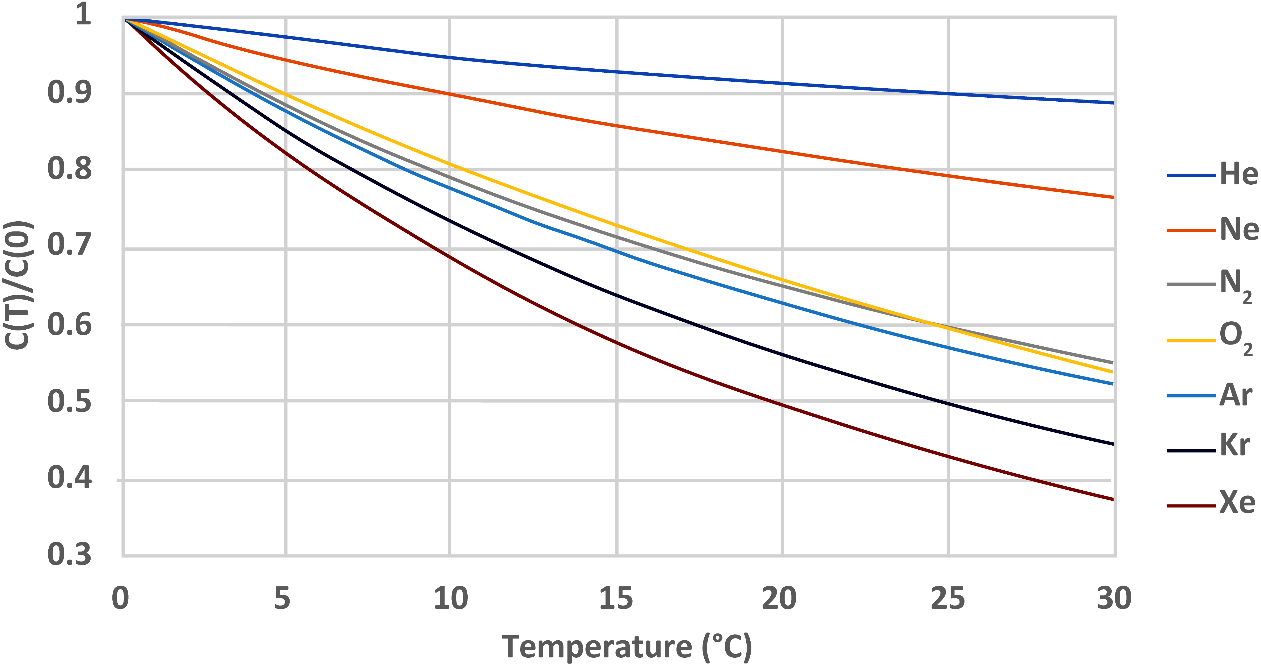
Figure 3 ‑ Dissolved concentration of various gases normalized by the concentration at 0 °C versus temperature. The sensitivity of the concentration to temperature is greater for heavy gases (e.g., [latex]Xe[/latex]) and less for light gases (e.g., [latex]He[/latex]).
The solubility of a gas also depends on salinity. As the salinity of water increases and the thermodynamic activity of water decreases, the concentration of gas dissolved in water that is in equilibrium with a gas phase is lower. This is known as the salting effect and is generally more significant for high molecular weight gases than for those with low molecular weight. The salting effect for various gases is shown in Figure 4. The solubility of [latex]Xe[/latex] decreases by about 25 percent from freshwater (salinity =[latex]\ 0[/latex]) to seawater (salinity =[latex]\ 35\ g/kg)[/latex] while the solubility of [latex]He[/latex] decreases by about 20 percent.
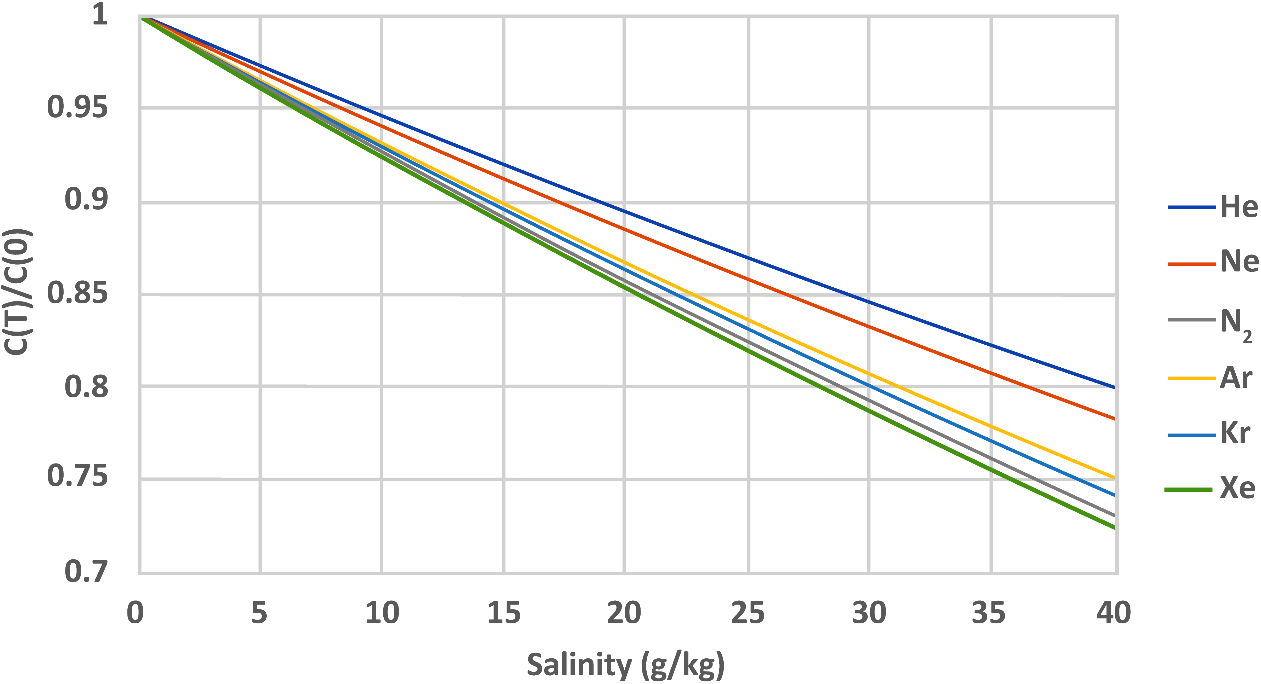
Figure 4 ‑ Dissolved concentration of various gases, normalized by the concentration at 0 salinity, versus salinity. At salinities below about 1 g/kg (i.e., 1,000 ppm), the salting effect is minimal, but it is significant at the salinity of seawater (35 g/kg).
In the subsurface, an important distinction is needed between open and closed systems. In general, open-system conditions exist in the vadose zone where both gas and liquid phases exist; gas molecules can exchange between phases. Closed system conditions generally occur in the saturated zone such that only dissolved gases exist.
While the solubility of gases is a function of temperature and salinity, it is important to note that below the water table under closed system conditions, the concentration of dissolved gases does not generally change as groundwater warms and/or becomes saltier. Groundwater that equilibrates with the atmosphere at the water table may warm and increase in salinity as it moves deeper into an aquifer. While the increase in temperature and salinity will reduce the equilibrium solubility of a gas—when both gas and liquid phases are present—the increase in fluid pressure is typically sufficient to prevent a gas phase from forming (i.e., bubble formation) and thus the concentration of the gas does not change.
For example, using a very high geothermal gradient of 40 °C/km, the pressure of dissolved [latex]N_{2}[/latex] plus [latex]O_{2}[/latex] would increase by 0.63 atm/km due to warming, whereas the hydrostatic pressure would increase more than 95 atm/km. Dissolved [latex]N_{2}[/latex] plus [latex]O_{2}[/latex] are used for this example because these are the dominant gases in infiltrating water, although [latex]O_{2}[/latex] can be replaced by [latex]{CO}_{2}[/latex] in the unsaturated zone. Even with a very large geothermal gradient, the increase in fluid pressure far exceeds the increase in gas pressure due to warming. Thus, the concentration of dissolved gases that is established at the water table does not typically change due to warming along groundwater flow paths.