
4.3 Sample Collection and Analysis
Collection of groundwater for [latex]_{}^{3}H[/latex] samples is straightforward and described in Section 3. Glass or high‑density polyethylene bottles are preferable and a sample volume of about one liter is typically sufficient for [latex]_{}^{3}H[/latex] analysis, although this can vary according to the tritium laboratory.
Collection of groundwater samples for determination of [latex]_{}^{3}{He}_{trit}[/latex] is more challenging but very feasible with good communication with the noble gas laboratory where the samples will be analyzed. Detailed descriptions of sampling procedures can be found in Aeschbach‑Hertig and Solomon (2013), which is summarized subsequently. Additional details are provided in Box 2⮧ and Box 3⮧. Practical considerations for selecting appropriate sampling sites (i.e., vadose zone thickness, well depth, screen length, among others) and a similar summary of sampling procedures can be found in Gilmore and others (2021).
Sampling containers and techniques may vary between noble gas labs (Aeschbach‑Hertig & Solomon, 2013), so it is important to coordinate with the lab to obtain materials from the labs and/or the detailed specifications of required equipment. Water samples are commonly collected in refrigeration‑grade copper tubes (Figure 14 and Boxes 2 and 3) for analysis of dissolved gases, but gas samples may also be collected directly in the field using diffusion samplers (Figure 14). In all cases, it is critical to avoid exposure of the groundwater sample or dissolved gas samples to air because dissolved noble gases can quickly equilibrate with the atmosphere as discussed in Section 2.
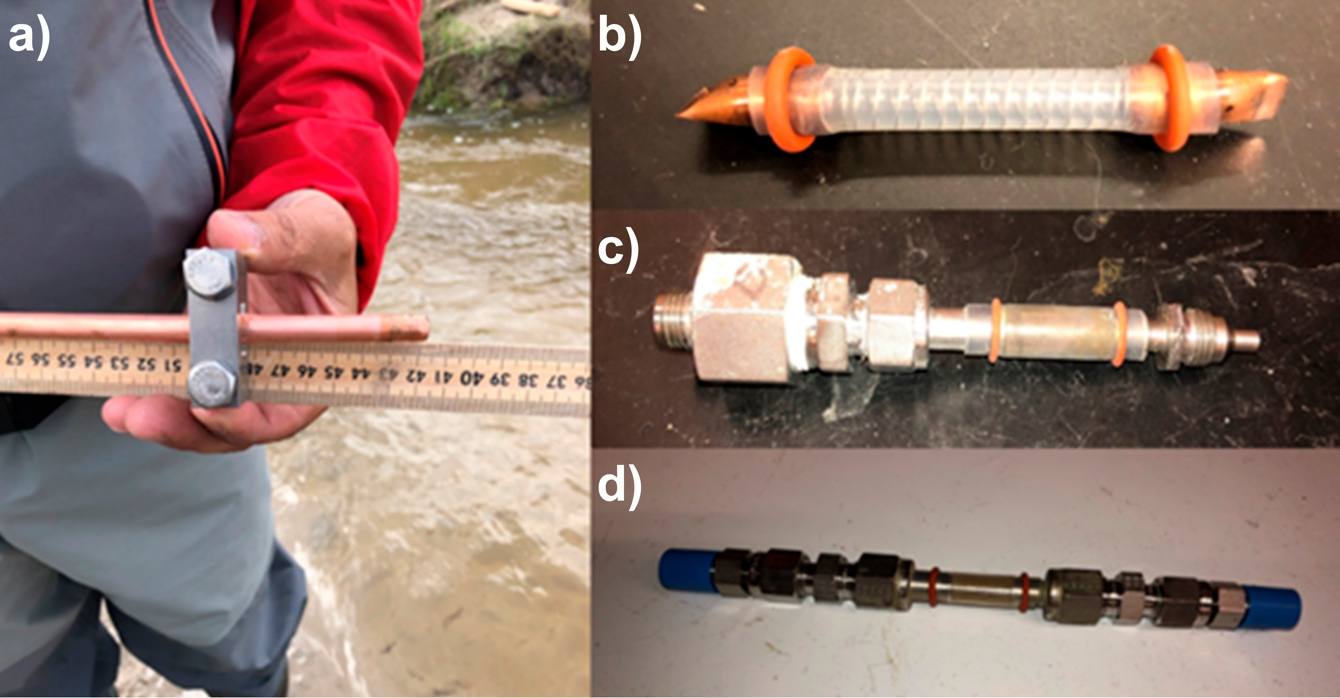
Figure 14 ‑ Noble gas sampling details including a) refrigeration clamp attached to the end of a copper tube and b) permeable tubing used for the standard diffusion sampler. The copper tubing shown is what remains after the gas samples have been collected in the field. Panels c) and d) show an advanced diffusion sampler (used with permission of Gilmore et al., 2021).
Parameters that are especially useful for dissolved gas sampling include temperature and conductivity because gas solubility is dependent on these two parameters. Dissolved oxygen and TDGP (Manning et al., 2003) are also useful measurements because they can indicate potential for loss of dissolved gases (degassing) due to high gas concentrations that can occur due to generation of biogenic gases in the subsurface. The potential for loss of dissolved gases from groundwater samples is especially high when sampling in hot weather, when gas solubility is lower. Pumping at a higher rate and/or shortening or insulating pump tubing can be helpful during hot weather. Similarly, elevating the overflow tubing to increase head pressure on the sample in the copper tube can also help to keep gases in solution. Box 2 and 3 discuss procedures for sampling from wells and streambeds respectively. Section 2 provides additional discussion of these field parameters along with the process of degassing and their relationship to noble gas concentrations in groundwater samples.
For noble gases, a diffusion‑based sampling method is available to passively extract dissolved gases from groundwater as an alternative to the copper tube method. A more detailed treatment of these methods is provided by Aeschbach‑Hertig and Solomon (2013). Standard diffusion samplers (e.g., Figure 14b) use a short piece of permeable tubing (e.g., a 10 cm length of silicone) attached to short pieces of copper tubing (8 cm) on each end. The outer ends of the copper tubing are sealed with a tungsten carbide pinch‑off tool to prevent water from entering the sampler and gas exchange once samples are collected. The sampler is submerged in a groundwater well for about 24 hours, allowing gases in the groundwater to equilibrate with the air in the permeable tubing and attached copper tubing (Sanford et al., 1996).
The sampler is then removed from the well and the pinch‑off tool is used to seal the copper tubes near the attachment point with the permeable membrane (e.g., Figure 14b). The process of sealing the sample gases in the copper tube must be completed quickly to avoid gas exchange with the atmosphere. This method requires in situ measurement of temperature and TDGP of the sampled groundwater (Aeschbach‑Hertig & Solomon, 2013).
An advanced diffusion sampler (Figure 14c, d) can be used to eliminate gas exchange with the atmosphere instead of collecting and sealing the standard diffusion sampler shown in Figure 14b (Gardner & Solomon, 2009). An added benefit of using an advanced sampler is that TDGP does not need to be measured in the field (Aeschbach‑Hertig & Solomon, 2013). There are four main components of advanced diffusion samplers:
- the volume where gas sample is collected and stored,
- the gas exchange membrane,
- a piston, and
- a hydraulic activation mechanism (Gardner & Solomon, 2009).
Like the passive sampler, the equilibration time for the advanced diffusion sampler is about 24 hours. A hand‑operated pump closes the sampler in‑situ to temporarily seal off the sample from further gas exchange. The sampler is then withdrawn from the well and the sample tubing is clamped shut for long‑term storage (Gardner & Solomon, 2009).
Lab analysis of groundwater for [latex]_{}^{3}H[/latex] activity is achieved using the helium in‑growth method as described in Section 3.3, which includes a description of [latex]_{}^{3}{He}[/latex] and [latex]_{}^{4}{He}[/latex] measurement in gas extracted from groundwater. The analytical approach for measuring [latex]_{}^{3}{He}[/latex] and [latex]_{}^{4}{He}[/latex] contained in sampled groundwater (i.e., the copper tube method) or gases in diffusion samplers is the same as for [latex]_{}^{3}{He}[/latex] and [latex]_{}^{4}{He}[/latex] extracted for the helium in‑growth method. These isotopes are measured by peak‑height manometry using large‑radius sector‑field mass spectrometry (SFMS).
Precise measurement of [latex]_{}^{3}{He}[/latex] is complicated because of its very low abundance in groundwater samples and because of its low abundance relative to [latex]_{}^{4}{He}[/latex]. The SFMS needs a high resolving power to separate [latex]_{}^{3}{He}[/latex] (mass = 3.016) from the hydrogen deuterium ion (HD[latex];[/latex] mass = 3.021) and is present in all metal vacuum systems, and to assure that the [latex]_{}^{3}{He}[/latex] peak has no interference from the tail of the [latex]_{}^{4}{He}[/latex] peak. Either SFMS or quadrupole mass spectrometry is used for other noble gases needed for the [latex]_{}^{3}H[/latex]/[latex]_{}^{3}{He}[/latex] age‑dating method. Ideally, a full suite of noble gases is measured in addition to [latex]_{}^{3}{He}[/latex], including [latex]Ne[/latex], [latex]Ar[/latex], [latex]Kr[/latex], and [latex]Xe[/latex] (Stanley et al., 2009). In some cases, only [latex]Ar[/latex] and/or [latex]Ne[/latex] are measured to decrease the cost of analysis.