
1.1 The Properties of Water
Pure water ([latex]H_{2}O[/latex])
- is clear, colorless;
- has no discernable taste or smell;
- at 1 atmosphere has a melting point of 0 °C and a boiling point of 100 °C; and
- has a density at 4 °C of 1.00 g/cc (1,000 kg/m3).
Water is present throughout the solar system, but other than on Earth it generally exists as a gas or solid. Earth is the only known planet with extensive bodies of liquid water on the surface. Liquid water most likely occurs in the subsurface on Mars, and there are likely extensive oceans of saline liquid water beneath the frozen surfaces of several moons of Jupiter and Saturn. Liquid water is essential for life as we know it, and it is one of the reasons Earth is such a unique place in the solar system.
One of the things that makes water so unique is that it is a highly polar molecule (Figure 1a)—that is, the distribution of charges within the molecule results in a partial positive charge on one side and a partial negative charge on the other. Because of this, water is cohesive (Figure 1b), and water molecules like to stick to each other as well as to surfaces and other molecules.
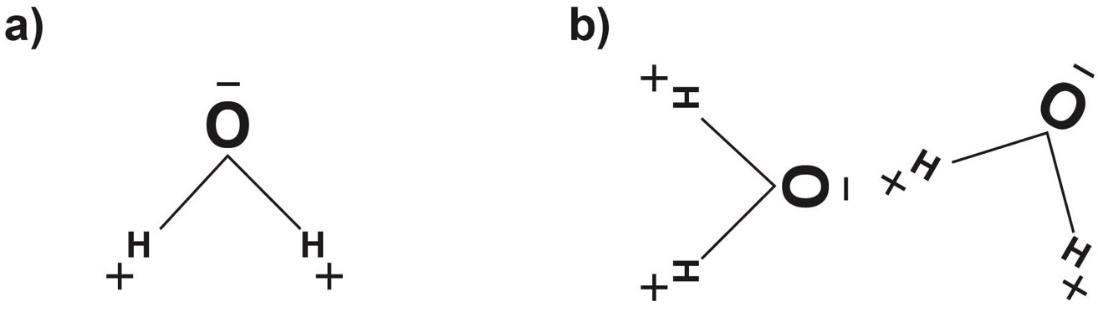
Figure 1 ‑ Model of water molecules showing a) molecule polarity and b) attraction between water molecules responsible for cohesiveness and surface tension.
Polarity of the water molecule results in high surface tension and high solvent ability, which is why we say that water is the universal solvent.