
14.4 Theory of Flow in an Unsaturated Porous Medium
In the unsaturated zone water is pulled down under the force of gravity and flow is, for the most part, vertical and downward. In saturated groundwater, flow is driven by the hydraulic gradient, which refers to the distribution of hydraulic heads in the flow system. Flow in the vadose zone is also driven by differences in head, and the head at any point in the unsaturated zone is like the saturated zone head in that it composed of an elevation component and a pressure component. More specifically, unsaturated zone head ([latex]hu[/latex]) is defined in Equation (109).
| [latex]hu = \psi + z[/latex] | (109) |
|---|
where (parameter dimensions are dark green font with mass as M, length as L, time as T):
| [latex]\psi[/latex] | = | matric potential (or negative pressure head, thus a negative length) (L) |
|---|---|---|
| [latex]z[/latex] | = | elevation head (L) |
Darcy’s law is also applicable in the unsaturated zone, since we are dealing with laminar flow, so we can describe the permeability in terms of a hydraulic conductivity. However, as previously stated, the matric potential and the hydraulic conductivity are both a function of the volumetric moisture content (𝜃). The implication is that, unlike in saturated sediments, hydraulic conductivity is no longer a constant, rather, it is a variable dependent upon 𝜃. When you think about it, the nonlinear nature of unsaturated flow becomes apparent—water infiltrates into the unsaturated zone at a rate that is dependent upon the moisture content, however, as it infiltrates, the moisture content increases, permeability increases, and water infiltrates faster, changing the permeability more, and so on. At the same time, the matric potential is also changing, so as water infiltrates, matric potential decreases, the gradient decreases, and the water infiltrates more slowly, and so on. The problem in modeling the unsaturated zone, therefore, is that both primary parameters (i.e., [latex]\psi[/latex] and K) change as conditions in the model change, and the changes are not linear—that is, doubling 𝜃 does not necessarily double [latex]K[/latex]. Not only do they change, but they change independent of each other—the magnitude of change of [latex]K[/latex] will not be the same as the change in [latex]\psi[/latex] for the same change in 𝜃.
The nonlinearity is complicated by the fact that the magnitude of the change in [latex]K[/latex] or [latex]\psi[/latex] depends on whether water is being added to the soil (wetting) or water is being removed from the soil (drying). In other words, the shape of the curves in Figure 115 will change depending on how the conditions are changing. This process is called hysteresis—that is, the dependence of the state of a system is based on its history. Figure 116 shows idealized curves of moisture content versus matric potential and hydraulic conductivity versus matric potential with one curve for draining (i.e., drying) a material and a different curve for rewetting the material. If the same sample were repeatedly drained and wetted, the drying and wetting curves would be different each time. The implication of this is that the prior moisture history of the soil will affect and control the relationship between [latex]\psi[/latex] and [latex]K[/latex].
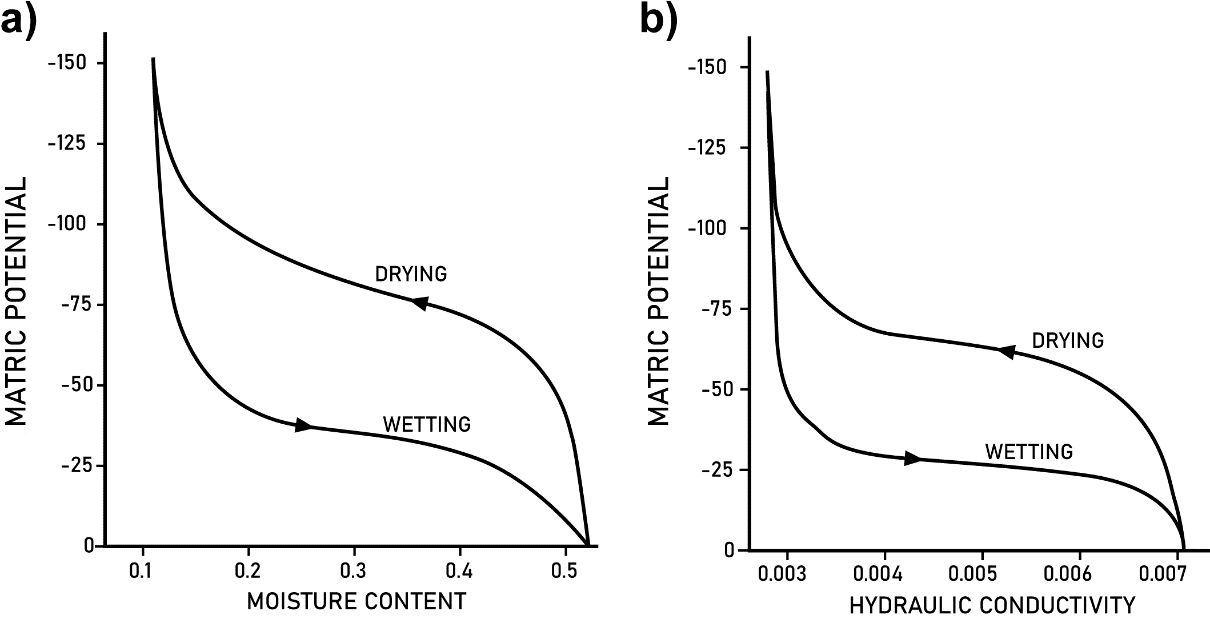
Figure 116 ‑ Idealized plots of a) water content and b) hydraulic conductivity versus matric potential showing separate curves for the drying and wetting paths.