
15.3 States of Stress in the Earth’s Crust
At all points in the subsurface, the rocks and sediments are under stress. Stresses can be normal or shear relative to the point of observation, and normal stresses can be either compressional or tensional (Figure 122).
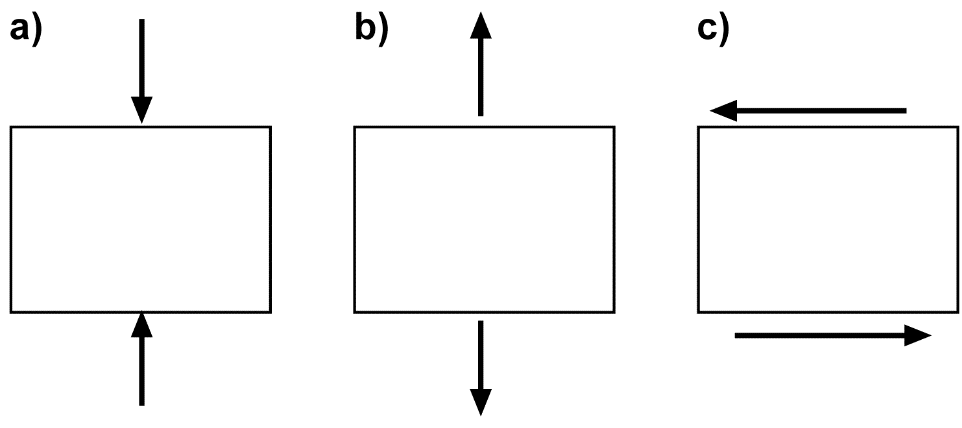
Figure 122 ‑ Schematic diagrams showing a) compressional stress, b) tensional stress, and c) shear stress.
Stress is a tensor quantity, meaning that it exists in three dimensions in the subsurface and the magnitude of stress varies with respect to location and direction. If we are dealing with an area that is at a tectonically active margin, or at a location with lots of topography and vertical relief—for example, next to a cliff face—the horizontal stresses could be significant. Fortunately, in most hydrogeologic settings with fluid‑related consolidation problems, we can generally ignore the horizontal stresses and only deal with vertical stress, so for our purposes we will ignore horizontal stress and only consider vertical stress—and resulting vertical strain.
The vertical stress at a given point in the subsurface is simply a function of the pressure exerted on that point by the weight of the overlying material. This pressure is equal to the unit weight of the material times the thickness of the material. We can express that relationship in Equation (110).
| [latex]\sigma_{v} = p_{b}gz[/latex] | (110) |
|---|
where (parameter dimensions are dark green font with mass as M, length as L, time as T):
| [latex]\sigma_{v}[/latex] | = | vertical stress (ML-1T-2) |
|---|---|---|
| [latex]p_{b}[/latex] | = | bulk density of the overlying material (ML-3) |
| [latex]g[/latex] | = | gravitational acceleration (LT-2) |
| [latex]z[/latex] | = | thickness of layer material (L) |
This equation calculates the total stress at any given depth in the subsurface, based on the thickness of the overlying material. The total stress, also called the lithostatic stress, is the sum of two different stresses: the effective stress, which is the stress from the column of rock above the point (Figure 123), and the pore fluid pressure, which is the stress related to the fluid in the pores (Figure 121). This relationship is summed up by Equation (111), also called Terzaghi’s Law. We are therefore considering two stresses—the effective stress, which is directed downward, and the pore fluid pressure, which is acting in all directions but can be considered to be acting opposite to the effective stress.
| [latex]\ \sigma = \sigma' + p_{f}[/latex] | (111) |
|---|
where (parameter dimensions are dark green font with mass as M, length as L, time as T):
| [latex]\sigma[/latex] | = | total vertical stress; also called the normal stress (ML-1T-2) |
|---|---|---|
| [latex]\sigma'[/latex] | = | effective stress, or “grain to grain” stress in the rock (ML-1T-2) |
| [latex]p_{f}[/latex] | = | pore fluid pressure (ML-1T-2) |
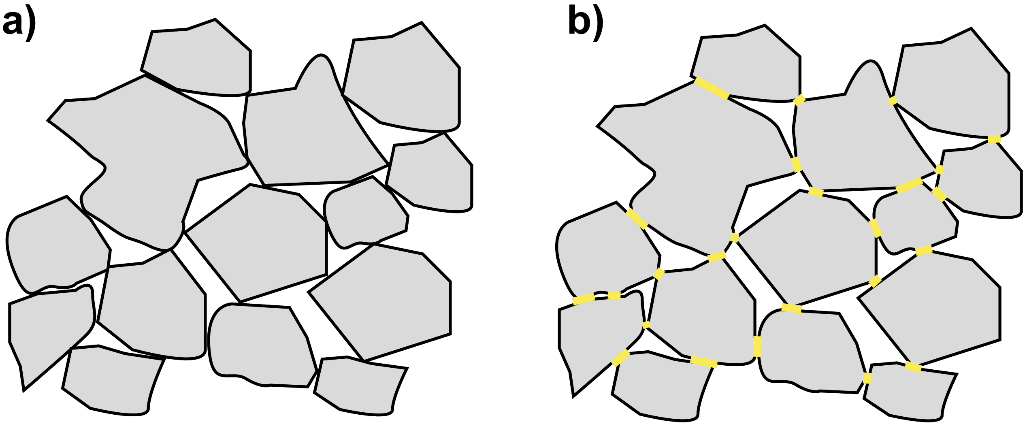
Figure 123 ‑ a) Close‑up of sand grains in the subsurface; b) same grains with grain contacts highlighted. The effective stress is the stress related to the weight of the sediment grains and is supported by the grain contacts.
In an unconfined aquifer, the pore fluid pressure is simply the pressure from the column of water above the point in the aquifer—just like the total stress is the pressure associated with all the material above that point. This is called the hydrostatic pressure. We can use Equation (112) to express the hydrostatic pressure.
| [latex]p_{h} = p_{w}gz[/latex] | (112) |
|---|
where (parameter dimensions are dark green font with mass as M, length as L, time as T):
| [latex]p_{h}[/latex] | = | hydrostatic pressure (ML-1T-2) | |
|---|---|---|---|
| [latex]p_{w}[/latex] | = | density of water (ML-3) | |
| [latex]z[/latex] | = | thickness of the overlying layer of water (L) | |
In a confined aquifer, the pore fluid pressure is equal to the hydrostatic pressure, plus the additional pressure that causes water to rise above the top of the aquifer in a well—that is, the excess fluid pressure (Figure 120). We can therefore combine Equation (110) and Equation (111) and rewrite the Terzaghi equation as Equation (113).
| [latex]\sigma = \sigma' + p_{w}gz + u[/latex] | (113) |
|---|
where (parameter dimensions are dark green font with mass as M, length as L, time as T):
| [latex]u[/latex] | = | excess fluid pressure (ML-1T-2) |
|---|
As this equation indicates, the stresses are a function of depth, and the lack of exponents in the equations tells us that they are linearly proportional to depth. We can therefore draw a diagram (Figure 124) that graphically represents the distribution of each component of stress—lithostatic, hydrostatic, and excess fluid pressure—in the subsurface. Hydrostatic pressure, [latex]p_{h}[/latex], is zero at the water table and increases linearly with depth. Lithostatic pressure, [latex]\sigma'[/latex], is zero at the surface and increases linearly with depth. A confined aquifer has an additional component of pressure, u. The effective stress, σ, is the sum of [latex]p_{h}[/latex], [latex]\sigma'[/latex], and u.
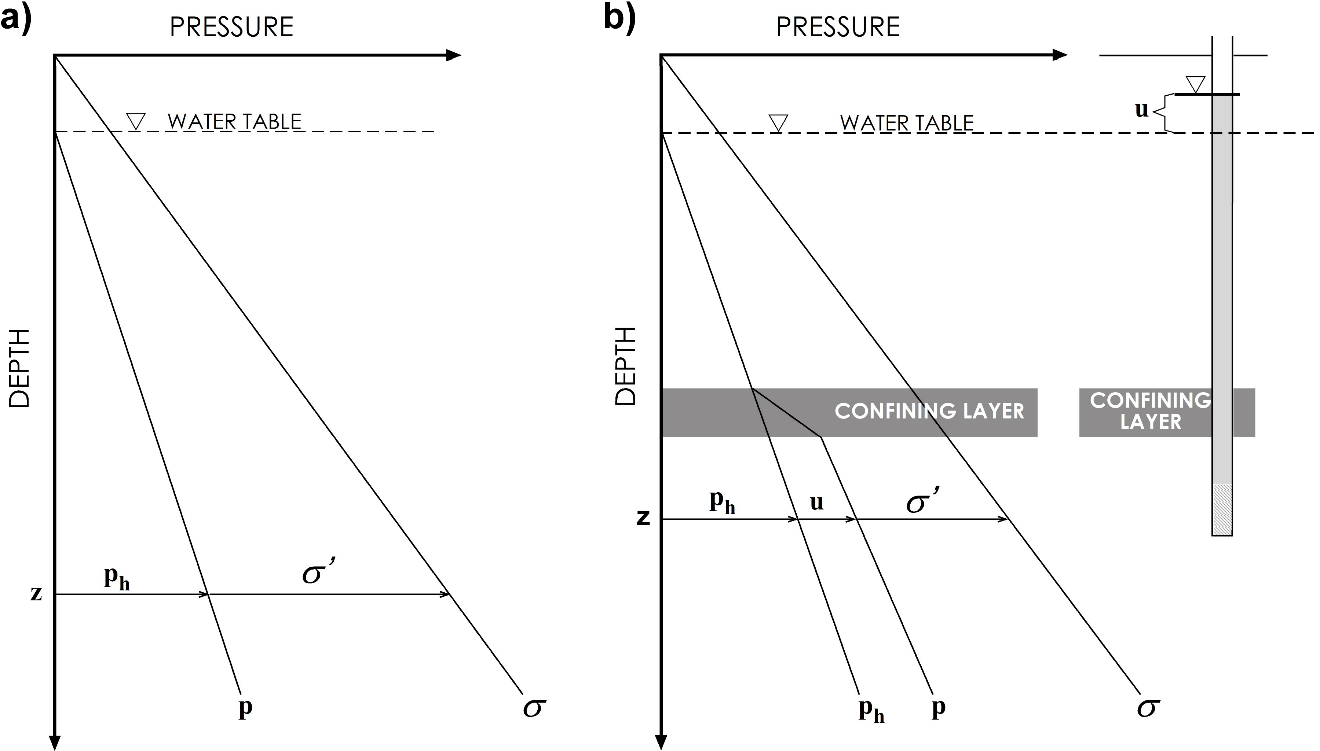
Figure 124 ‑ Changes in hydrostatic (ph) and lithostatic (σ) stress with depth in a) an unconfined aquifer, and b) a confined aquifer with excess fluid pressure (u). The well on the right in (b) illustrates the definition of u relative to water levels in a well.
Figure 124a shows the relationship between stress and depth in an unconfined aquifer. Both the lithostatic and the pore fluid pressures increase linearly with depth, and the pore fluid pressure is generally a little less than half of the lithostatic. Figure 124b shows the relationship between stress and depth in a confined aquifer with an overlying unconfined aquifer. In the water table above the confining layer, the pore fluid pressure increases linearly; below the confining layer there is an additional component of pore fluid pressure ([latex]u[/latex]). The additional pore fluid pressure decreases the effective stress accordingly—in other words, the pore fluid pressure pushes against the grains and reduces the stress at the grain contacts. The additional stress, u, represents the additional pressure head associated with the elevation of the potentiometric surface above the water table.
Thought Question 17: As pore fluid pressure increases, it decreases the effective stress—in other words, it pushes against the stress of the weight of the overlying rock. What would happen if the fluid pressure increased so much that it equaled the lithostatic stress—that is, if the effective stress were zero?