
Solution Exercise 20
The following table contains the results of an analysis of a water sample with the concentrations of various ions (column A) given in milligrams per liter (mg/L) in column B.
- For column C: The atomic weight is the number at the bottom of each element cell in the interactive periodic table provided by the link; e.g., the number indicated by the red polygon on the entry for calcium provided here.
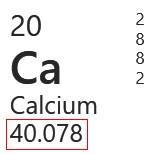
- For column D: Divide the concentration in mg/L by the atomic weight of each ion to convert the concentration from mg/L to molarity (mmol/L).
- For column E: Enter the valence charge for each ion.
- For column F: Multiply the molarity by the valence charge to calculate the concentration in milliequivalents per liter (meq/L)
| A | B | C | D | E | F |
| Solute | Measured Concentration (mg/L) | Atomic weight(g) | Molarity (mmol/L) | Valence (charge) | meq/L |
| [latex]{Ca}_{}^{2 +}[/latex] | 92 | 40.08 | 2.30 | 2 | 4.59 |
| [latex]{Mg}_{}^{2 +}[/latex] | 34 | 24.31 | 1.40 | 2 | 2.80 |
| [latex]{Na}_{}^{+}[/latex] | 8.2 | 23.00 | 0.36 | 1 | 0.36 |
| [latex]K_{}^{+}[/latex] | 1.4 | 39.10 | 0.036 | 1 | 0.036 |
| [latex]{Fe(III)}_{}^{}[/latex] | 0.1 | 55.80 | 0.02 | 3 | 0.005 |
| [latex]{HCO}_{3}^{-}[/latex] | 325 | 61.00 | 5.33 | 1 | 5.33 |
| [latex]{SO}_{4}^{2 -}[/latex] | 84 | 96.00 | 0.88 | 2 | 1.75 |
| [latex]{Cl}_{}^{-}[/latex] | 9.6 | 35.50 | 0.27 | 1 | 0.27 |
| [latex]{NO}_{3}^{-}[/latex] | 13 | 62.00 | 0.21 | 1 | 0.21 |