
3.2 Porosity
All geologic materials have some amount of pore space, or empty space, in them. The term porosity (φ) refers to the fraction of the total volume of a rock or sediment that is pore space. More rigorously, it is defined as the volume of the voids divided by the total volume as shown by Equation (10).
| [latex]\varphi = \frac{V_{voids}}{V_{total}}[/latex] | (10) |
|---|
where (parameter dimensions are dark green font with mass as M, length as L, time as T):
| [latex]V_{voids}[/latex] | [latex]=[/latex] | volume of the voids (L3) |
|---|---|---|
| [latex]V_{total}[/latex] | [latex]=[/latex] | total volume of the sample (L3) |
(The symbol n is sometimes used as a variable for porosity.)
Porosity is a dimensionless quantity and can be expressed as a percentage by multiplying the ratio by 100. We can also define a quantity called the void ratio (e), which is the volume of voids divided by the volume of solids, as expressed by Equation (11).
| [latex]e = \frac{V_{voids}}{V_{solids}}[/latex] | (11) |
|---|
where (parameter dimensions are dark green font with mass as M, length as L, time as T):
| [latex]V_{solids}[/latex] | [latex]=[/latex] | volume of the solids (L3) |
|---|
In nature, geologic materials are almost never completely dry, and the void space will always contain some volume of water. We can think about geologic materials as composed of multiple phases: a solid phase, a water phase, and a gas phase (Figure 10). In turn, the solid phase can be further divided into its individual mineral phases (Figure 11).
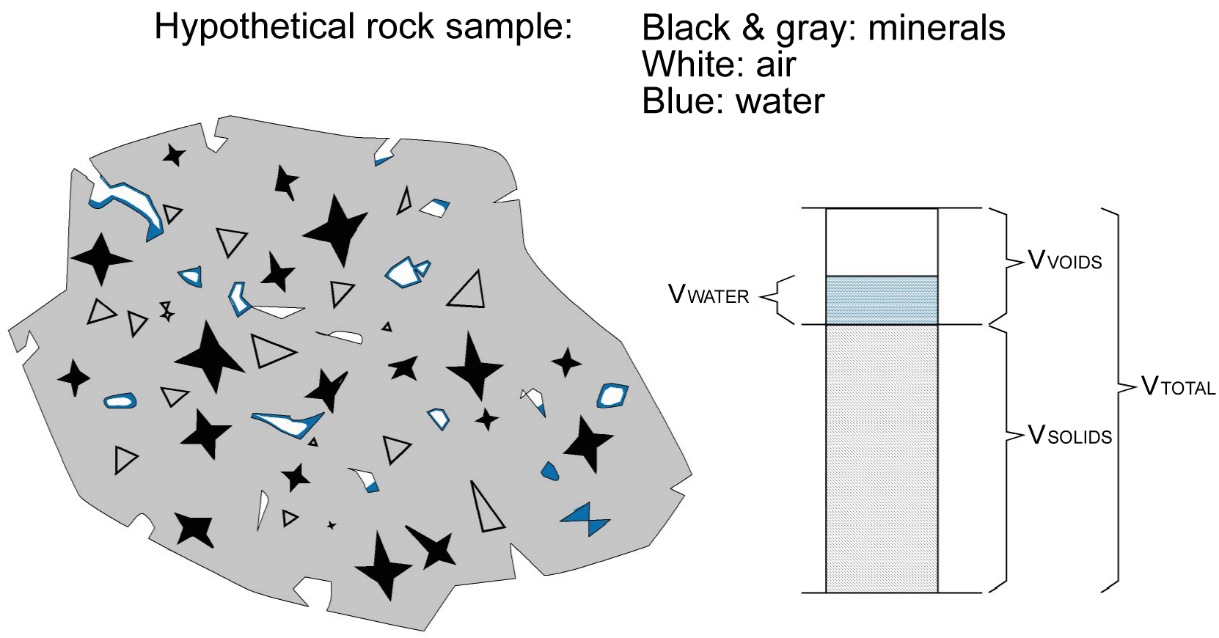
Figure 10 – Graphic depiction of solids (i.e., minerals) and partially and fully saturated pore space in a rock.
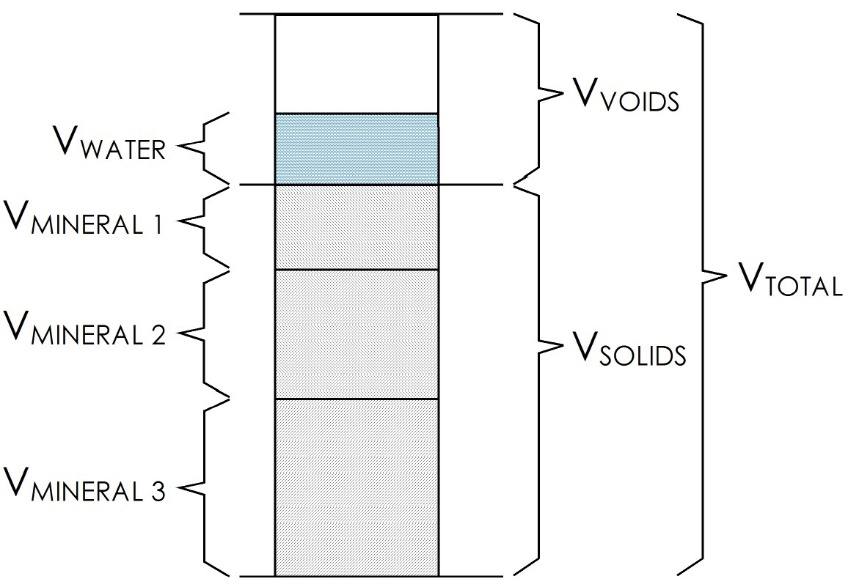
Figure 11 ‑ Phase content (by volume).
Each of the mineral phases in a rock or sediment sample has a volume and mass associated with it. Every fluid and every mineral has a density associated with it.
Density
Density is defined as the ratio of an object’s mass to its volume with dimensions of (ML-3). We can therefore express it mathematically as shown by Equation (12) .
| [latex]density = \frac{mass}{volume}[/latex] | (12) |
|---|
Often, we use the symbol [latex]\rho[/latex] (i.e., the Greek letter rho) for density. Table 2 lists densities of some common substances.
Table 2 ‑ Densities of some common substances at room temperature and pressure.
| g/cm3 | kg/m3 | |
| Air | 0.0012 | 1.2 |
| Water | 1.0 | 1,000 |
| Quartz | 2.65 | 2,650 |
| Aluminum | 2.70 | 2,700 |
| Iron | 7.86 | 7,860 |
| Gold | 19.3 | 19,300 |
Density is not a constant; it varies with temperature and pressure. Generally:
- higher temperature [latex]=[/latex] lower density;
- lower temperature[latex]\ =[/latex] higher density;
- higher pressure [latex]=[/latex] higher density; and
- lower pressure [latex]=[/latex] lower density.
Therefore, when density is reported, it is usually accompanied by a temperature and a pressure. If no temperature or pressure is given, it is usually implied that the density value is at standard temperature and pressure (STP), or 25 °C and 1 atmosphere (101,325 Pa). For naturally occurring water and other solutions, density also varies with salinity:
- higher salinity [latex]=[/latex] higher density; and
- lower salinity [latex]=[/latex] lower density.
The density of water behaves differently than most other substances. As liquid water cools, the density increases as expected. However, when water reaches about 4 °C, it attains its maximum density (1,000 kg/m3), then as it cools further, the density decreases. This is why frozen water (ice) floats on liquid water, whereas the solid form of most other substances is denser than the liquid form and thus the solid form sinks in its liquid form.
We can also express density as the unit weight of a substance, where unit weight is equal to the density of a substance times gravitational acceleration (9.8 m/s2). Unit weight is simply a way of expressing density in terms of weights that we measure on a scale. The unit weight of water is 9.807 kilonewtons per cubic meter (kN/m³) at 4° Celsius (39° Fahrenheit). Or in imperial measure, 62.43 pounds-force per cubic foot (lb/ft³).
Density can also be expressed in a non‑dimensional way (i.e., without units) by taking the ratio of the density of the substance to the density of water. This non‑dimensional ratio is called the specific gravity ([latex]\gamma[/latex]; i.e., the Greek letter gamma), and is expressed mathematically by Equation (13).
| [latex]\gamma = \frac{\rho_{substance}}{\rho_{water}}[/latex] | (13) |
|---|
Specific gravity allows us to record density values in a way that is independent of units. We can convert specific gravity values to density values in whatever units we want simply by multiplying by the density of water. Since the density of water is approximately 1 g /cm3 (1,000 kg/m3), specific gravity is basically equivalent to density in g/cm3. Table 3 lists the specific gravities of some common rock forming minerals.
Table 3 ‑ Specific gravities of some common rock‑forming minerals.
| Mineral name | Specific gravity |
| Quartz | 2.65 |
| Calcite | 2.71 |
| Dolomite | 2.85 |
| [latex]Na[/latex]‑feldspar | 2.62 |
| [latex]K[/latex]‑feldspar | 2.57 |
| Muscovite mica | ≈2.80 |
| Clay (kaolinite) | 2.60 |
The majority of the rock‑forming minerals that we are likely to encounter have a specific gravity of about 2.65 to 2.7. Since most rocks in the Earth’s crust are made of minerals with specific gravities of about 2.7, we can usually assume a specific gravity of ≈2.7 when estimating the density of rocks.
However, all rocks have some amount of void (i.e., empty) space in them, and a certain percentage of this void space contains air and/or water. When determining the density of a sample of rock or soil, we need to consider the percentage of void space in the rock, and the percentage of that void space that contains water, to determine the bulk density of the sample. The bulk density is defined as the overall density of a sample of rock—including the void spaces, any water in the void spaces, and any other substances that might be incorporated into the rock, such as organic material—as opposed to the density of the individual minerals that make up the rock.
For example, if we consider a 1 cm3 piece of solid quartz, we know that quartz has a specific gravity of 2.65 and a density of 2.65 g/cm3 (2,650 kg/m3); therefore, the piece of solid quartz has a mass of 2.65 grams (0.00265 kg). However, if we consider a 1 cm3 (1×10⁻⁶ m3) piece of quartz sandstone, the quartz sandstone contains some percentage volume of quartz grains, a percentage volume of empty space in between the quartz grains, and a percentage volume of water in the empty spaces. Since water has a specific gravity of 1.0 (at STP), and the mass of air is so small that it is negligible, the overall density (i.e., bulk density) of the sample of sandstone is less than 2.65 g/cm3 (2,650 kg/m3), and the mass of the 1 cm3 (1×10⁻⁶ m3) sample is less than 2.65 grams (0.00265 kg). Or, if our sandstone contains a large percentage of a heavier mineral, like magnetite ([latex]\gamma =[/latex] 5.2) or galena ([latex]\gamma =[/latex] 7.5), the sample may have a bulk density greater than 2.65 g/cm3 (0.00265 kg/m3). When calculating the mass of a sample, we need to first determine the bulk density of the sample, and then use that instead of the density of the minerals that make up the rock to calculate mass.
To calculate a bulk density of a sample of rock or sediment, we need to know the volume percentage of each phase—the water in the void space is a phase, each mineral is a phase, and so on—and the density of each phase in the sample. Bulk density is calculated by multiplying the volume percentage of each phase by the density of that phase, then summing up the products, expressed in mathematical terms by Equation (14). Exercise 4⮧ provides an opportunity to work with the relationships between density, porosity, and saturation.
[latex]\rho_{bulk} = \left( \rho_{MinA} \times \left\lbrack \frac{{\% volume}_{mineral - A}}{100} \right\rbrack \right)[/latex]
|
(14) |
|---|
As previously stated, there is usually some measurable quantity of water in the pore spaces of any rock or sediment sample. We have several ways of quantifying the moisture content of geologic materials.
Moisture Content
Moisture content can be expressed as gravimetric moisture content—that is, moisture content by weight—or volumetric moisture content (i.e., moisture content by volume). The gravimetric moisture content ([latex]\omega[/latex] ; i.e., the Greek letter omega) is the weight of water in the sample divided by the weight of the solids in the sample, as expressed in Equation (15).
| [latex]\omega = \frac{{weight}_{water}}{{weight}_{solids}}[/latex] | (15) |
|---|
Volumetric moisture content (θ) is the volume of water in the sample divided by the total volume of the sample, as expressed in Equation (16).
| [latex]\theta = \frac{{volume}_{water}}{{volume}_{total}}[/latex] | (16) |
|---|
Note that volumetric moisture content is always some value less than or equal to the porosity of the rock. We can also express the moisture content as the degree of saturation ([latex]S_{d}[/latex]), which is the percentage of the void volume that is filled with water, as shown in Equation (17).
| [latex]S_{d} = \frac{{volume}_{water}}{{volume}_{voids}}[/latex] | (17) |
|---|
All these quantities are expressed as fractions. We can also multiply the fraction by 100 to express the final value as a percentage.
If we combine the equations for porosity, moisture content, and degree of saturation, we see that they are all related such that the volumetric moisture content is equal to the porosity times the degree of saturation, as shown in Equation (18) and Equation (19):
| [latex]\theta = S_{d}\ \varphi[/latex] | (18) | ||||
|---|---|---|---|---|---|
| [latex]\frac{{volume}_{water}}{{volume}_{total}} = \left( \frac{{volume}_{water}}{{volume}_{voids}} \right)\left( \frac{V_{voids}}{V_{total}} \right)[/latex] | (19) |
Geologic Materials and Implications for Fluid Flow
Now that the basic concepts have been described, let’s discuss porosity in the context of geologic materials.
Primary Versus Secondary
We distinguish between two main types of porosity in geologic materials:
Primary Porosity is void space that forms in the rock during deposition and diagenesis:
- for example, empty space between sand grains in a sandstone, or within vesicles in a basalt; and
- generally primary porosity provides more storage but supports less flow than secondary porosity.
Secondary Porosity is void space that forms post‑diagenesis:
- for example, fractures or dissolution features; and
- generally secondary porosity provides less storage but more flow than primary porosity.
The idea of fluid storage versus fluid flow is discussed later in this book along with dual porosity flow that occurs in fractured rocks and karst.
Effective Porosity
We defined the porosity of a rock as the volume of voids over the total volume. However, in the field, not all the porosity is available for fluid flow. Some voids are too small, or the pore throats are too narrow, or the pore is a dead end, or is isolated from the rest of the pores. In addition, some amount of moisture adheres to the solid by surface tension and not move with the groundwater flow. The porosity available for fluid flow is called the effective porosity ([latex]\phi_{eff}[/latex]). Figure 12 illustrates the relationship between the total porosity and the effective porosity in a hypothetical rock.

Figure 12 ‑ Effective porosity—only the connected pores (light blue) can transmit water; the unconnected pores (dark blue) are not a part of the effective porosity.
Examples of materials with potentially high total, but low effective, porosity include:
- clay (lots of saturated void space, but pores are very small); and,
- vesicular basalts (many of the vesicles are not connected).
Thought Question 2: Is porosity a scalar, vector, or tensor quantity? How about effective porosity?
Specific Yield
If we saturate a rock and let it drain by gravity, some portion of the water in the pore spaces will be held in by surface tension and narrow pore throats and in pores that are not connected. The fraction that drains is the specific yield ([latex]S_{y}[/latex]) and the fraction that is retained is called the specific retention ([latex]S_{r}[/latex]). More rigorous definitions are shown in Equation (20) and Equation (21). Their sum equals the total porosity, i.e., [latex]S_{y} + S_{r}\mathbf{= \ }\phi[/latex].
| [latex]S_{y} = \frac{{volume}_{drained}}{{volume}_{total}}[/latex] | (20) | |
|---|---|---|
| [latex]S_{r} = \frac{{volume}_{retained}}{{volume}_{total}}[/latex] | (21) |
Thought Question 3: What is the relationship between [latex]S_{y}[/latex] and [latex]\phi_{eff}[/latex]?
Grain Size and Packing
For an ideal situation where grains are perfectly round with uniform size and packing, porosity does not vary with grain size. Grain packing affects porosity (Figure 13a and b), as does grain sorting (Figure 13c and d). Figure 13a and c have the same porosity because they have the same packing and the same sorting; the geometry of the pore space and relative volume of pore space is the same for these two figures.

Figure 13 ‑ Affect of packing and sorting on porosity: a) cubic packing; b) rhombic packing; c) well‑sorted sediments have higher porosity, but size does not impact porosity for the same packing so the porosity of (a) and (c) are the same; and d) poor sorting fills up the pore space between larger grains with smaller grains and lowers the total porosity.