
Solution Exercise 23
Calculate the Piper Fractions:
| Solutes | meq/L | Piper Fractions | |
| [latex]{Ca}_{}^{2 +}[/latex] | 4.59 | 4.59/7.78 = 0.59(100) = | 59% |
| [latex]{Mg}_{}^{2 +}[/latex] | 2.80 | 2.8/7.78 = 0.36(100) = | 36% |
| [latex]{Na}_{}^{+}[/latex] | 0.36 | (0.36+0.04)/7.78 = 0.05(100) = | 5% |
| [latex]K_{}^{+}[/latex] | 0.04 | ||
| Sum cations: | 7.78 meq/L | ||
| [latex]{HCO}_{3}^{-}[/latex] | 5.33 | 5.33/7.35 = 0.73(100) = | 73% |
| [latex]{SO}_{4}^{2 -}[/latex] | 1.75 | 1.75/7.35 = 0.24(100) = | 24% |
| [latex]{Cl}_{}^{-}[/latex] | 0.27 | 0.27/7.35 = 0.04(100) = | 4% |
| Sum anions: | 7.35 meq/L | ||
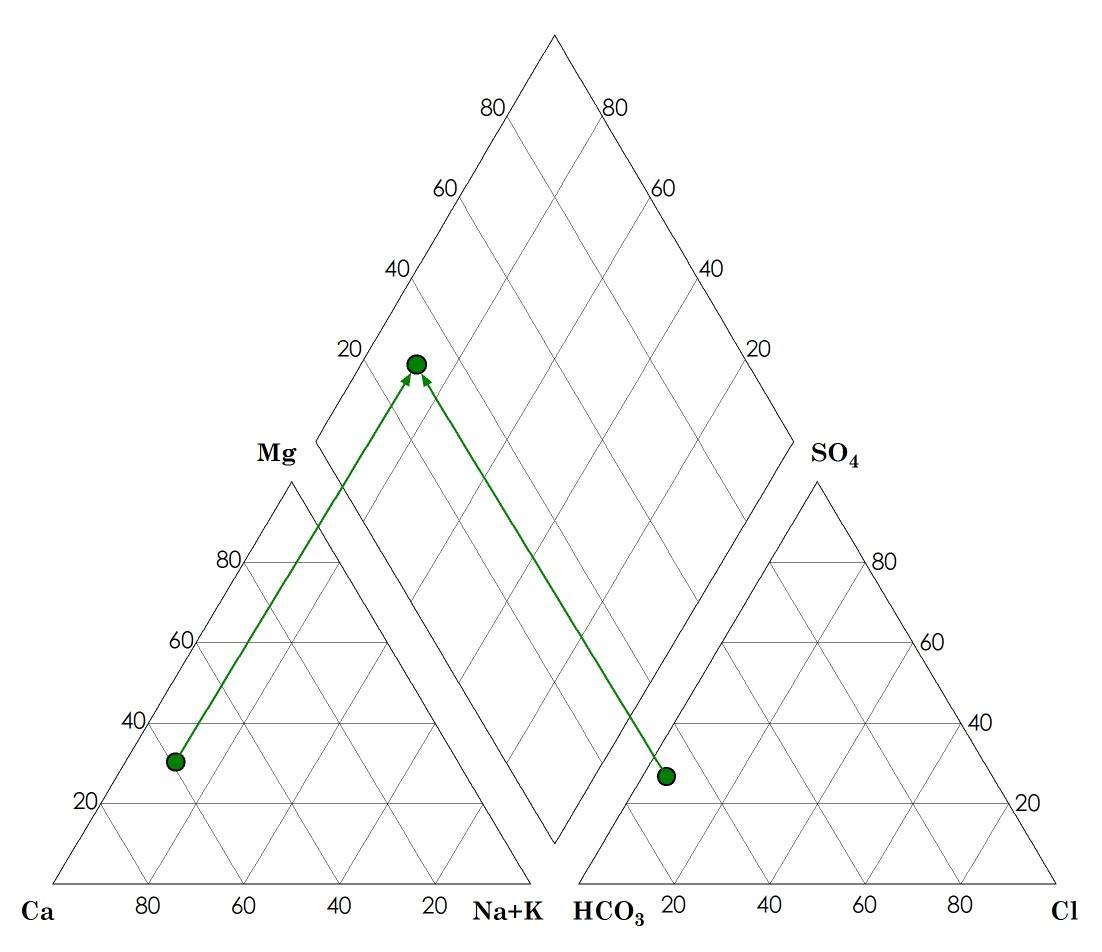
The water is a Calcium-Magnesium-Bicarbonate type as indicated in Figure 82. However, it is more appropriate to call it a Calcium-Bicarbonate water as Ca2+ makes up more than 50% of all the cations.