
5.2 Aquifers
Before we discuss storage parameters, let’s review what an aquifer is and discuss aquifer conditions and the occurrence of groundwater in nature.
An aquifer is a geologic unit that can store and transmit enough water to supply a well. The factors that determine if a geologic unit is an aquifer include:
- the formation must be capable of storing sufficient volumes of water;
- the rock or sediments in the aquifer must have a sufficiently high permeability that flow to a well or spring can be maintained; and
- the aquifer must have sufficient areal extent and saturated thickness to supply water to the well.
If the aquifer unit is close to the Earth’s surface, and the sediments that comprise it are relatively permeable, the primary source of recharge to the aquifer will probably be infiltration of groundwater from precipitation that falls directly on the ground. In this case, a water table will form, and the aquifer is called a water‑table aquifer or an unconfined aquifer (Figure 21). In a water‑table aquifer the water table is defined as the point where the pore‑water pressure and the atmospheric pressure are equal. Under those conditions, water in a well will rise to the point where the water table was encountered during drilling.
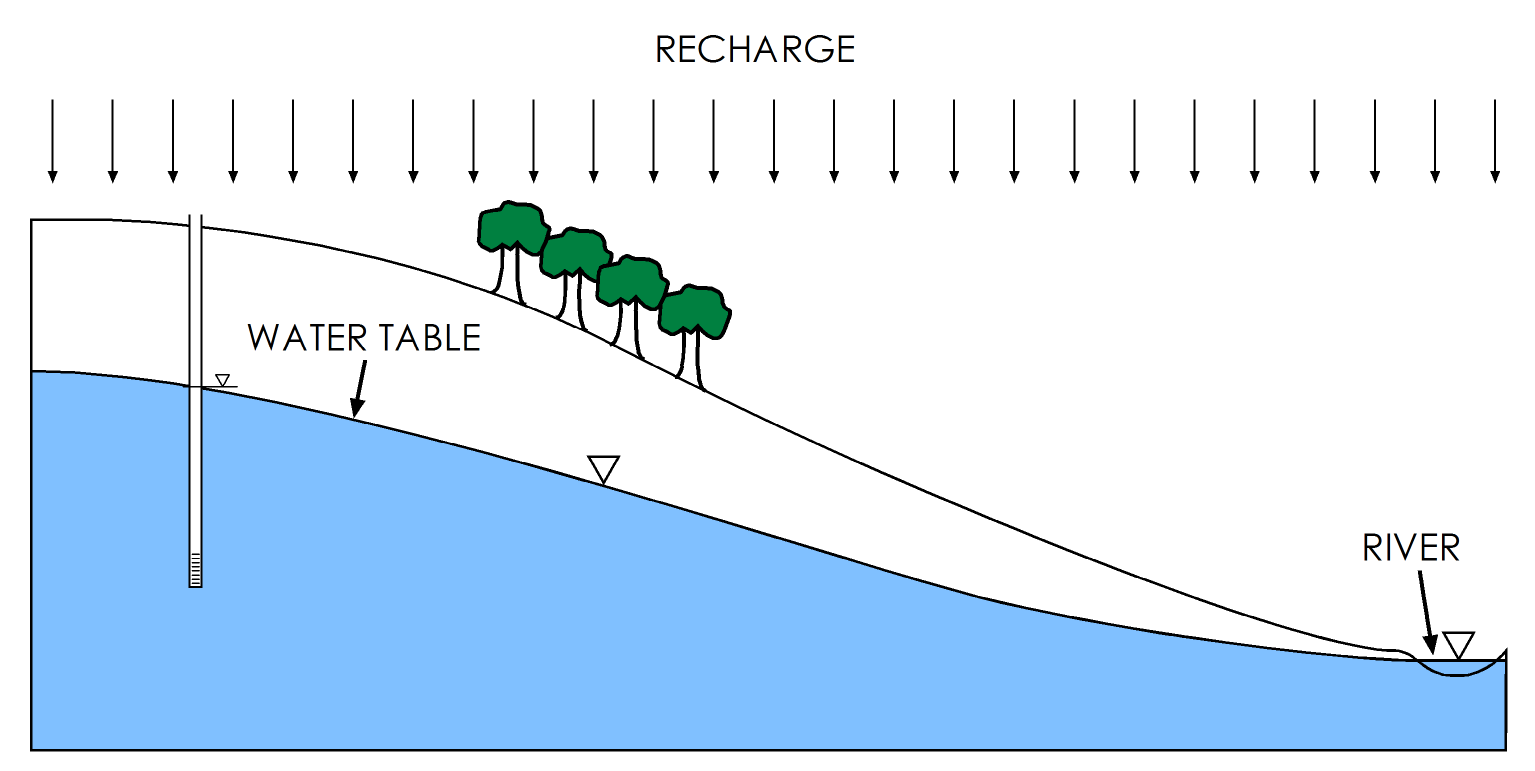
Figure 21 ‑ Unconfined aquifer.
If the regional geology consists of alternating layers of low‑ and high‑permeability units (e.g., interbedded sand and clay), then the permeable layers that are overlain by the low‑permeability units can form confined aquifers (Figure 22). Confined aquifers contain an additional component of pressure head that causes the water in a well to rise above the top of the aquifer unit. The low‑permeability units are called confining layers.
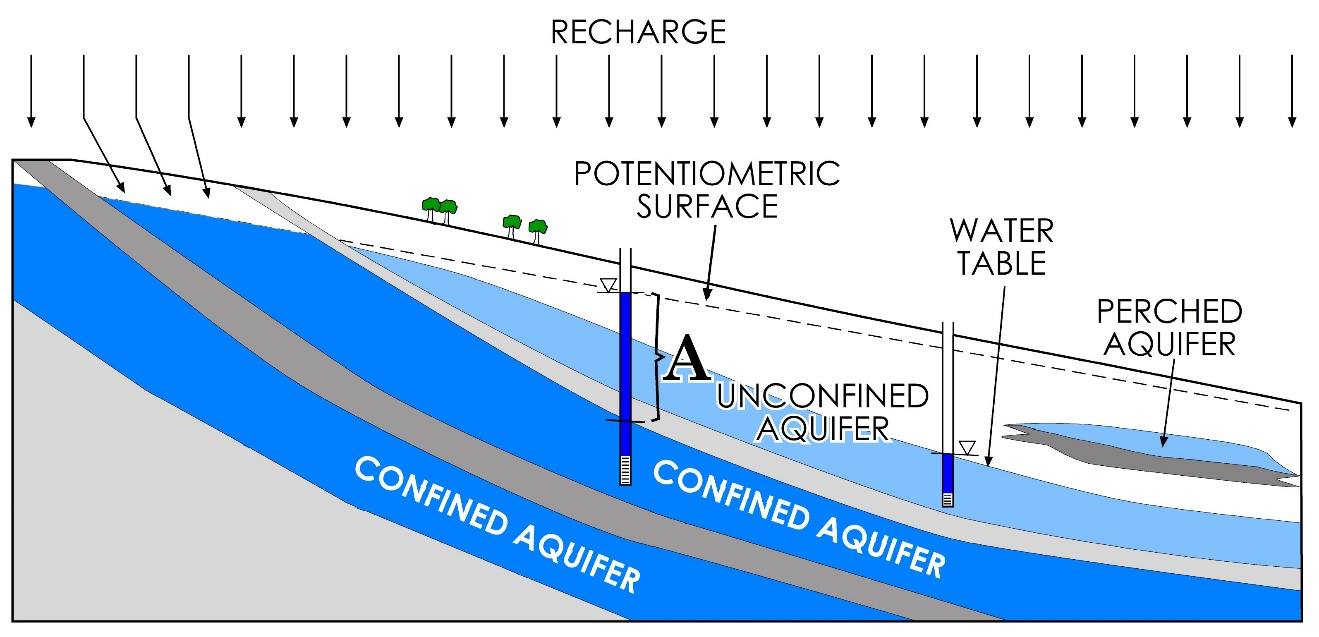
Figure 22 ‑ Interbedded sand and clay units creating both confined and unconfined aquifers. The bent lines on the left indicate recharge to the outcrop of the confined aquifer.
This additional component of pressure head (A in Figure 22) occurs because water enters at a higher elevation in the recharge area and, even though groundwater loses energy as it flows to the point in the aquifer where the well is completed, the remaining energy in the water is greater than that of the water in the overlying unconfined aquifer.
This is the same as what we see in the Darcy tube—the reservoir to the left represents the recharge area, and the change in head from one manometer to the other represents the potentiometric (or piezometric) surface (Figure 23).
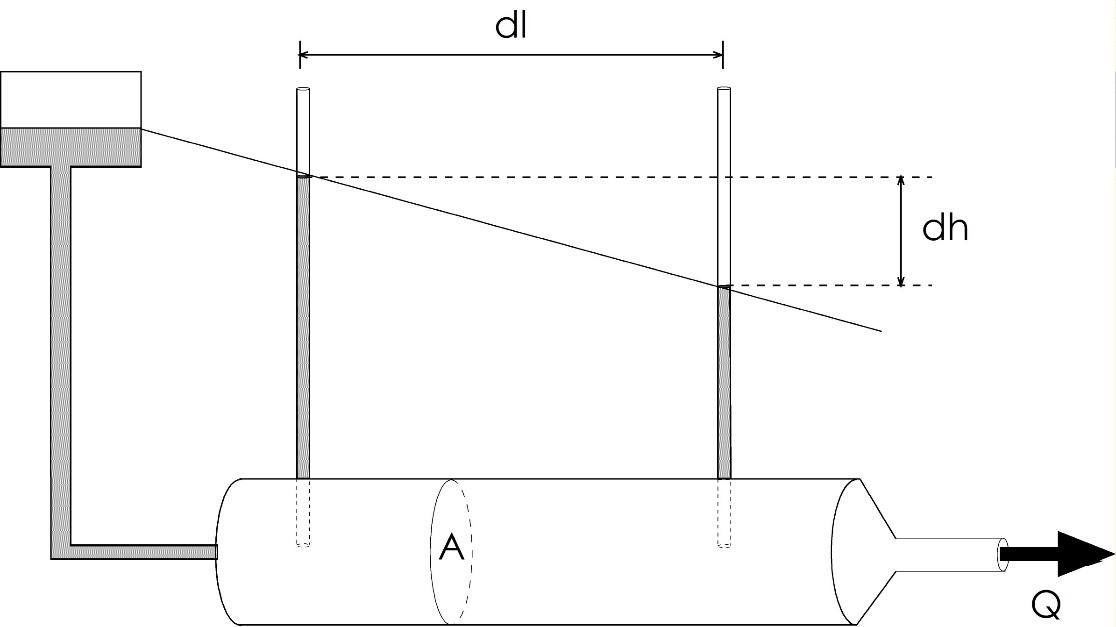
Figure 23 ‑ Darcy tube experiment.
In addition to unconfined and confined aquifers, there are also perched aquifers, which are saturated zones above isolated low‑permeability units (like clay lenses) as illustrated on the right end of Figure 22. These are unconfined aquifers that are not laterally continuous.
The important concept established here is that there are two types of groundwater conditions. Unconfined conditions exist where the groundwater is not restricted by a confining layer and the pore fluid pressures at the top of saturation are equal to atmospheric pressure. Confined conditions exist where there is a confining layer and the water under the confining layer has an additional component of pressure that causes it to rise in a well to a point above the top of the confined aquifer. This point represents a point on the potentiometric (or piezometric) surface of the confined aquifer.
The reason we bring this up now is because the storage parameters that characterize an aquifer depend on the aquifer condition. Now we move on to a discussion of storage parameters, focusing first on storage of water in a confined aquifer.