
16.4 Formation of Fractures
There are generally three modes of fracture loading, which involve different fracture surface displacements (Figure 132). The three modes are listed here.
- Mode 1: opening or tensile mode—the fracture faces are pulled apart (Figure 132a).
- Mode 2: sliding or in‑plane shear—the fracture surfaces slide over each other (Figure 132b).
- Mode 3: tearing or anti‑plane shear—the fracture surfaces move parallel to the leading edge of the fracture and relative to each other (Figure 132c).
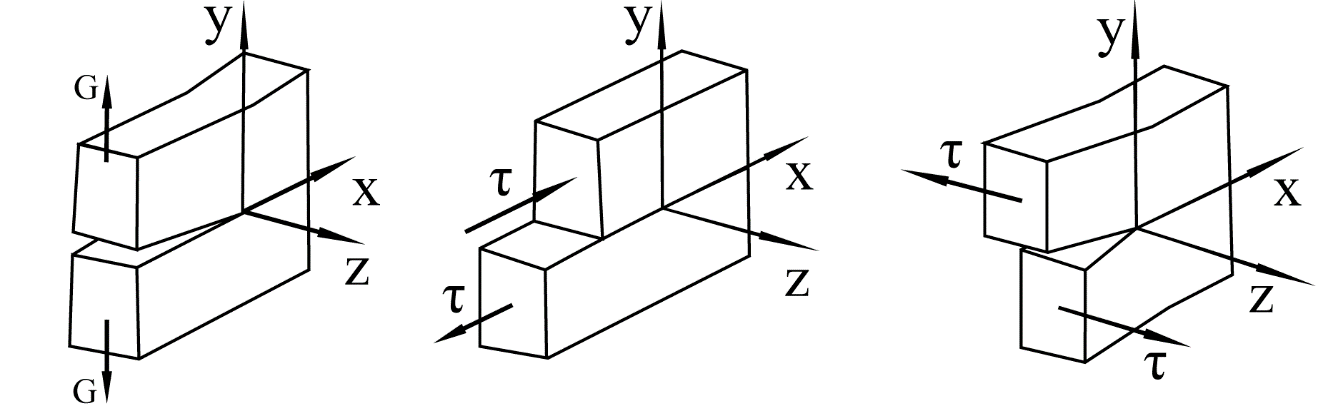
Figure 132 ‑ Fracture modes based on the stress and the relative displacement (reproduced courtesy of John M. Sharp, University of Texas, Austin).
Different fracture modes will result in different fracture properties. Modes 2 and 3 have shear stresses that will affect the walls of the fracture. As a result, asperities will be sheared off and minerals may form on the surface, creating surface features called slickensides.
As a fracture forms and propagates through a rock, the stresses that are breaking the rock are distributed throughout the rock so that high compressive stresses occur just ahead of the tip of the fracture. Because of this, when two fractures propagate towards each other, the stresses of each will deflect the direction of propagation for the other fracture (Figure 133).
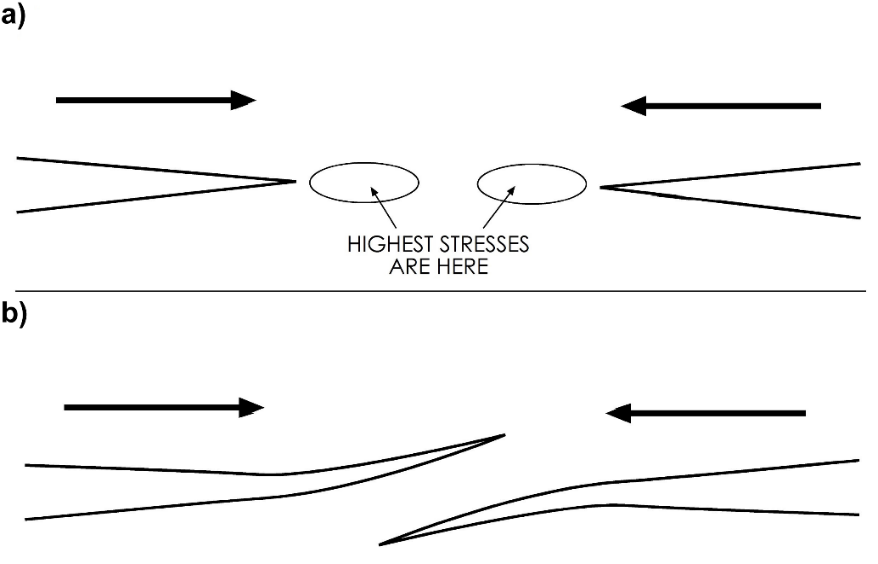
Figure 133 ‑ a) As fractures propagate, high stresses occur just ahead of the fracture tip. b) When the fracture tips get close, the high stress region deflects the direction of propagation.
Stresses that create fractures include the following.
- Tectonic movements.
- Unloading and exfoliation—when a rock is buried, it is under compressive stress; when the overburden is released, the release of stress causes the rock to fracture.
- Cooling—cooling lava will often contract, creating joint sets that are usually vertical and often result in sets of polygonal columns called columnar joints.
- Gravity and freeze‑thaw—can cause existing fractures to propagate further.