
Solution Exercise 19
I visited https://interactive-education.gw-project.org/wtr/wtr.html↗ and input the following data sets.
Data Set 1 Date Set 2
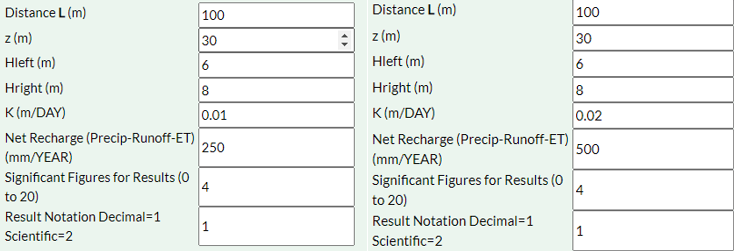
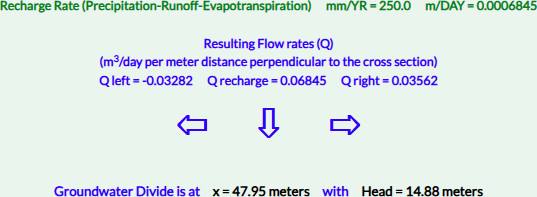
The output from Data Set 1 and Data Set 2 have identical graphs of head, while the flows are twice as large for Data Set 2.
Data Set 1
Data Set 2
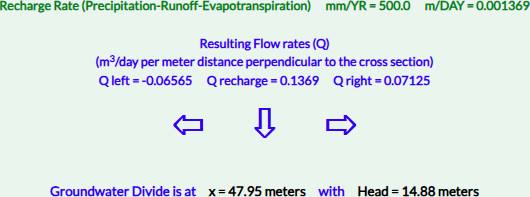
- The only difference in the two outputs are the flow rates.
- The water levels are identical.
- The flows are a factor of 2 higher for Data Set 2.
- If a hydrogeologist had only head measurements for the system and adjusted parameter inputs until the calculated heads matched the measured heads, there would be no way of knowing if the K and recharge rate were correct because if both are adjusted by the same factor the head distribution stays the same, so only the ratio of recharge to K can be determined, not the absolute values. This is known as model non-uniqueness.
- If a measurement of flow were obtained and considered along with the head measurements, then the magnitude of recharge could be determined and knowing the ratio of K to recharge the K could also be independently estimated. Such a measurement could be obtained by making a measurement of seepage to the water body on either side of the system. This is sometimes done by measuring stream discharge at two locations and taking the difference to determine how much groundwater flowed into the stream over that reach.
- I would not trust predictions of a model that matches the water levels, but does not consider the flow balance because the values of K and recharge would not be reliable so any predictions made with the model would not be reliable. For example, if the values of Data Set1 were representative of the field system but the values of Data Set 2 were used to make predictions, hydrogeologists would predict that the system could support twice the well pumping rate than could be sustained in the field. Also, all else being equal, they would predict faster migration of contaminants thus lower concentrations.