
12.3 Reactions and Retardation
Some constituents in groundwater are relatively stable and do not undergo significant reactions in the subsurface. These are called conservative constituents. An example is the chloride ion—chloride doesn’t stick to anything, it doesn’t undergo biological reactions involving micro‑organisms in the subsurface, and it is generally one of the last ions to precipitate out of groundwater into a mineral phase. Not all solutes and contaminants are like that; in fact, most solutes and contaminants are reactive in the subsurface. This complicates our understanding of mass transport because, in addition to dilution of the contaminant from dispersion, the mass of the solute or contaminant in the system changes with time.
Reactions in the groundwater usually involve degradation or decay of the contaminant. For radioactive contaminants, decay of the contaminant will occur based on the half-life of the radioactive constituent. For non-radioactive contaminants, decay and degradation is typically related to some sort of biologically controlled process, or biodegradation, that involves microorganisms in the groundwater breaking down contaminants as part of their metabolism. Biologically controlled degradation is much more difficult to understand and quantify, as there are often multiple types of organisms that are “consuming” the contaminant and they are all connected within complex subterranean ecosystems. In addition, biological degradation involves changing the contaminant to a different molecule or type of molecule, which reduces the mass of the contaminant in the system. This can be problematic when the daughter products, or the molecules that result from degradation, are also considered contaminants; for example, the degradation of chlorinated solvents can result in the production of additional chlorinated compounds that are just as toxic or dangerous as the original compound.
More information on microbial ecosystems in groundwater and on biodegradation can be found in Groundwater Microbiology↗ by Ferris and others (2021), Biotic Transformations of Organic Contaminants↗ by Rittmann (2023), and Processes Controlling the Natural Attenuation of Fuel Hydrocarbons and MTBE in the UK Chalk Aquifer↗ by Thornton and others (2006); each of these books is available as a free download from The Groundwater Project. More information on chlorinated solvents in groundwater can be found in the classic text Dense Chlorinated Solvents and other DNAPLs in Groundwater↗ by Pankow and Cherry (1996), which is also available as a free download from The Groundwater Project.
Some of the reactions do not involve degradation of the contaminant; rather they slow down the overall movement of the contaminant through the groundwater. This process is called retardation. Most retardation reactions involve sorption, which is a general term that describes how one entity sticks to another. Sorption is usually reversible, so there is no loss in mass, just a delay in travel time (hence the term retardation). Sorption works in two ways.
- Absorption: A contaminant particle is absorbed into the volume of something else (Figure 96). For example, most organic compounds have high solubility in other organic compounds but have low solubility in water; organic contaminants in groundwater can basically dissolve into organic matter in soil or subsurface sediments.
- Adsorption: A contaminant particle sticks onto the surface of something else (Figure 96). This is basically the same as absorption, but it is a surface phenomenon. This happens with ions and clays; clays have charges on their surfaces, and this electrostatic attraction can grab ions out of solution.
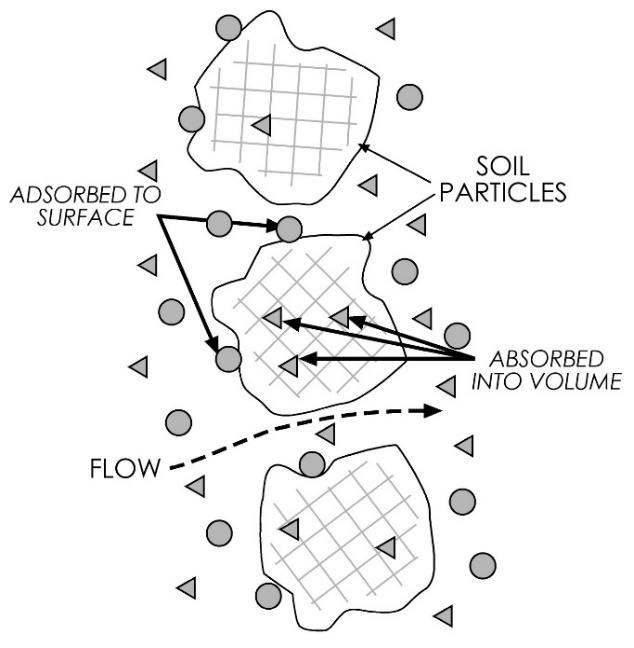
Figure 96 ‑ Adsorption and absorption of different types of contaminant particles in soil.
Clays have very large surface area per volume and tend to have significant electrostatic charge on the surface. In clays, the negatively charged sites are more abundant than positive, as the positive charges tend to occur on the edges of the minerals while negative charges cover the surface. Divalent cations—cations with a +2 charge, like calcium and magnesium—are more strongly attracted to clays than monovalent cations—cations with a +1 charge, like sodium. In some groundwater systems, divalent cations in solution will be pulled out by the clays and replaced with sodium ions. This process is called cation exchange.
More information on the movement of particles and sorption processes for colloids (i.e., nano‑ and micro‑particles) can be found in Colloid (Nano‑ and Micro-Particle) Transport and Surface Interaction in Groundwater↗ by Johnson and Pazmiño (2023), which is available as a free download from The Groundwater Project.