
1.3 The Hydrologic Cycle
To understand the hydrologic cycle, we must first understand systems and the components of a cycle.
Systems
Systems are a way of conceptualizing natural phenomenon based on the way that mass and energy move within and across the system boundaries. We can distinguish between three types of systems (Figure 2).
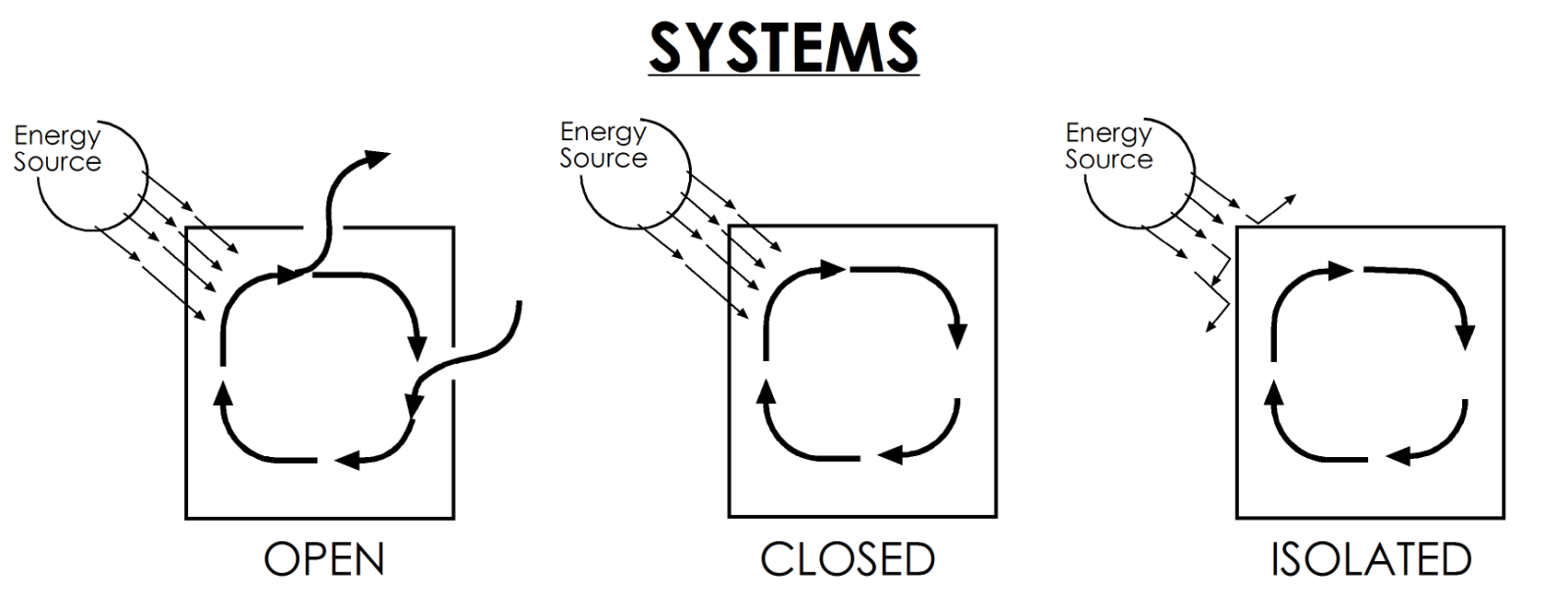
Figure 2 – Types of systems.
In an open system, mass and energy can move across the boundaries of the system. An example of an open systems is a lake, as mass (i.e., water) can flow into and out of the lake and energy can enter and leave the lake through sunlight and radiation of heat, respectively. In a closed system, mass stays constant and energy can move across the boundaries. We can consider the Earth as a closed system that receives energy from the sun and loses energy to space through radiation, but the overall mass of all elements on the earth is essentially constant (as long as we ignore the tiny addition of mass from meteorites and the loss of small amounts of atmosphere to space). In an isolated system, neither energy nor matter can move across the boundaries. The only truly isolated system is the entire universe, although the concept is useful for dealing with chemical reactions in sealed and thermally insulated flasks.
When we study and model natural systems, we can deal with them in two ways—as lumped systems or as distributed systems. Lumped systems deal only with inputs and outputs as a function of time. These systems ignore the details of what is going on within each reservoir or part of the system. When we deal with lumped systems, we are basically using some version of the hydrologic equation—also called the continuity equation or the conservation of mass equation—as shown in Equation (1).
| [latex]I(t)\ - \ O(t) = \frac{\mathrm{\Delta}Storage}{\mathrm{\Delta}t}[/latex] | (1) |
|---|
where:
| I(t) | = | input to a system over time |
|---|---|---|
| O(t) | = | output from a system over time |
| ∆Storage/∆t | = | change in storage during time [latex]\mathrm{\Delta}t[/latex] |
Distributed systems deal with the particulars of how various parameters—such as temperature, pressure, and salinity—vary throughout the system with respect to space as well as time. We look at distributed models in more detail in Section 10 when we discuss modeling in general and groundwater flow models in particular.
Cycles
A cycle is defined as a dynamic system that contains the following four components:
- a substance, element, or set of elements (not necessarily a chemical element) that are in flux, such as water;
- a set of reservoirs in which the element resides, such as the oceans and the ice caps;
- a set of fluxes, or processes that are moving the elements within reservoirs and from one reservoir to another, such as evaporation moves water from the ocean to the atmosphere and condensation creates precipitation that falls back to the ocean; and
- some source of energy that is driving the cycle.
Overview of the Hydrologic Cycle
Water occurs throughout the Earth from the outer reaches of the atmosphere to deep within the mantle—possibly as deep as the core. Early in the history of the Earth’s formation, around the time that the Earth’s crust began to form, volcanic activity released lots of volatile gasses, including water, from the underlying mantle. In addition, comets and asteroids likely delivered a lot of water to the Earth’s surface during that time. These volatile gasses made up the early atmosphere and oceans. It is thought that almost all the water that we find in the oceans, lakes, streams, atmosphere, and subsurface today was outgassed at this time, and essentially the same volume of water has been moving through the hydrologic cycle ever since.
The hydrologic cycle is defined as the set of reservoirs and fluxes that hold and move water through the atmosphere, on the surface, and in the subsurface of the Earth (Figure 3). Except for minor amounts of extraterrestrial water brought in by comets, and small amounts of water vapor that are lost to outer space at the upper reaches of the atmosphere, there is a constant volume of water in the entire water cycle. Within the cycle, various reservoirs hold water and various processes that move water within reservoirs and from one reservoir to the next.
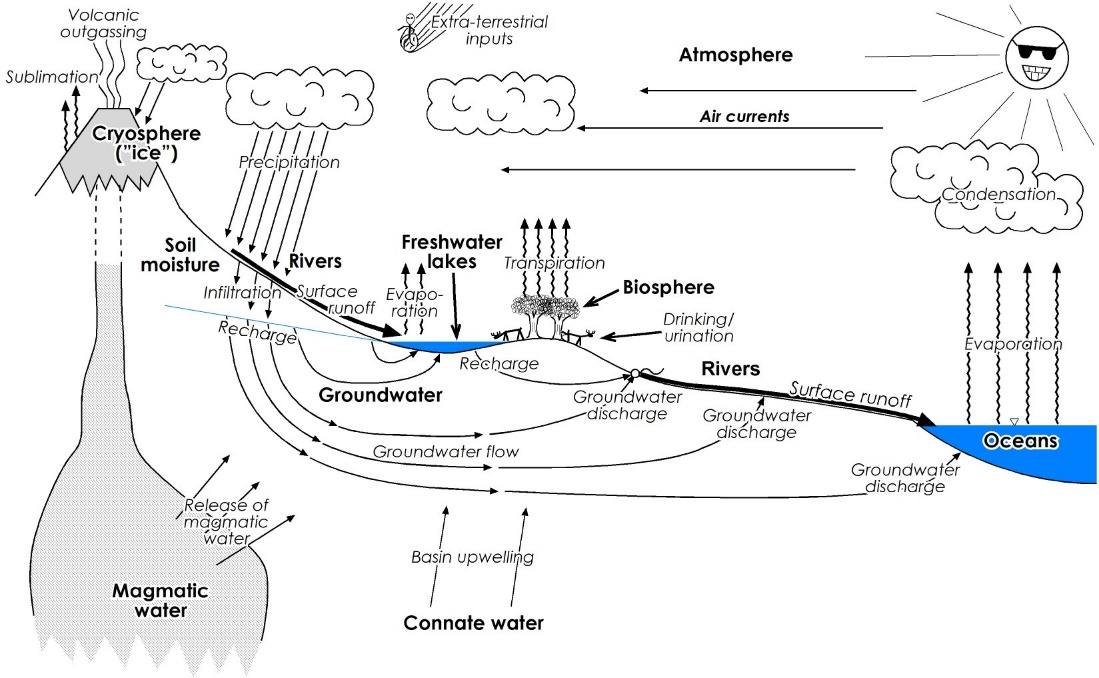
Figure 3 ‑ A generalized and simplified diagram of the hydrologic cycle. Arrows show movement of water within and between reservoirs with straight lines representing movement of liquid and wavy lines represent movement of vapor .
Figure 3 shows the main reservoirs and fluxes, as well as the energy sources that drive the cycle. Reservoirs in the water cycle include the oceans, atmosphere, rivers, freshwater lakes, the unsaturated soil moisture, the saturated groundwater, connate water in deep sedimentary rocks, magmatic water from the mantle, water in the ice caps and glaciers (the cryosphere), and water in plants and animals (the biosphere). Fluxes of water are the result of processes that move water from one reservoir to the next—such as evaporation and infiltration—or within a reservoir—such as mechanical flow that moves groundwater and creates ocean currents.
Thought Question 1: What is the primary source of energy driving the hydrologic cycle? What is a secondary source of energy?
In terms of the systems discussed in Figure 2, we treat the hydrologic cycle like a closed system: The cycle has a set amount of water that does not change, however, energy enters the system in the form of sunlight. The amount of water gained from—or lost to—outer space is so small that we can consider it negligible. Within the hydrologic cycle, we can identify and delineate several open systems. The oceans are an example: water enters the oceans from rain, surface runoff, and groundwater discharge, and water leaves the oceans through evaporation, through mineral reactions, and at subduction zones; energy enters the ocean from solar radiation and leaves the ocean via evaporation and conduction. A lake is another example of an open system.
The science of hydrogeology deals with a specific part of the hydrologic cycle—the part that is underground. The primary focus of this book is on the saturated groundwater flow systems near the surface of the Earth, that is, within the first one or two kilometers below the surface. The water in the unsaturated zone (the moisture in the soil) and the flowing water on the surface of the Earth (the rivers and lakes) are also dealt with in separate sections. Magmatic water in the mantle and lower lithosphere, connate water (water that was trapped in sediments when they were first deposited), and petroleum‑related fluids are not addressed in this book.
A more detailed overview of how groundwater fits into the overall hydrologic cycle is provided in Groundwater in Our Water Cycle: Getting to Know Earth’s Most Important Fresh Water Source↗ by Poeter and others (2020) and can be downloaded for free or read online. In addition, the US Geological Survey (USGS) has a detailed water cycle diagram↗ that presents the same basic reservoirs and fluxes as Figure 3 but also includes the extensive anthropogenic aspects of the water cycle, such as groundwater pumping, surface water diversions, urban runoff, and agricultural return flows.