
11.2 First, a Little Background Chemistry
This will be review for most people, but it is provided to ensure everyone understands the terminology and concepts.
Basic Chemistry Concepts and Definitions
Atoms and elements are the basic building blocks of nature. They are described in the periodic table. An interactive periodic table is available at https://ptable.com/#Properties↗. Each element has a symbol associated with it—for example, carbon is [latex]C[/latex], potassium is [latex]K[/latex], neodymium is [latex]Nd[/latex]. Atoms are made of the following smaller particles (Figure 80):
- Protons are positively charged particles that reside in the nucleus of the atom. The number of protons in an atom is called the atomic number. The atomic number is the large number written above the element symbol on a periodic chart, and it determines the element—for example, carbon has 6 protons, argon has 18, uranium has 92. Protons have mass and make up part of the mass of the atom. Each proton has a mass equal to 1 amu (atomic mass unit).
- Electrons are negatively charged particles that orbit the nucleus of the atom. The number of electrons in a stable atom equals the number of protons—so there is no net charge. Electrons have a mass that is so small it is negligible, so we will consider their mass is zero.
- Neutrons are particles with mass, but no charge, which reside in the nucleus with the protons. The number of neutrons usually equals the number of protons; however, the number can vary—usually a few more than the protons. The number of neutrons does not affect the properties of the element, but it does affect the mass of the element.
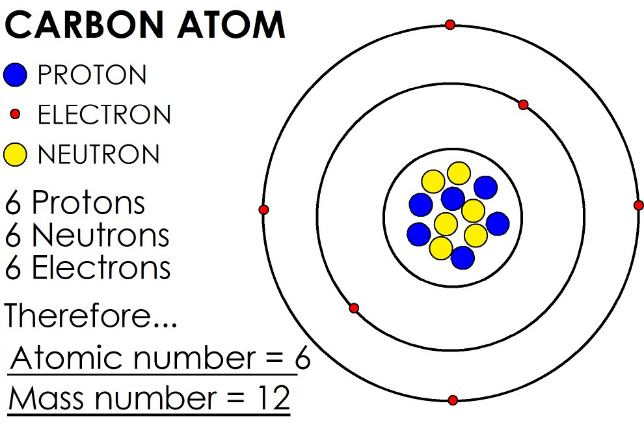
Figure 80 ‑ General structure of a carbon atom.
Elements with the same number of protons, but different numbers of neutrons, are called isotopes of the element.
- For example, a stable carbon atom has 6 protons and 6 electrons. Carbon atoms in nature usually have 6 neutrons (6 neutrons [latex]+[/latex] 6 protons[latex]\ =[/latex] carbon 12, or [latex]_{}^{12}C[/latex]). Some carbon atoms have 7 neutrons ([latex]_{}^{13}C[/latex]) or 8 neutrons ([latex]_{}^{14}C[/latex]). These are all isotopes of carbon.
- Each of these isotopes is still carbon; they are all the same size and react with other elements in the same way. The main difference is that [latex]_{}^{13}C[/latex] and [latex]_{}^{14}C[/latex] are heavier, and [latex]_{}^{14}C[/latex] is radioactive—that is, it is unstable and decays into [latex]_{}^{14}N[/latex].
The mass of the protons and neutrons add up to make the atomic mass of the element—the smaller number written below the element symbol on the periodic table.
Molecules contain two or more atoms bonded together into a single particle. Molecules can be made up of a single type of element—for example, nitrogen in the atmosphere is [latex]N_{2}[/latex]—or it could be several elements—for example, my favorite molecule, [latex]C_{8}H_{10}N_{4}O_{2}[/latex].
Ions are elements that have gained or lost one or more electrons after they dissolve into water, and so have a positive or negative charge. For example, when table salt ([latex]NaCl[/latex]) dissolves in water, it dissociates into sodium ions ([latex]{Na}^{+}[/latex]) and chloride ions ([latex]{Cl}^{-}[/latex]). Molecules that dissociate into ions in solution are called electrolytes.
- Positively charged ions are called cations. Examples include:
- calcium ‑ [latex]{Ca}^{2 +}[/latex]
- sodium ‑ [latex]{Na}^{+}[/latex]
- Negatively charged ions are called anions. Examples include:
- chloride – [latex]{Cl}^{-}[/latex]
- bicarbonate – [latex]{HCO}_{3}^{-}[/latex]
- sulfate – [latex]{SO}_{4}^{2 -}[/latex]
Some ions, like bicarbonate and sulfate, consist of two or more elements.
Some compounds do not dissociate into ions in water; rather they stay in molecular, or nonionic, form. Most organic molecules are nonionic, although some will dissociate into organic cations and anions.
The basic types of chemical bonds—the forces that hold atoms together in a molecule—are as follows:
- ionic bonds: positive ions stick to negative ions—for example, table salt;
- covalent bonds: two elements share an electron—for example, many organic molecules;
- metallic bonds: are arranged in crystals within a “soup” of electrons that are freely shared by all nuclei; and
- Van der Waals bonds: are held by a weak intermolecular force that temporarily bonds molecules together.
Atomic Mass and the Mole
As previously stated, the atomic mass is related to the number of protons and neutrons in an element. The mass changes when different isotopes are present, but the average mass of all the isotopes is given on the periodic chart and is sufficiently accurate for use in our calculations.
In any sort of chemistry, we are interested in knowing the number of atoms, ions, or molecules that are being exchanged when reactions occur. For example, consider the reaction of calcite dissolution and precipitation:
[latex]CaCO_{3} + {CO}_{2} + H_{2}O \leftrightarrows {Ca}^{2 +} + {2HCO}_{3}^{-}[/latex]
Each molecule of calcite reacts with one carbon dioxide molecule and one water molecule to produce one calcium ion and two bicarbonate ions. So, if we know how many calcite molecules we have, we can figure out how much water and carbon dioxide we need to dissolve all of it, and how much calcium and bicarbonate will be produced.
However, we can’t directly measure the number of atoms or ions in a solution. What we can easily measure is the mass of the elements in the solution. This is a problem because each element has a unique atomic mass, so a given mass of one element will not have the same number of atoms as a similar mass of another element. Fortunately, we can easily relate the mass of an element to the number of atoms using the unit called the mole.
A mole is the number of atoms (defined by Avogadro’s Number, [latex]6.02x10^{23}[/latex]) in a mass of element equal to its atomic mass in grams. For example:
- Oxygen has an atomic mass of 16—actually, it’s 15.9994, but 16 is close enough for our purposes here. Therefore, 16 grams of oxygen contains [latex]6.02x10^{23}[/latex] oxygen atoms, and 1 mole of oxygen weighs 16 grams.
We can also express compounds as moles by determining the formula weight of the molecule. This is done by summing up the masses of the individual atoms in the molecule. For example, the formula mass of caffeine ([latex]C_{8}H_{10}N_{4}O_{2})[/latex] is the sum of:
- atomic mass of C is 12 amu in each of 8 atoms = 96 amu;
- atomic mass of H is 1 amu in each of 10 atoms = 10 amu;
- atomic mass of N is 14 amu in each of 4 atoms = 56 amu;
- atomic mass of O is 16 amu in each of 2 atoms = 32 amu;
- total atomic mass = 194 amu;
- therefore, one mole of [latex]C_{8}H_{10}N_{4}O_{2}[/latex] has a mass of 194 grams.
In any given chemical reaction, a certain number of atoms of one element will react with a certain number of atoms of another element. We can use the atomic mass to convert the masses of our elements to moles, then calculate how many moles of each element react with the other elements, then convert back to mass.
Concentrations of Solutions
An element that dissolves into water—or some other liquid—is called a solute. Frequently, the individual elements or molecules that are dissolved will be called dissolved species or dissolved constituents. The liquid it dissolves into is called a solvent. We can measure and express the concentration of the solute in the solvent in terms of the mass of the solute or the number of moles of the solute.
- Mass solute per unit volume of solution is most often expressed as milligrams per liter (mg/L) or micrograms per liter (μg/L).
- Mass of solute per unit mass of solution used to be expressed as parts per million (ppm) or parts per billion (ppb); now they are usually reported as mg/kg or μg/kg.
- Molarity, or molar concentration (M) refers to the number of moles of a species per liter of solution. Molality, or molal concentration, (m) refers to the number of moles of a species per kilogram of solution. These two values are generally the same for aqueous solutions since a liter of fresh water has a mass of about 1 kilogram. However, the mass of a liter of solution increases as the concentration increases, so for a saline solution like seawater, molarity and molality are not the same.
One can use the formula weight of an element to convert between mass concentrations and mole concentrations. To do so, express the concentration as grams per volume, then divide by the formula weight to get moles per volume.
The reason we use mole concentrations is because chemical reactions involve numbers of atoms rather than masses of atoms. However, in dealing with ionic reactions—like the precipitation or dissolution of salts—the number of ions that will react with each other depends on the charge of the ions. An ion with a +2 charge—for example, the calcium ion, or [latex]{Ca}^{2 +}[/latex]—will react with two ions with a –1 charge—for example, the chloride ion, or [latex]{Cl}^{-}[/latex]. Therefore, it is sometimes useful to express concentrations in terms of equivalent charge concentrations. The equivalent charge concentration—in equivalents (eq) per liter—is equal to the molarity times the charge of the ion. The following provide a couple of examples.
- Sodium ([latex]{Na}^{+}[/latex]) has a charge of plus one, ∴1 M sodium solution [latex]=[/latex] 1 eq/L
- Calcium ([latex]{Ca}^{2 +}[/latex]) has a charge of plus two, ∴1 M calcium solution [latex]=[/latex] 2 eq/L
Equivalent concentrations are usually expressed in milliequivalents per liter (meq/L) or per kilogram (meq/kg). We can convert from mg/L to meq/L by dividing by the formula weight and then multiplying by the charge of the ion. Exercise 20⮧ provides an opportunity to make these conversions and use them in later exercises.