
16.2 Conceptualizing Fractured Media
The term fractured media refers to an aquifer or formation with fractures that are a significant part of the flow system. Fractured media can be classified into four categories based on hydraulic properties of the fractures relative to the matrix—that is, the blocks of rock between the fractures (Figure 125). The hydraulic properties of interest are the permeability, or hydraulic conductivity, and the storage characteristics of each component (i.e., fractures and matrix) of the system. These are idealized conceptualizations of natural materials, the differences between them are gradational, and natural systems may be a combination of two or more classifications shown in (Figure 125).
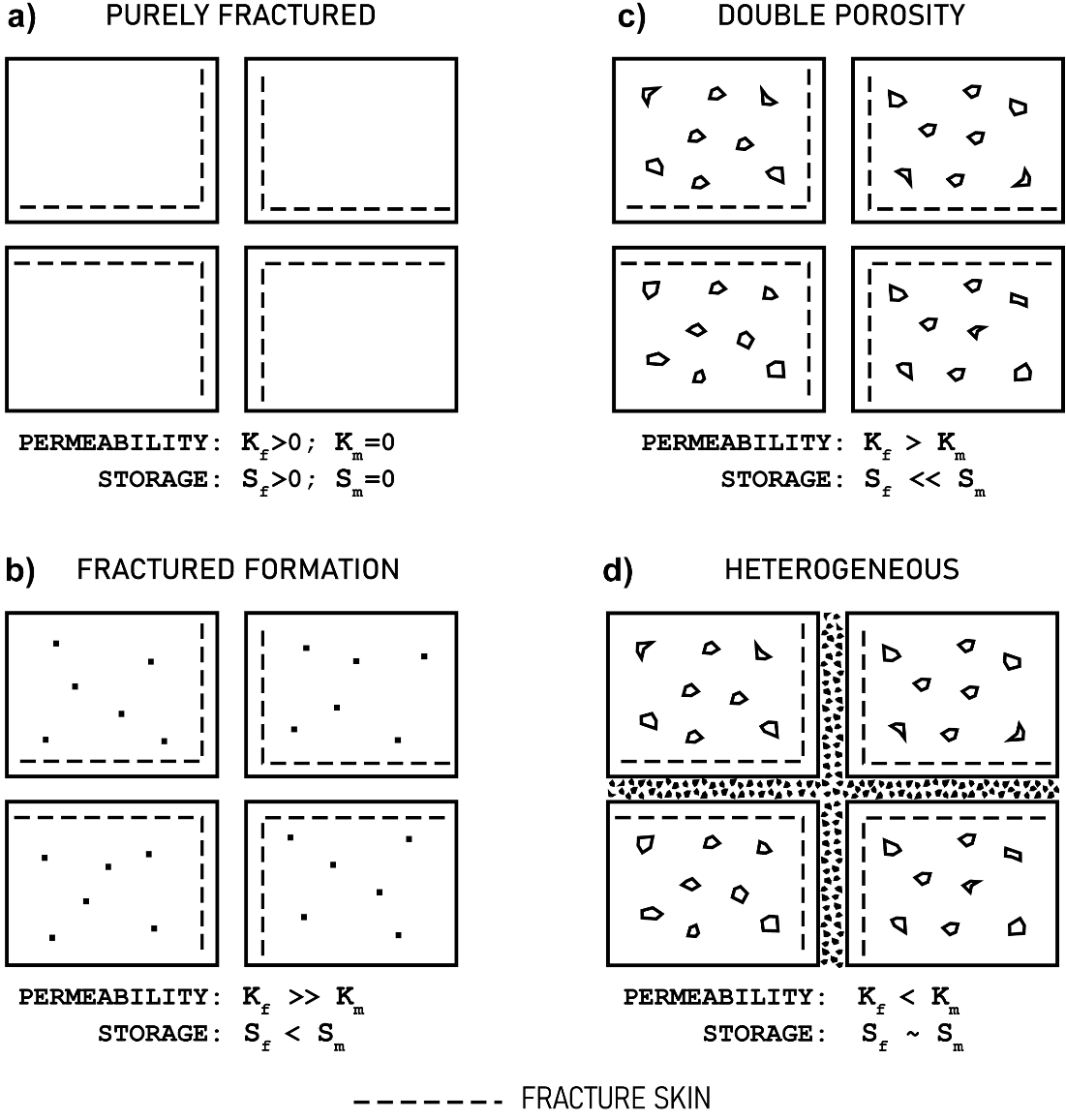
Figure 125 ‑ Hydrogeologic classification of fractured media: [latex]K_{f}[/latex] is permeability of the fractures; [latex]K_{m}[/latex] is permeability of the matrix; [latex]S_{f}[/latex] is storage coefficient of the fractures; [latex]S_{m}[/latex] is storage coefficient of the matrix (modified from Sharp, 1993).
In a purely fractured system (Figure 125a), the permeability and porosity of the matrix is so low that it is essentially impermeable; such that all fluid flow in the system occurs in the fractures and all fluid stored in the system is stored in the fractures.
In a fractured formation (Figure 125b), the permeability of the matrix is relatively low, but the porosity is significant. In these systems, the permeability of the fractures is so much higher than the matrix that all of the fluid flow is in the fractures, but most of the water is stored in the matrix. As we show later, it does not take a very large fracture to have a high permeability. Fractured formations are very significant in the petroleum industry; in many petroleum reservoirs, most of the oil is stored in the matrix, but it has to flow through the fractures to get to the oil wells.
In the double porosity system (Figure 125c), permeability of the matrix is high enough to allow for significant flow in the matrix as well as in the fractures. As with the fractured formation, most of the fluid is stored in the matrix. In this type of system there can be a great deal of interaction between the two (water moving from the matrix into the fracture and vice versa), which can complicate modeling of contaminant transport. This type of system, as well as the previous two, are difficult to model and quantify because the geometry of the fractures is poorly known and because it is difficult to characterize the matrix-fracture interactions.
The final system is called a heterogeneous system (Figure 125d). In this system, the fractures have been filled in with sediment that has a different permeability than the matrix—frequently lower. In this case, the fractures may act as barriers to flow, rather than conduits.
Figure 125 also introduces the concept of a fracture skin (dashed line). The fracture skin refers to a zone along and immediately beneath the surface of the fracture in which the matrix has been altered. This alteration could be from precipitation of minerals (e.g., iron or manganese oxides, calcite), dissolution of minerals from the matrix, or deposition of clay particles in pores (from transport through the aquifer or from alteration of feldspars and micas in the matrix). Fracture skins are significant because they affect the hydraulic relationship between the matrix and the fractures. They can also change the sorption and exchange properties of fracture surfaces, which can in turn affect contaminant transport.
In most cases, fracture skins have a lower permeability than the matrix, and they act to impede the exchange of water between the matrix and the fracture. In some cases, especially where the fracture skin has experienced dissolution, the skin can have a higher permeability than the matrix.
Thought Question 18: Give a geologic example of each type of fractured media.