
Box 1 – Derivation of the Radial Flow Equation
In Section 8, we stated the two‑dimensional groundwater flow equation with respect to Cartesian coordinate system [latex]x,\ y[/latex] is as shown in Equation Box (1-1).
| [latex]\frac{\partial^{2}h}{{\partial x}^{2}} + \frac{\partial^{2}h}{{\partial y}^{2}} = \frac{S}{T}\frac{\partial h}{\partial t}[/latex] | Equation Box (1‑1) |
|---|
where (parameter dimensions are dark green font with mass as M, length as L, time as T):
| [latex]h[/latex] | = | hydraulic head (L) |
|---|---|---|
| [latex]S[/latex] | = | storativity (:) |
| [latex]T[/latex] | = | transmissivity (L2T‑1) |
| [latex]t[/latex] | = | time (T) |
Flow to a well is radial; in other words, flow lines are converging on the well from all sides (Figure Box 1‑1).
Because the flow lines converge, the equipotential lines that define the cone of depression around the well get closer together near the well. In this case, we cannot use the Cartesian form of the equation, and therefore need to express the equation in terms of a polar coordinate system.
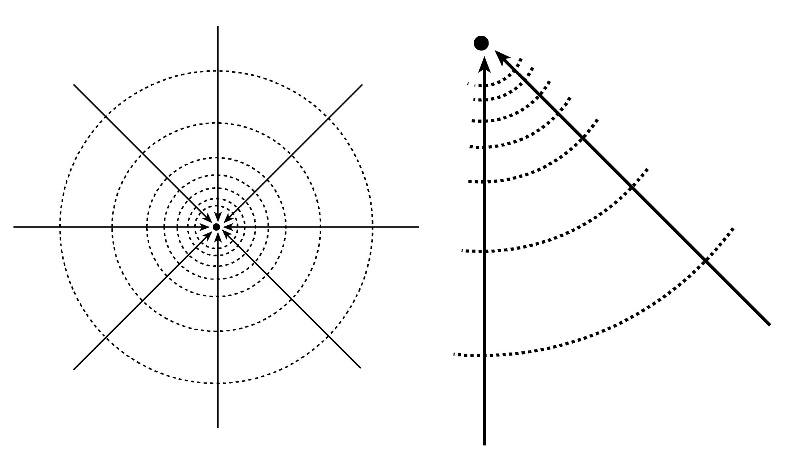
Figure Box 1‑1 ‑ Radial flow to a well.
In a polar coordinate system, a point is defined by its location with respect to a fixed central pole (Figure Box 1‑2). The location of a point is defined by its radial distance from the pole ([latex]r[/latex]) and the angle (𝜃) between the radial line and some fixed polar axis (e.g., north).
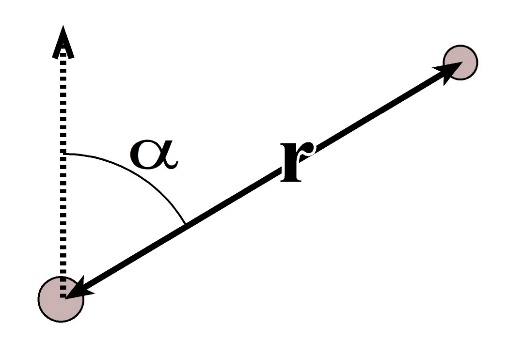
Figure Box 1‑2 ‑ Polar coordinate system.
The derivation of the transformation of the equation in Cartesian coordinates to polar coordinates follows below.
The Pythagorean theorem as shown by Equation Box (1‑2).
| [latex]r = \left( x^{2} + y^{2} \right)^{\frac{1}{2}}[/latex] | Equation Box (1‑2) |
|---|
where (parameter dimensions are dark green font with mass as M, length as L, time as T):
| [latex]r[/latex] | = | radial distance from the central pole (L) |
|---|---|---|
| [latex]x,\ y[/latex] | = | Cartesian coordinates (L) |
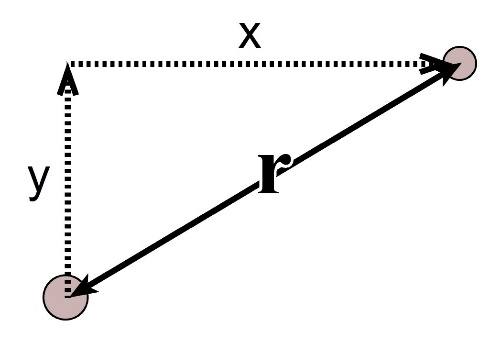
Figure Box 1‑3 ‑ Definition of terms in Equation Box 1‑2.
If we assume that [latex]h(x,y)\ = \ h(r)[/latex], then
| [latex]\frac{\partial h}{\partial x} = \frac{\partial h}{\partial r}\frac{\partial r}{\partial x}[/latex] | Equation Box (1‑3) |
|---|
and
| [latex]\frac{\partial h}{\partial y} = \frac{\partial h}{\partial r}\frac{\partial r}{\partial y}[/latex] | Equation Box (1‑4) |
|---|
The second partial of [latex]h[/latex] with respect to [latex]x[/latex] is
| [latex]\frac{\partial}{\partial x}\left( \frac{\partial h}{\partial x} \right) = \frac{\partial}{\partial x}\left\lbrack \frac{\partial h}{\partial r}\frac{\partial r}{\partial x} \right\rbrack[/latex] | Equation Box (1‑5) |
|---|
Using the product rule, we can remove the [latex]\partial h/\partial r[/latex] and take the second derivative of [latex]r[/latex] with respect to [latex]x[/latex] to get [latex]\left( \frac{\partial h}{\partial r} \right)\left( \frac{\partial^{2}r}{{dx}^{2}} \right)[/latex] . This product rule also gives us [latex]\left( \frac{\partial r}{\partial x} \right)\ \left( \frac{\partial}{\partial x} \right)[/latex]of [latex]\left( \frac{\partial h}{\partial r} \right)[/latex], or
| [latex]\frac{\partial}{\partial x}\left( \frac{\partial h}{\partial x} \right) = \frac{\partial h}{\partial r}\left\lbrack \frac{\partial^{2}r}{{\partial x}^{2}} \right\rbrack + \frac{\partial r}{\partial x}\left\lbrack \frac{\partial}{\partial x}\frac{\partial h}{\partial r} \right\rbrack[/latex] | Equation Box (1‑6) |
|---|
Now we use the chain rule on the terms in the brackets at the end of the equation. Recognizing that [latex]h[/latex] is a function of [latex]r[/latex], which itself is a function of [latex]x[/latex] and [latex]y[/latex]—that is, [latex]h\lbrack r(x,y)\rbrack[/latex]—we get [latex]\partial^{2}r/{dx}^{2}[/latex]times an additional [latex]\partial r/\partial x[/latex] out of those brackets, or
| [latex]\frac{\partial}{\partial x}\left( \frac{\partial h}{\partial x} \right) = \frac{\partial h}{\partial r}\left\lbrack \frac{\partial^{2}r}{{\partial x}^{2}} \right\rbrack + \frac{\partial r}{\partial x}\left\lbrack \frac{\partial^{2}h}{\partial r^{2}}\frac{\partial r}{\partial x} \right\rbrack[/latex] | Equation Box (1‑7) |
|---|
Therefore, the second partial derivative of [latex]h[/latex] with respect to [latex]x[/latex] is:
| [latex]\frac{\partial\left( \frac{\partial h}{\partial x} \right)}{\partial x} = \frac{\partial^{2}h}{{\partial x}^{2}} = \frac{\partial h}{\partial r}\frac{\partial^{2}r}{{\partial x}^{2}} + \frac{\partial r}{\partial x}\frac{\partial^{2}h}{{\partial r}^{2}}\frac{\partial r}{\partial x} = \frac{\partial h}{\partial r}\frac{\partial^{2}r}{{\partial x}^{2}} + \frac{\partial^{2}h}{{dr}^{2}}\left( \frac{\partial r}{\partial x} \right)^{2}[/latex] | Equation Box (1‑8) |
|---|
and the second partial derivative of [latex]h[/latex] with respect to [latex]y[/latex] is:
| [latex]\frac{\partial\left( \frac{\partial h}{\partial y} \right)}{\partial y} = \frac{\partial^{2}h}{{\partial y}^{2}} = \frac{\partial h}{\partial r}\frac{\partial^{2}r}{{\partial y}^{2}} + \frac{\partial r}{\partial y}\frac{\partial^{2}h}{{\partial r}^{2}}\frac{\partial r}{\partial y} = \frac{\partial h}{\partial r}\frac{\partial^{2}r}{{\partial y}^{2}} + \frac{\partial^{2}h}{{dr}^{2}}\left( \frac{\partial r}{\partial y} \right)^{2}[/latex] | Equation Box (1‑9) |
|---|
Now, the partial derivative of [latex]r[/latex] with respect to [latex]x[/latex] is:
| [latex]\frac{\partial r}{\partial x} = \frac{1}{2}\left( x^{2} + y^{2} \right)^{\frac{- 1}{\ \ \ 2}}2x = \frac{1}{2}\frac{1}{r}2x = \frac{x}{r}[/latex] | Equation Box (1‑10) |
|---|
Next, we use the quotient rule to get the second derivative of [latex]r[/latex] with respect to [latex]x[/latex]. The quotient rule says that:
| [latex]\left( \frac{f}{g} \right) = \frac{f'g - fg'}{g}[/latex] | Equation Box (1‑11) |
|---|
so, if [latex]\partial r/\partial x\ = \ x/r,[/latex] then [latex]\frac{\partial^{2}r}{{\partial x}^{2}}[/latex] is as below (because [latex]f’\ = \ \partial x/\partial x\ = \ 1[/latex]).
| [latex]\frac{\partial^{2}r}{{\partial x}^{2}} = \frac{r - x\left( \frac{\partial r}{\partial x} \right)}{r^{2}} = \frac{r(r) - r\left( x\left( \frac{x}{r} \right) \right)}{r\left( r^{2} \right)} = \frac{r^{2} - x^{2}}{r^{3}}[/latex] | Equation Box (1‑12) |
|---|
but since
| [latex]r = \left( x^{2} + y^{2} \right)^{\frac{1}{2}}\ and\ r^{2} = x^{2} + y^{2}[/latex] | (Equation Box 1‑13) |
|---|
and
| [latex]y^{2} = r^{2} - x^{2}[/latex] | (Equation Box 1‑14) |
|---|
The second partial with respect to x is:
| [latex]\frac{\partial^{2}r}{{\partial x}^{2}} = \frac{y^{2}}{r^{3}}[/latex] | (Equation Box 1‑15) |
|---|
And, similarly, the partials of [latex]r[/latex] with respect to [latex]y[/latex] are:
| [latex]\frac{\partial r}{\partial y} = \frac{y}{r}[/latex] | (Equation Box 1‑16) |
|---|
and
| [latex]\frac{\partial^{2}r}{{\partial y}^{2}} = \frac{x^{2}}{r^{3}}[/latex] | (Equation Box 1‑17) |
|---|
We can substitute into the expression for the second partial of h with respect to x and y to obtain:
| [latex]\frac{\partial^{2}h}{{\partial x}^{2}} = \frac{\partial h}{\partial r}\frac{y^{2}}{r^{3}} + \frac{\partial^{2}h}{{\partial r}^{2}}\frac{x^{2}}{r^{2}}[/latex] | (Equation Box 1‑18) |
|---|
| [latex]\frac{\partial^{2}h}{{\partial y}^{2}} = \frac{\partial h}{\partial r}\frac{x^{2}}{r^{3}} + \frac{\partial^{2}h}{{\partial r}^{2}}\frac{y^{2}}{r^{2}}[/latex] | (Equation Box 1‑19) |
|---|
Therefore, we have:
| [latex]\frac{\partial^{2}h}{{\partial x}^{2}} + \frac{\partial^{2}h}{{\partial y}^{2}}\ \ \ \ \ \ = \frac{\partial h}{\partial r}\frac{y^{2}}{r^{3}} + \frac{\partial^{2}h}{{\partial r}^{2}}\frac{x^{2}}{r^{2}} + \frac{\partial h}{\partial r}\frac{x^{2}}{r^{3}} + \frac{\partial^{2}h}{{\partial r}^{2}}\frac{y^{2}}{r^{2}} = \frac{\partial h}{\partial r}\frac{\left( x^{2} + y^{2} \right)}{r^{3}} + \frac{\partial^{2}h}{{\partial r}^{2}}\frac{\left( x^{2} + y^{2} \right)}{r^{2}} = \frac{\partial h}{\partial r}\frac{r^{2}}{r^{3}} + \frac{\partial^{2}h}{{\partial r}^{2}}\frac{r^{2}}{r^{2}}[/latex]
[latex]= \frac{1}{r}\frac{\partial h}{\partial r} + \frac{\partial^{2}h}{{\partial r}^{2}}[/latex] |
(Equation Box 1‑20) |
|---|
and substituting for the left side of Equation Box (1-1):
| [latex]\frac{\partial^{2}h}{{\partial r}^{2}} + \frac{1}{r}\frac{\partial h}{\partial r} = \frac{S}{T}\frac{\partial h}{\partial t}[/latex] | (Equation Box 1‑21) |
|---|