
23. Thought Questions Answered
Thought Question 1 Answer: The primary source of energy driving the hydrologic cycle is the sun. A secondary source of energy is the internal heat of the Earth, which is primarily sourced from the radioactive decay of unstable elements in the Earth’s mantle and core.
Thought Question 2 Answer: Porosity is a scalar quantity, as it does not vary with respect to direction. Effective porosity is also considered to be a scalar quantity; however, some modelling studies have shown that it can vary slightly with respect to the direction of flow depending on the orientation of the pore connections. In practice, both quantities are generally considered to be scalar.
Thought Question 3 Answer: [latex]S_{y}[/latex] and [latex]\phi_{eff}[/latex] have essentially the same value. [latex]S_{y}[/latex] reflects the fractional volume of interconnected pores that drain when water levels is lowered. [latex]\phi_{eff}[/latex] reflects the fractional volume of interconnected pores that are part of the active flow in a porous medium.
Thought Question 4 Answer: The limits of Darcy’s Law may be exceeded in karst or fractured media because high velocity flow in conduit or fractures may be turbulent. Its limits may be exceeded in tight, fine-grained, materials in which the hydraulic gradient is not sufficient to overcome viscous fluid forces and thus cannot force groundwater through pores.
Thought Question 5 Answer: The average linear velocity considers both high and low groundwater velocities so some contaminants will arrive at a downgradient receptor sooner than predicted by the average linear velocity and some will arrive later.
Thought Question 6 Answer: Specific storage is the volume of water released from a unit volume of aquifer for a unit decline of hydraulic head, so it is volume per volume per length (i.e., L3 per L3 per L, which is L3L-3L-1) thus has units of L-1. Storativity is the product of specific storage and aquifer thickness (i.e., L-1L) so it is dimensionless.
Thought Question 7 Answer: Storage in a confined aquifer is controlled by the elastic response of the aquifer, and storativity values for typical confined aquifers range from 1 x 10⁻⁶ to 1 x 10⁻⁴. Storage in an unconfined aquifer is controlled by drainage of the pore space, therefore, the storativity will essentially be equivalent to the specific yield, which typically ranges from 0.01 to 0.5. If all other factors are equal (thickness, permeability, pumping rates, etc.), then a greater storativity results in less drawdown. Since confined aquifers tend to have much lower storativity than unconfined aquifers, the confined aquifer will experience greater drawdown.
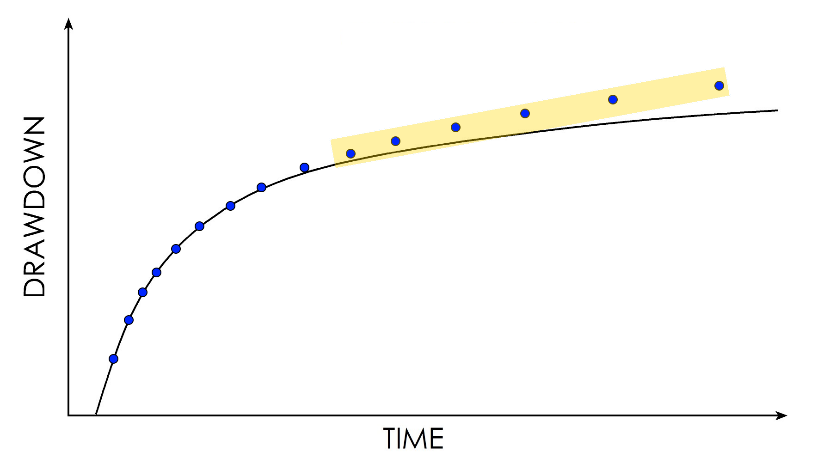
Thought Question 8 Answer: A sketch of the situation is shown below. The highlighted points plot above the type curve, which indicates that the observation well is experiencing more drawdown than expected from an ideal confined aquifer. A deviation from the Theis curve toward more drawdown in the later time indicates a no‑flow boundary in the aquifer is decreasing the aquifer area available to provide flow from storage to the well.
Thought Question 9 Answer: Transmissivity is underestimated when determined using head in a pumping well that is experiencing well losses because the lower head would suggest a steeper gradient is needed to deliver the rate of water discharged by the well then exists in the formation just beyond the well bore. Thus, the estimated T would be less than estimated using data from an observation well.
Thought Question 10 Answer: Hydrogeologists might study a flow system that supports an ecosystem that is valuable to humans for reasons that do not include a water supply – for example, a sensitive groundwater-supported wetland that provides a critical part of the surface water system and contains endangered or critical species. Another example is a flow system near a contaminated site that is not sufficiently productive to be considered an aquifer but is still capable of transmitting contamination to receptors.
Thought Question 11 Answer: As indicated in Section 3.3.3, permeability is a function of the properties of the fluid as well as the properties of the media through which the fluid flows; more specifically, the density and viscosity of the fluid. A high concentration of contaminant could potentially increase the density of the groundwater enough to alter the hydraulic conductivity in the vicinity of the higher density and to alter the force driving the flow. The same could happen if there is sufficient contaminant present to affect the viscosity of the water.
Thought Question 12 Answer: Dispersivity spreads contaminants out so a setting with a high dispersivity would have a breakthrough curve with earlier first arrivals, a lower peak and longer tail.
Thought Question 13 Answer: The stage-discharge curve is dependent on the stream channel morphology, so anything that changes the profile of the stream channel, e.g., significant erosion, deposition of sediment, or a landslide into a stream channel, would likely change the stage-discharge curve. Also, changes within the watershed or catchment area supplying water to the gaging station can result in stream morphology changes. For example, extensive urbanization within the watershed results in a lot of paved surfaces, which in turn increases runoff and peak flows that can increase erosion throughout the stream channel.
Thought Question 14 Answer: The stream runoff peak occurs earlier than the baseflow peak because surface runoff is rapid—on the order of days or weeks—while baseflow discharge is slow, typically occurring over weeks or months.
Thought Question 15 Answer: The shape of the runoff and baseflow portions of a storm discharge curve depend on the size and topography of the basin as well as the character of the storm and the nature of the groundwater system.
Thought Question 16 Answer: The thickness of the capillary fringe depends on the size of pore openings. Its variability within and between aquifers depends on the variations in pore size distributions in the vicinity of the water table. The water table fluctuates and so the thickness of the fringe can vary with time as the water table occurs in materials of differing pore sizes.
Thought Question 17 Answer: If effective stress drops to zero in unconsolidated sediments near the surface, a quick condition occurs, that is the material losses its solid behavior and instead behaves as a liquid, i.e. it becomes quicksand. If the effective stress drops to zero in consolidated rock beneath the surface, the pore fluid pressure will cause the rock to fracture. This is the process involved in fracking, or hydraulically fracturing a formation to increase permeability and fluid recovery.
Thought Question 18 Answer: Geologic examples of the four types of fractured systems:
- purely fractured, a very dense, fractured, igneous rock with no matrix porosity;
- fractured formation, a shale;
- double porosity, a fractured sandstone;
- heterogeneous system, a fractured sandstone in which mineral deposition has clogged the fractures.
Thought Question 19 Answer: Discharge is directly proportional to density because hydraulic conductivity increases as density of the fluid increases, but it is inversely proportional to viscosity because hydraulic conductivity decreases as viscosity increases. The properties of the fluid are needed to calculate hydraulic conductivity from permeability, and density is in the numerator while viscosity is in the denominator.