
14.1 The Slug Test
Slug tests are used to obtain estimates of horizontal hydraulic conductivity by observing the rate of recovery of induced water‑level change in a well bore. Storage properties are usually not computed; however, some methods can provide estimates of storativity (e.g., Butler, 1998; Cooper et al., 1967).
A slug test can be conducted by causing the head in the well to rapidly rise by adding a slug (volume) to a well bore, or rapidly decline by removing a slug (volume) from the well bore. Once the initial change in water level occurs, the rate of water level recovery is recorded. When the static water level in a well is rapidly raised or lowered the rate of water‑level recovery is proportional to the horizontal (radial) hydraulic conductivity of material adjacent to the perforated portion of the well (Figure 102). Slug tests can be conducted in low‑ to high‑permeability formations of confined and unconfined systems.
Slug‑test types are referred to as either a slug‑in test (or falling‑head test), or a slug‑out test (or rising‑head slug test). When conducting a slug‑in test the head is initially increased and declines (falls) back to the static water level. When water level is rapidly lowered, a slug‑out test, the water level increases (rises) returning to the equilibrium position (Figure 102).
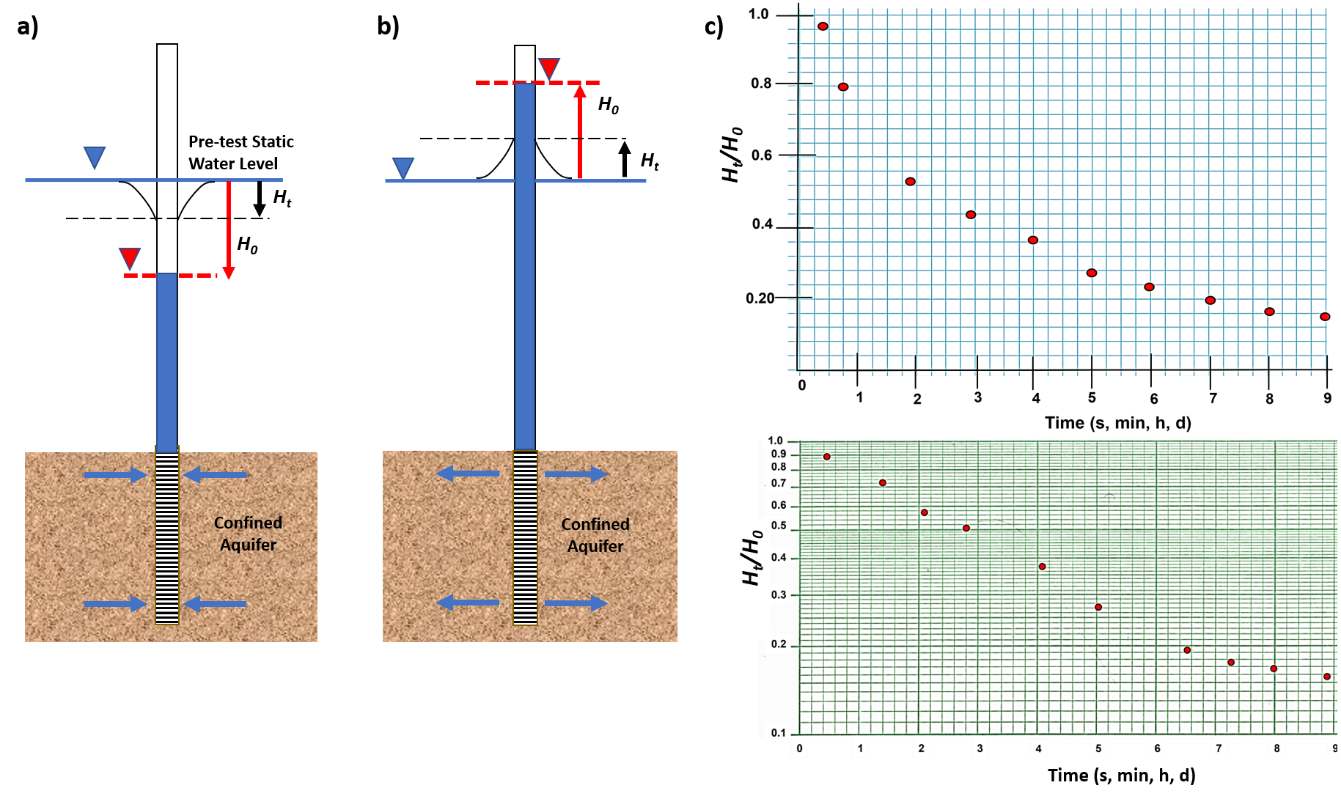
Figure 102 ‑ Schematic of slug tests where the water level is instantaneously lowered or raised in a well penetrating a confined aquifer. The horizontal black lines show the perforated interval in communication with the aquifer. Red items show initial conditions at the time the slug is withdrawn or inserted when the abrupt change of the water level in the well bore creates a steep gradient between the head in the well bore and the formation. a) A rising head slug test or slug‑out test. b) A falling head slug test or slug‑in test. c) Plots of the ratio of the normalized head, Ht/H0 and time for a test with an overdamped water level response. H0 is the initial maximum rise or fall of the water level and Ht is the unrecovered head at some time t. The upper plot is arithmetic, and the lower plot is a semi‑log plot. The recovery rate is generally logarithmic as shown in this example.
A slug test is used to characterize the hydrogeologic conditions in the immediate vicinity of the perforated interval of an unpumped well. The test samples a much smaller volume of hydrogeologic material than a pumping test. Care in interpreting results is needed as results are often dominated by conditions related to the well drilling and design, the degree of well development and hydrogeologic properties of materials immediately adjacent to the borehole (e.g., Vonhof, 1975). Slug‑test results are therefore more representative of local conditions and less representative of overall aquifer conditions.
When several slug tests are conducted from similarly constructed and developed wells at a study site, overall aquifer conditions can be estimated by combining slug‑test results. Slug tests are easy to execute, inexpensive, and can be applied to existing wells including small‑diameter monitoring wells and piezometers. Consequently, slug tests are the test of choice at sites where pumping wells are not available or, in some cases, the groundwater system is contaminated.
The type of water‑level response during a slug test is referred to as either overdamped, underdamped, or critically damped (Figure 103).
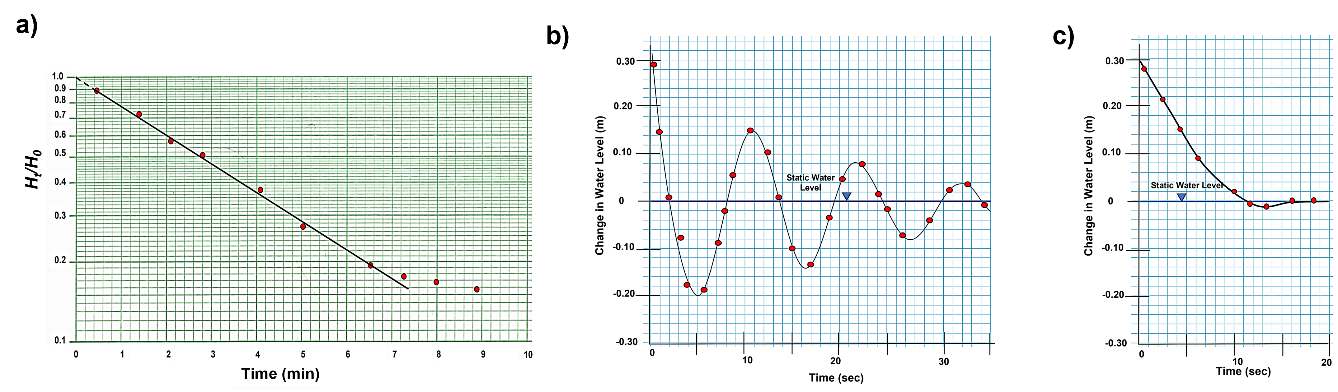
Figure 103 ‑ Examples of overdamped, underdamped, and critically damped slug test results. a) An overdamped response plotted as the log of Ht/H0 versus time (Figure 102). The black straight line is fitted to the straight‑line portion of the data. b) An underdamped slug test response plotted on arithmetic scales as the change in water level versus time. The response is oscillatory. c) Plot of a critically damped response. This response shows the change in water level versus time plotted on arithmetic scales. The critically damped response is considered transitional, between the overdamped and underdamped response.
Overdamped recovery occurs when the unrecovered water level Ht divided by the initial maximum water level at the start of the test, H0, logarithmically declines as represented in Figure 103. The uncovered ratio of Ht/H0 is plotted on a log scale. The resulting straight‑line portion of the data set is fitted with a straight line. The slope of the straight‑line is proportional to the formational hydraulic conductivity. Overdamped responses are observed for tests conducted in low to moderate hydraulic conductivity settings. Schematics of the overdamped responses of slug tests conducted in sand, silt and clay rich formations are shown in Figure 104.
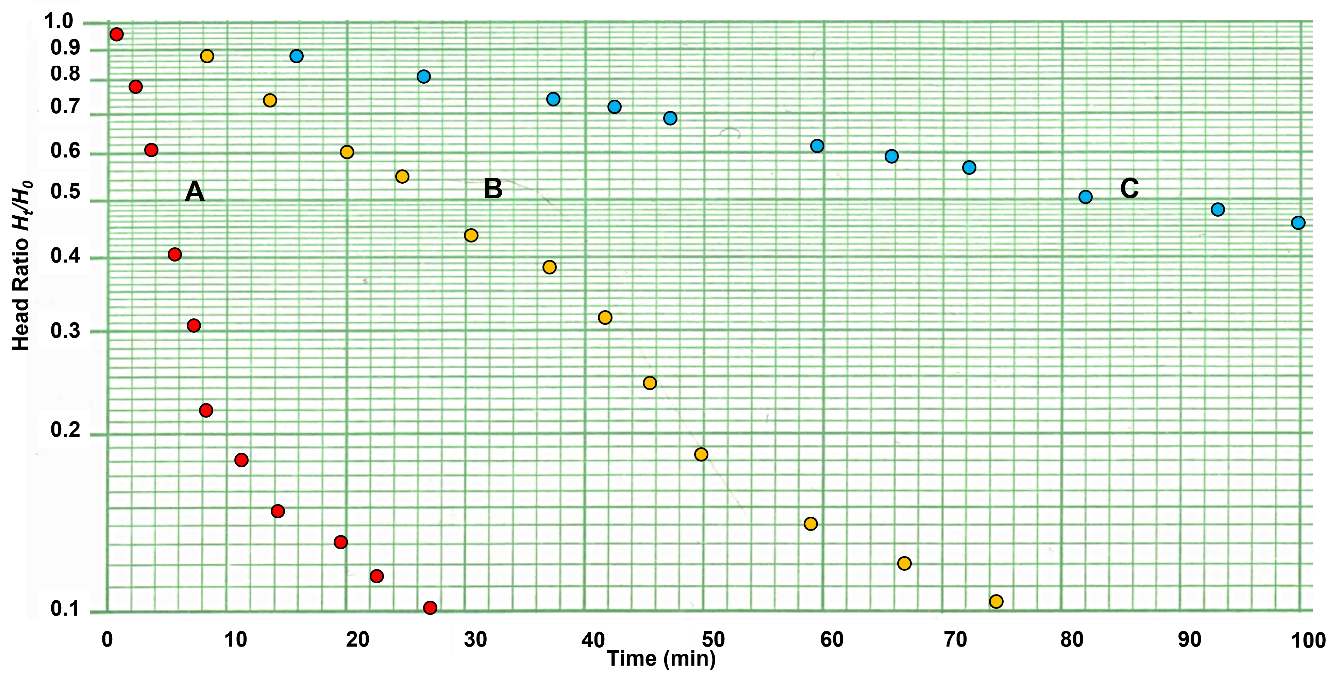
Figure 104 ‑ Hypothetical example of the overdamped response (head ratio or normalized head) of slug tests performed in a sand rich formation (A), a silt rich formation (B) and a clay rich formation (C). The slope of the curve is smaller for lower horizontal hydraulic conductivity, KA>KB>KC.
The underdamped oscillatory water‑level changes are observed when high‑hydraulic‑conductivity formations are slug tested (Figure 103). The hydraulic conductivity in these settings is related to the degree of dampening, as well as the period and timing of the oscillations (Butler et al., 2003). The critically damped response is seen when hydraulic conductivities are between moderate and high (Figure 103). Critically damped response data are often analyzed using methods developed for both overdamped and underdamped responses.
Slug tests can be completed in small‑diameter observation wells and unpumped water‑supply wells. In settings with small‑diameter wells that penetrate highly permeable materials, an individual test may be completed in a few seconds. In the opposite setting where permeabilities are low, hours to days to months may be required to reach full recovery of test water levels. Slug tests are not restricted to use in aquifer systems (permeable systems that yield water to wells for a specific use). They are also used to characterize low‑permeability units such as aquitards and fractured rocks as discussed in Section 16.