
2 Types of Hydraulic Tests
There are three main types of field‑scale hydraulic tests: pumping tests, slug tests, and testing with packers (Figure 1). Pumping tests involve pumping or injecting water from/to a well. Slug tests involve quickly raising or lowering the water level in a well bore without pumping. Testing with packers involves isolating intervals in open boreholes using an inflatable bladder and displacing borehole water. Hydraulic tests are commonly referred to as aquifer tests, where aquifers are saturated geologic materials that store and transmit water in sufficient quantities and rates such that they can be sources of water for humans (Woessner & Poeter, 2020). Despite that terminology, they are also commonly used to characterize hydrogeologic properties of less permeable units that do not meet the definition of an aquifer. Hydraulic tests are sometimes referred to as “pump tests.” Though this is used as an abbreviated term for a pumping test, the wording indicates a test of the pump (e.g., is it working, what sustained yield can it produce, and so on) as opposed to an evaluation of subsurface properties. In units where head is above the ground level, an uncapped well in the unit may flow without the use of a pump. Hydraulic testing of flowing wells will be referred to as a pumping test in this book because natural conditions are “pumping” the well. Thus, pumping test is the preferred term used in this text.
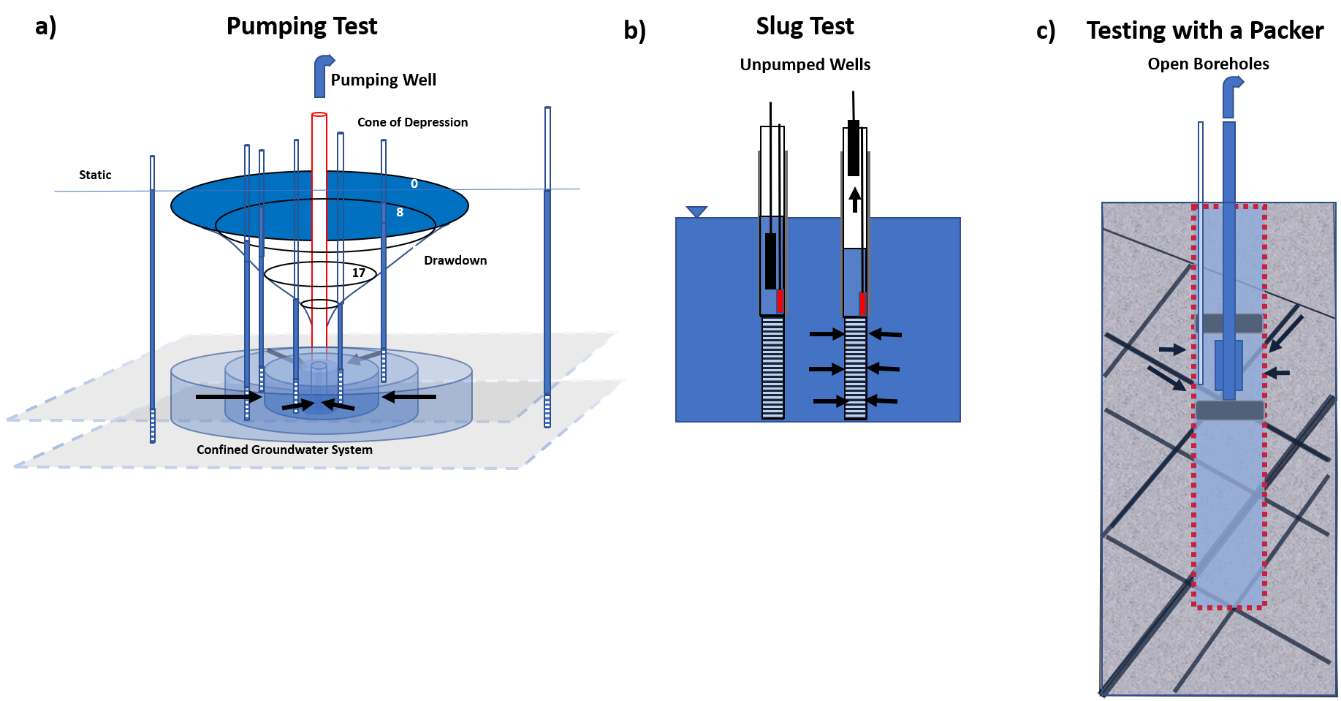
Figure 1 ‑ Schematic of three types of hydraulic tests. Black arrows indicate the direction of groundwater flow. a) Pumping test where a well in a groundwater system is pumped and the change in water levels are observed in the pumping well and observation wells (smaller‑diameter surrounding wells). The potentiometric surface at a specific time during the test is shown to represent the drawdown (initial water level minus pumping‑induced water level). This drawdown is called the cone of depression. b) Slug test where a solid cylinder is inserted or removed from a well causing an abrupt change of water level in the well, then the water level recovery is monitored over time. c) Testing with packers in an open borehole where a section of an open borehole (red dashed lines) intersecting fractures (blue and gray intersecting lines) of a rock in a groundwater system is isolated with packers (gray rectangles). The interval between the packers is pumped and water levels are monitored through time.