
5.3 Methods to Measure and Maintain a Pumping Rate
Discharge should be monitored frequently during a test to document variations in pumping rates. As described earlier, because standard electric submersible or line shaft turbine pumps operate at a constant number of revolutions per minute, observed initial discharge rates tend to decline over time as the head in the well declines. This is because as drawdown occurs the pump must lift water from a greater depth affecting the pump efficiency. Though variable‑rate pumping tests can be conducted, most pumping tests are designed as constant‑rate discharge tests. If a constant‑rate test is planned, a method to maintain a constant pumping rate must be deployed. Typically, a valve is included in the pump discharge line that is not fully open when the test begins and set to deliver the target discharge rate (Figure 16). As the test proceeds, the valve can be opened to adjust the discharge rate as needed. When rates vary during a constant‑rate test, an average weighted discharge is often computed to represent the test pumping rate.
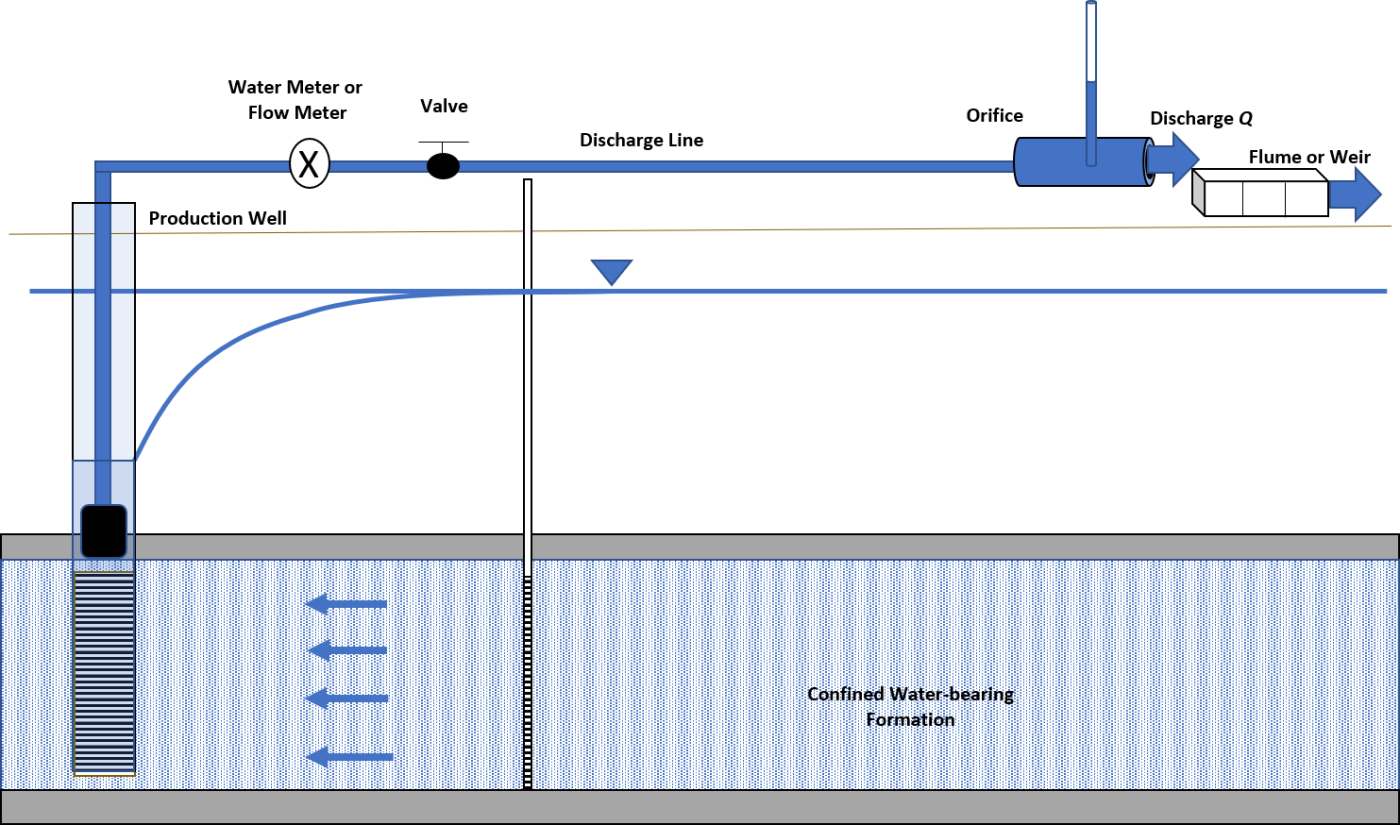
Figure 16 – Methods to monitor and control discharge: To reduce the number of variables when analyzing pumping test data, it is desirable to have the pumping rate remain constant. This requires measuring the discharge rate accurately. It is also important to have the ability to adjust the pumping rate as needed. In this example a valve is installed in the discharge line so that it can be opened to compensate for a decrease in flow rate as the water level in the well declines. If pumps with variable frequency drives are available, the pumps can be programed to maintain a constant discharge rate.
Given the difficulty of maintaining a constant discharge rate, the use of an electric pumps with a variable frequency drive can dramatically improve the quality of the test data. These specialized pumps maintain a constant discharge rate by increasing the revolutions per minute when discharge decreases. A discharge monitoring schedule should still be followed to assure proper operation of the variable frequency drive pump. If a line shaft turbine pump is powered with a diesel motor with speed adjustment, discharge rates can be maintained by increasing or decreasing the pump rotation speed.
The discharge rate can be monitored using an in‑line water meter or flow meter placed in the discharge pipe. The discharge pipe and flow meters should be assembled to ensure accurate readings. Discharge pipes must be full and the meter installed several pipe diameters distant from sources of turbulence such as bends or valves. Meters (especially older models) should be independently calibrated and checked prior to or during the test. Other discharge‑rate measurement devices include orifice meters, flumes, and weirs installed at the end of discharge pipe. (Figure 16). For low pumping rates, a volumetric measurement can be made by frequently timing how long it takes to fill a bucket or drum of known volume (for example, it takes three minutes to fill a 20‑L bucket, flow rate is Q = 20 L / 3 minute = 6.7 L/minute). Extra time and personnel may be required to oversee the discharge rate measurements and adjustments when orifices, weirs, or flumes are used.
Because pumping tests often produce large volumes of water (e.g., a well operating at 4,000 L/minute pumped for 8 hours delivers 1,920,000 L of water), a plan is needed to manage the volumes of water produced during the pumping test. Depending on the regulations in the local of the test it may be necessary to acquire water rights to pump and discharge the water which may take time as well as create additional expense, so this should be addressed well in advance of the testing date. Further, it may be necessary to secure an environmental permit to discharge the pumped water. There are four major physical concerns that require consideration during planning and design of the test.
- Water discharged to the surface may infiltrate and become artificial recharge to the unit being tested. This recirculation would slow the rate of observed drawdown, making observed water level changes inaccurate.
- Discharging substantial volumes of water near the production well can flood the operational area making data collection difficult. Discharging water off‑site could have adverse effects on off‑site property.
- Discharge of high flow rates can cause significant erosion at the point of discharge.
- If the water being withdrawn is contaminated, plans for proper containment and disposal are required.
To avoid Concern #1, discharge must be routed away from the test area to eliminate the possibility of recharge within the radius of influence (drawdown cone). In unconfined aquifers, water must be conveyed via hose, pipe, ditch, storm sewer, or surface water feature beyond the radius of influence of the pumping well. The radius of influence can be estimated based on transmissivity estimates and basic analytical equations. If a deep confined aquifer is being pumped, under most conditions, infiltrating pump discharge may not impact test results. Under these conditions it may be feasible to infiltrate the discharge to the shallow subsurface via a pit or trenches without affecting water levels within the confined hydrogeologic unit being tested. However, if possible, the discharge should be piped away from the site.
Concern #2 can usually be avoided by conveying the discharge away from the test area. This often requires many meters of discharge pipe or hose. In some cases, a municipal drainage system, or a nearby surface‑water feature, may handle the water. In arid areas, a lined evaporation pond may be able to dispose of the pumped water. Affected off‑site property owners should be consulted to obtain permission and avoid adverse effects.
Concern #3 can be alleviated by discharging directly into large surface water bodies or infiltration galleries or constructing energy dissipation structures at the ultimate point of discharge (e.g., Thompson and Kilgore, 2006).
Concern #4 may be resolved by capturing contaminated water and processing it before release. However, when large volumes of water are produced containing or treating discharge water may be cost prohibitive and other testing methods not requiring pumping should be considered (Section 14, Slug Testing).