
Exercise 6
A discussion of interpreting single well pumping tests methods used to evaluate a well performance test is presented (Section 12). Though performance test data have limitations (e.g., uncertainty related to: the nature and location of water bearing units in the well, pumping water levels, and well loss during pumping), approximations of T can be made. Most commonly, performance test data are found on driller’s logs when a well is constructed. Review the well log presented in the image below.
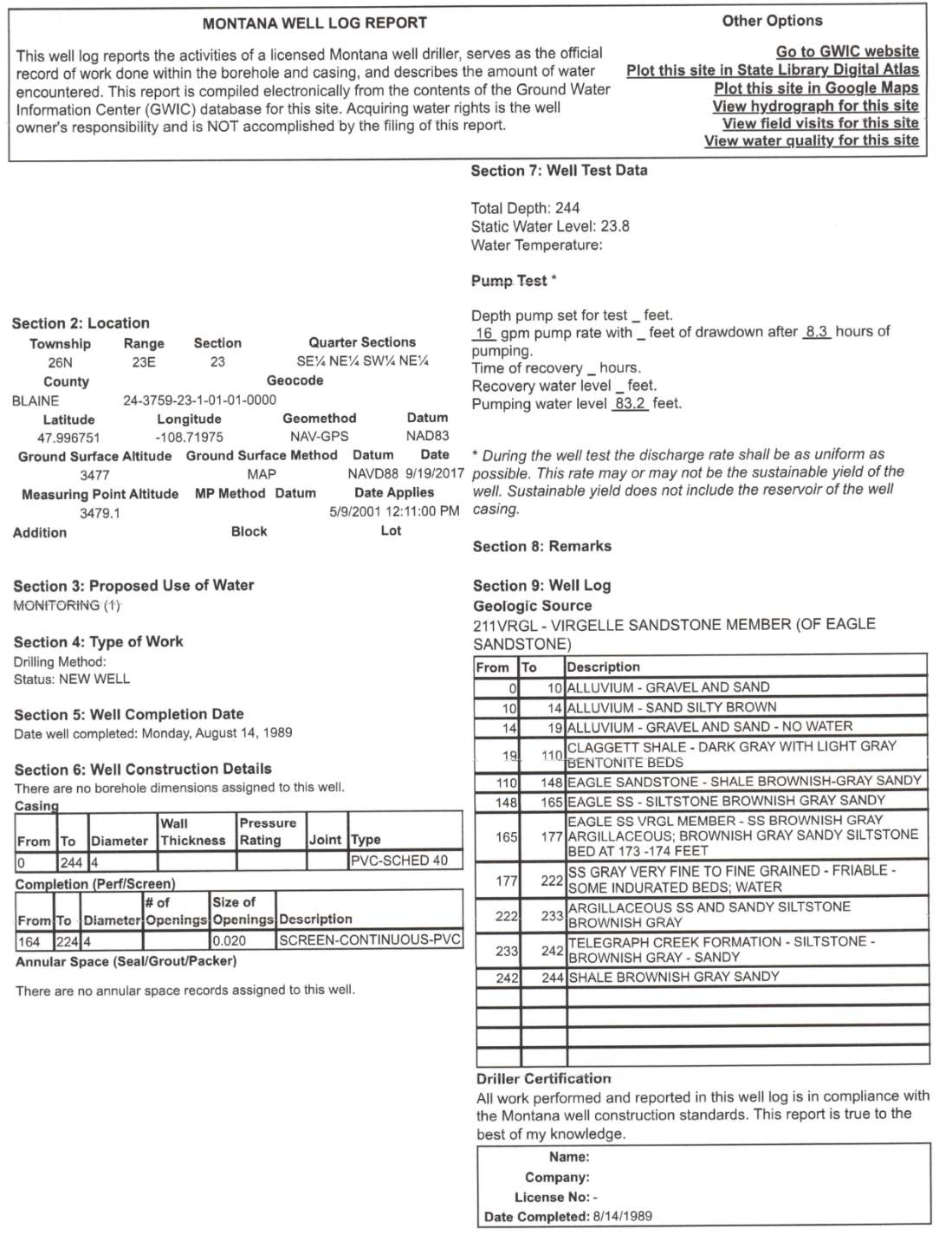
Example of a driller’s well log report for the completion of a well in Montana, USA. All length units are reported in feet and pumping rate is in gallons per minute. This log provides information on the static water level at the time of drilling, performance testing data including a pumping rate, length of the test, and the pumping level at the end of the test. It also shows a geologic log of the borehole. The owner of the well has been deleted from the figure.
Using this driller’s log answer the following questions:
- What depth interval and geologic material did the driller perforate to produce water to the well?
- Is this water producing unit likely confined or unconfined? Support your answer.
- Examine the static water level and performance test information, compute the specific capacity of the well.
- Based on the pumping data recorded by the driller, estimate the transmissivity of the aquifer using two methods. When applying each method justify your approach
- Method 1: Assume the pumping has not proceeded to a steady state.
- Method 2: Assume the pumping has resulted in near steady state conditions (simple equation approximation).
- When you only have performance data for a single pumping well do you anticipate the formational values of T will be greater or less than the values you computed? Why?