
Box 4 Production Well Efficiency
Forecasting drawdown at the pumping well assumes no additional head loss occurs as the water enters the well. This is usually not the case, so drawdown measured in the pumping well is usually greater than the theoretical values computed from the well hydraulics analytical equations. One factor effecting the pumping water well could be partial penetration of the screen and the resulting longer vertical flow paths. When there is head loss due to partial penetration (i.e., the well penetrates less than 80 percent of the aquifer) the difference between the theoretical pumping level and the observed level is referred to as well loss (Figure Box 4‑1). Additional head loss occurs when groundwater flows through the damaged formation near the well and through the perforated or screened casing at high velocity causing turbulent flow.
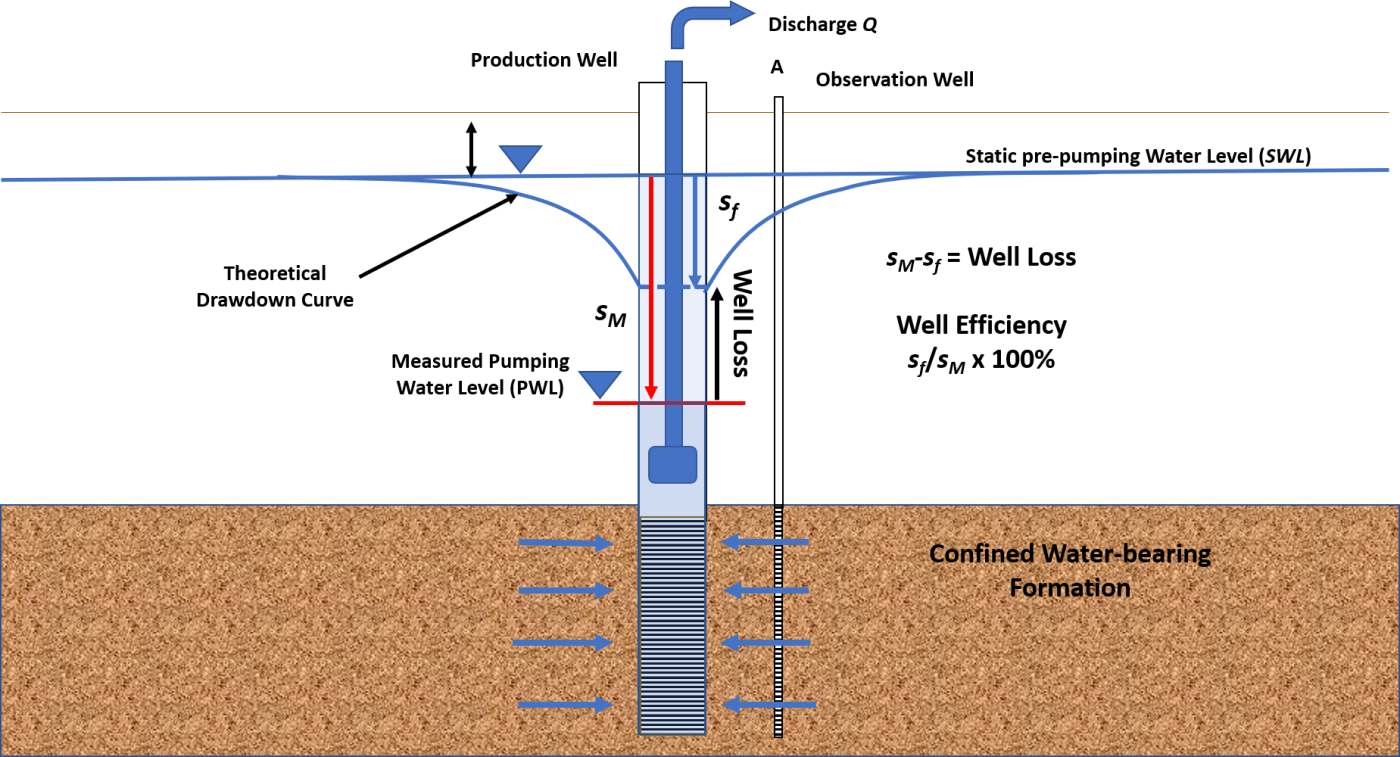
Figure Box 4‑1 ‑ Comparison of the measured pumping well drawdown (sM) and the computed theoretical formational drawdown (sf) for a fully penetrating well. The difference between the measured drawdown and the theoretical drawdown is the well loss. The production well efficiency is computed by multiplying the ratio of sf/sM by 100 percent. Most production wells are less than 100 percent efficient because high velocities and turbulent flow in the area associated with the screened or perforated casing cause additional head loss during pumping.
The ratio of the theoretical drawdown to the actual measured drawdown is a measure of the pumping well efficiency (E) as shown in Equation Box 4‑1.
| [latex]E = \frac{s_{theoretical\ formational}}{s_{measured}}100\ percent[/latex] | (Box 4‑1) |
|---|
The theoretical drawdown in the pumping well can be computed using analytical well hydraulics equations where the radial distance is set equal to the well radius. The computed head does not account for well loss, so the computed theoretical drawdown represents a 100 percent efficient well.
When aquifers behave as totally confined, a second method can be used to determine the theoretical drawdown in the pumping well. This distance‑drawdown method projects the cone of depression represented by a semi‑log plot of observation well drawdowns—which are not pumped so are 100 percent efficient—for a fixed time at various distances from the pumping well to the radius of the production well (Figure Box 4‑2). The projected theoretical drawdown is then compared to the actual measured pumping well drawdown to compute the well efficiency (Equation Box 4‑1). Once the well efficiency is determined, the pumping well drawdown data can be corrected for the well loss (Figure Box 4‑1) and the corrected drawdown obtained can be used for analysis because it meets the simplifying assumptions.
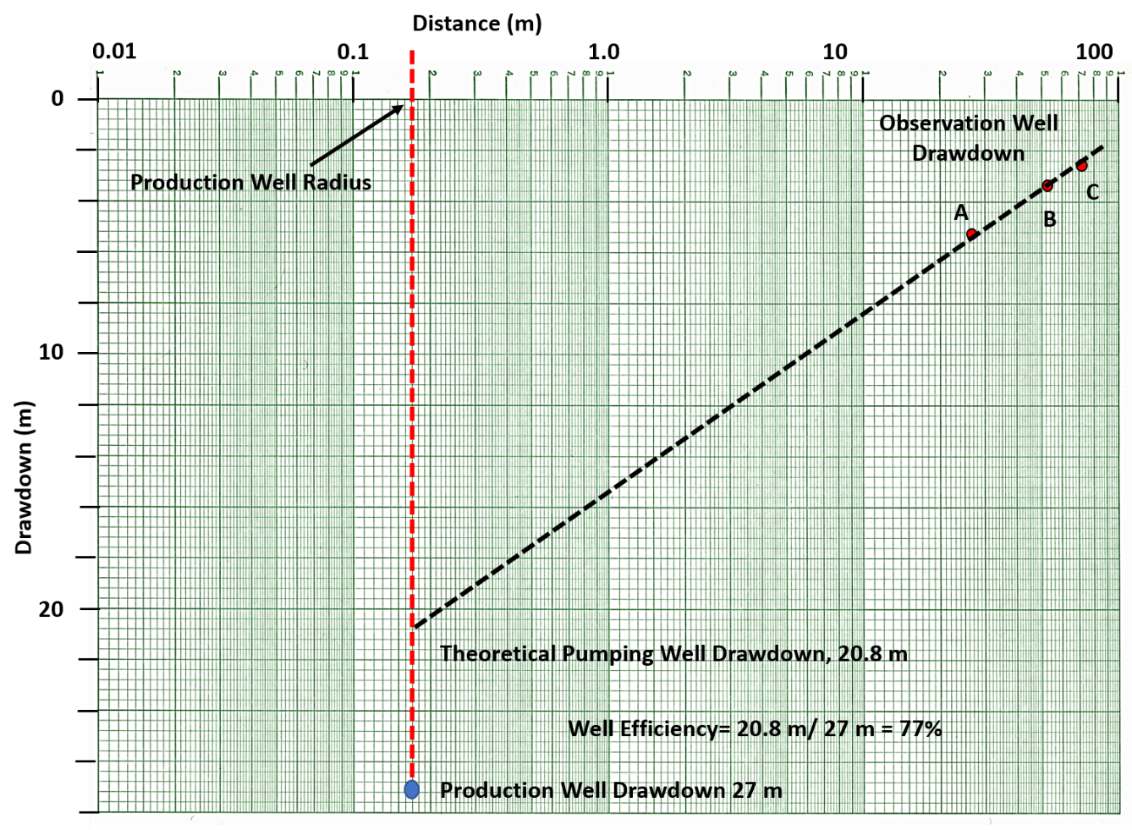
Figure Box 4‑2 ‑ A distance‑drawdown method used to determine well efficiency and the theoretical pumping well drawdown when hydraulic testing a totally confined aquifer that is consistent with the Theis model. A semi‑log distance‑drawdown plot where A, B and C are observation well measurements of drawdown at various radial distances collected at the same time (e.g., 100 min). The dashed black line represents a projection of the logarithmic cone of depression to the radius of the pumping well which is indicated by the red dashed line at 0.17 m. The intersection of the two dashed lines is the theoretical pumping well drawdown caused by formational properties at the specified time. The difference between the actual pumping well drawdown at 100 min (blue dot) and the theoretical drawdown is used to determine the production well efficiency reported here as 0.77 multiplied by 100 percent = 77 %.
A third method to determine well efficiency is to analyze the time‑drawdown results of a step‑drawdown test of the production well as discussed in Section 12. The step test compares drawdown in the production well at various pumping rates maintained for specified periods of time and the data are used to compute production well loss (Sterrett, 2007).