
PART 1: PUMPING TESTS
Part 1 includes Sections 3 through 13 and focuses on hydraulic tests that use a pumping well to perturb the water table or potentiometric surface in the target formation.
- Section 3 describes how groundwater systems respond to a pumping well.
- Test design and methods used to conduct a pumping test with observation wells are described in Section 4.
- Section 5 describes test execution and data collection.
- Section 6 provides mathematical foundation required to analyze pumping test results.
- Sections 7 through 10 describe analysis of steady‑state and transient pumping test data sets under confined, leaky confined, and unconfined conditions. More specifically, analyses of confined and unconfined steady‑state conditions are described in Section 7; while Sections 8, 9, and 10 describe transient pumping of fully confined, leaky confined, and unconfined aquifers, respectively.
- Section 11 addresses how pumping multiple wells under various boundary conditions influence pumping test results.
- Section 12 describes additional considerations required to analyze data when pumping tests are conducted using only one well.
- Section 13 describes how specialized software is used to analyze pumping test results.
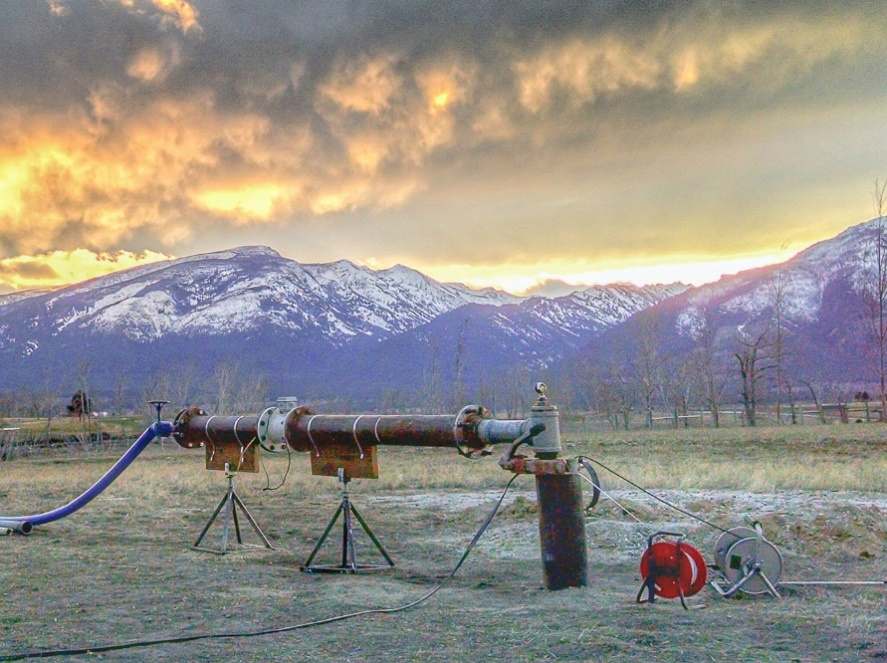
This photograph shows a pumping test being conducted in an unconfined sand and gravel aquifer in the Bitterroot valley, Western Montana, USA. The photograph is used with permission from Montana Bureau of Mines and Geology (2023).