
6 Mathematics of Flow to a Pumping Well
This section discusses the mathematics describing groundwater flow to a pumping well. When the properties of a horizontal hydrogeologic unit are isotropic and homogeneous, and perforations of the pumping well fully penetrate the unit (Figure 17), flow to a pumping well is horizontal and radial (equal in all directions). Calculus is used to describe hydraulic responses to partial differential equations that are useful for forecasting the effect of pumping on groundwater systems and deriving field scale parameters such as T and S from pumping tests.
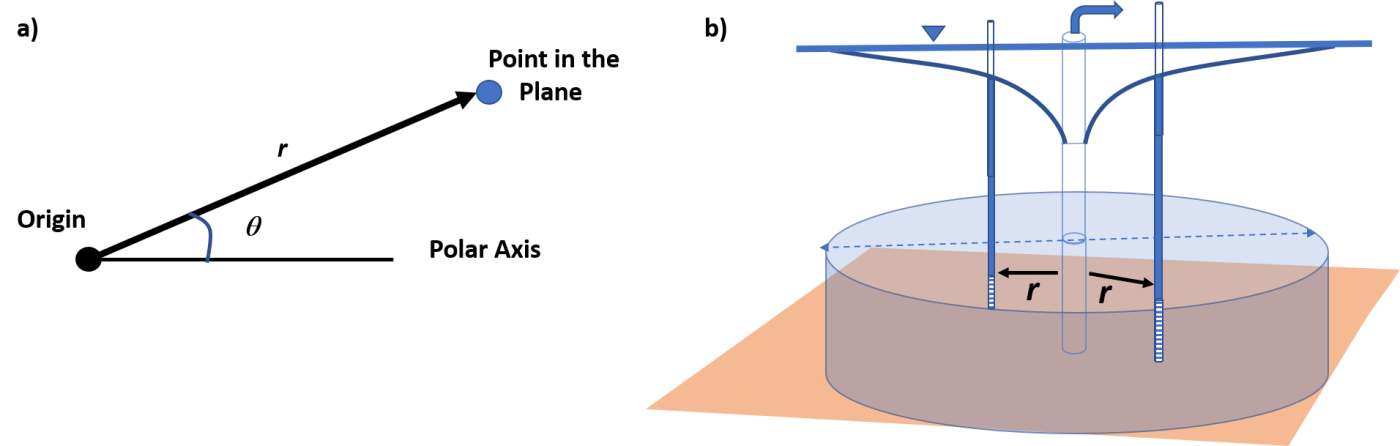
Figure 17 ‑ Radial flow to a well described using polar coordinates. a) Polar coordinates are defined as the radial distance from the origin to a point in a plane with the angle, θ, measured counterclockwise from a horizontal polar axis. b) The radial distance (r) from the pumping well (origin) to two observation wells penetrating a confined aquifer (represented by the light blue shaded cylindrical volume) is illustrated. The cylinder represents the portion of the aquifer impacted by pumping. The cylinder diameter is represented by a dashed blue, double‑arrow line. The orange square represents the impermeable aquifer base.